Show notes
Bain: "Proprietary intelligence" is how to win with AI
2026-08-21
Bain's June 2026 piece, Proprietary Intelligence: How to Win with AI, opens with an uncomfortable distinction: most CEOs believe they are leading an AI transformation when what they actually run is a portfolio of pilots, and "these are not the same thing, and the gap between them is widening fast." The frustration numbers back the diagnosis: in Bain's 2026 survey of a hundred CEOs, roughly 80 percent are unhappy with the pace of their AI transformation, and 82 percent say it has at best partially realized its intended results. Only 18 percent report reaching most or all of their ambition. These are my notes on it; the companion AI-native enterprise explainer, the decision-3 data chapter, the decision-4 architecture deep dive, the decision-5 operating model, the decision-6 learning system, the decision-7 governance chapter, and the strategy trio, decisions 1 and 2 plus the conclusion, have their own.
A pilot portfolio is not a transformation
The report's starting claim is that the frustration is an execution problem wearing a technology costume. When the surveyed CEOs name their barriers, none of the top three is a model or a vendor: 43 percent cite a lack of in-house expertise and tools, 41 percent say they are stuck on local pilots rather than broad transformation, and 39 percent say their data and platforms are not ready for AI at scale. The authors' sharper observation is about the companies pulling ahead: "the emerging leaders are not simply moving faster on the same path; they are operating on a different logic." Speed on the pilot path does not converge to transformation, because the pilot path optimizes for demonstrations while the leaders are building something cumulative.
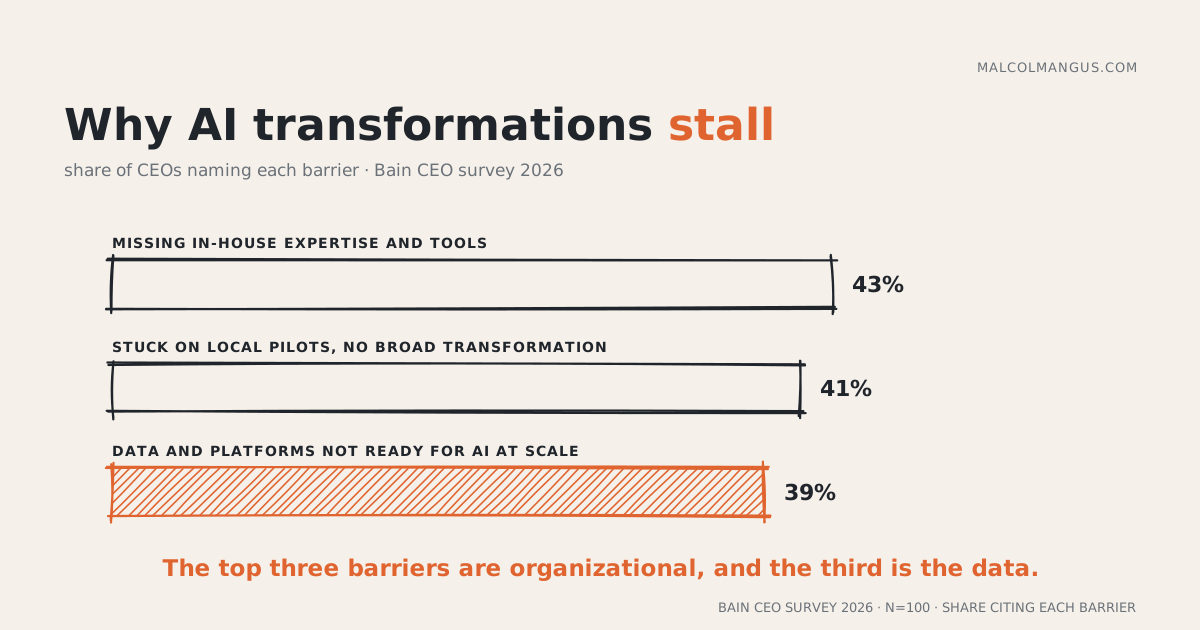
Put simply: 82 percent of CEOs report at best partial results from AI, and the barriers they name are capability, pilot-sprawl, and data readiness, all organizational. The leaders are not faster on the same path; they are on a different one.
Proprietary intelligence is a loop, not an asset
The construct the piece is named for has three parts: unique proprietary data accumulated from customers, operations, and outcomes; institutional knowledge encoded into workflows that agents run at scale; and a learning architecture, the human-AI feedback loops that make each deployment progressively smarter. What makes it a strategy rather than an inventory is that the parts feed each other, and the report's one-sentence version is the best in the piece: "proprietary data sharpens the agents, agents sharpen the people, the people redesign the work and encode the new workflows, and the new work generates better data."
That loop is also the basis for the report's urgency argument. Unlike cloud migration or platform modernization, where a late mover could eventually buy their way to parity, the authors claim AI advantage "compounds from Day 1 through reinforcing mechanisms that did not exist in the same way in prior technology waves." A competitor who starts the loop a year later is not a year behind; they are behind by every turn of the flywheel you have taken in that year, on data they do not have. It is the strongest strategic claim in the piece and also the least evidenced one; the mechanism is plausible, but the report asserts the compounding rather than measuring it.
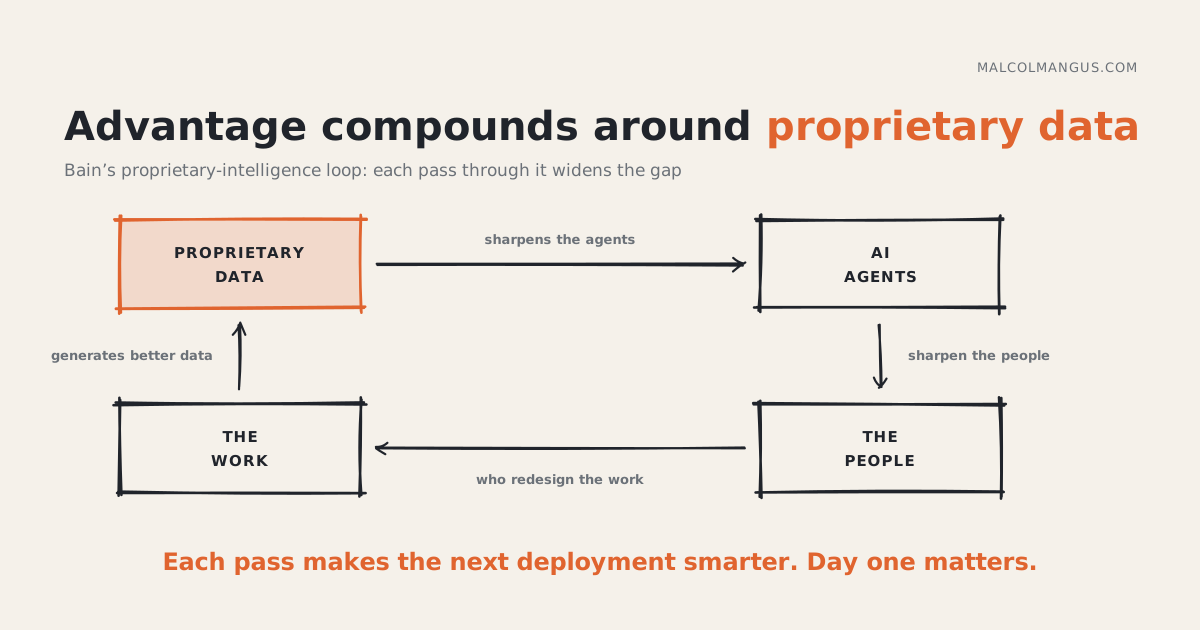
Put simply: Proprietary intelligence is unique data, encoded workflows, and a learning architecture feeding each other in a loop. The report's case for urgency is that the loop compounds from day one, so a late start is not a fixed gap but a widening one.
Seven decisions, and who owns the data one
The operational core is seven board-level decisions the authors say separate leaders from laggards, with the repeated refrain that "none of them can be delegated. All of them sit with the CEO." Posture: commit multi-year capital to a strategic position rather than subjecting AI to in-year ROI tests. Domains: concentrate on three to five bets where AI changes the economics of the business, not dozens of scattered pilots. Data: fund proprietary data and a semantic layer as a competitive foundation, built ahead of the agents. Architecture: keep the orchestration layer that ties agents to your data and workflows in-house rather than ceding it to a single vendor, because "you cannot buy your way to a proprietary enterprise orchestration layer"; it has to be built. Operating model: redesign workflows and the workforce in parallel, with CEO sponsorship for the job and boundary changes that stall when sponsored lower down. Learning system: build the feedback, memory, and evaluation plumbing so each deployment makes the next one smarter and cheaper. Governance: run a parallel governance motion with one leader personally accountable for AI risk.
The third decision is the one this site keeps circling. Bain's sequencing, semantic layer before agents, is the same argument as putting a warehouse between the AI and your systems: do the modeling ahead of time, so the agents query a governed foundation instead of re-plumbing raw systems per question. The report adds the capability warning that makes decision four hard: internal software development muscle has atrophied across the Fortune 500, and the orchestration layer that cannot be bought must be built by teams many companies no longer have.
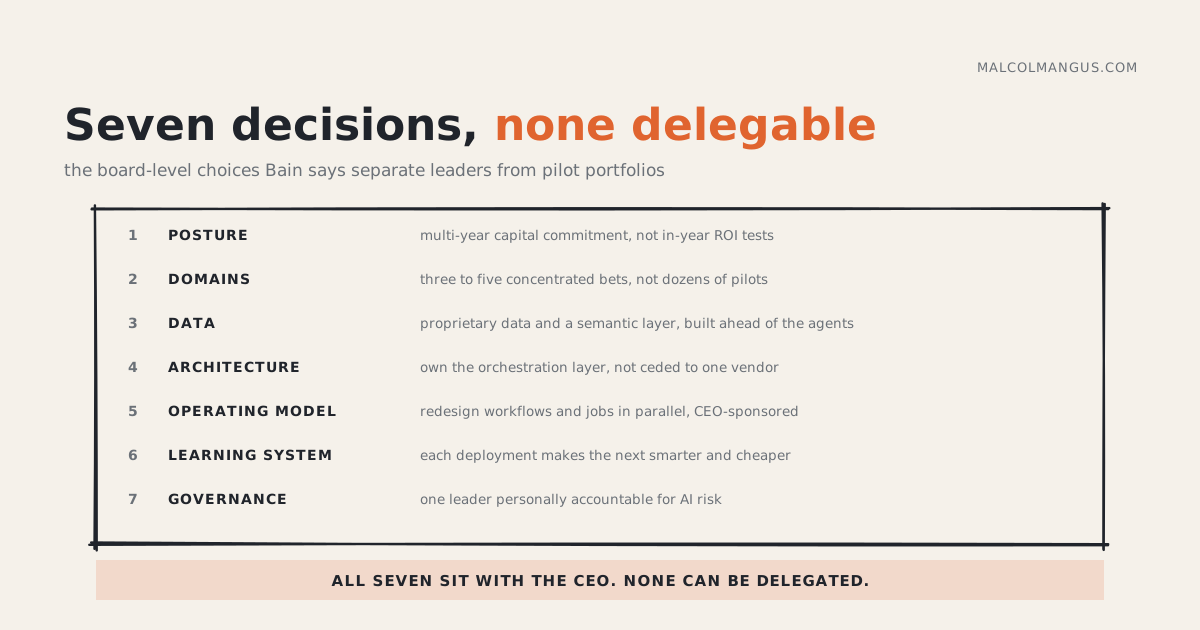
Put simply: Seven choices, posture, domains, data, architecture, operating model, learning system, governance, and the report insists every one sits with the CEO. The data decision is sequencing: semantic layer first, agents second, which is the ahead-of-time argument by another name.
What the leaders actually look like
The examples carry the argument's texture. Ramp drove AI tool adoption to 99 percent of the company, hit a plateau, and responded by building Glass, an internal productivity layer that connects the tools, propagates workflows, and carries context across sessions, on the stated philosophy that "internal productivity is a moat, and an organization does not hand its moat to a vendor." Bradesco's first agentic architecture flunked its beta, too slow, too costly, unable to scale, and the team took a five-month reset to rebuild it; the rebuilt system now runs customer-facing AI across core banking moments for 22 million customers, which the report offers as evidence that the learning loop includes learning from architectural mistakes. And Adecco's CEO Denis Machuel personally fronts the transformation, on the conviction that "AI has to happen with people, not to people," with an ambition of agentic AI powering half of revenue by the end of 2026.
From the winners the authors distill three behaviors: personal commitment, the leaders as "the storytellers in chief, not the sponsors of someone else's story"; ruthless concentration, fewer and better-resourced initiatives in two or three domains; and investing for learning, treating each of the seven decisions as a choice about whether advantage accumulates or evaporates. The closing device is a mirror: seven diagnostic questions asking CEOs whether they made each decision deliberately, or whether it got made for them by default. For most of the surveyed hundred, the honest answer is the second one, which is how a company ends up with a pilot portfolio and the sincere belief that it is a transformation.
Put simply: The leaders look like Ramp building its own productivity layer, Bradesco eating a five-month reset to get the architecture right, and Adecco's CEO personally fronting the change. The common thread is deliberate choices on all seven decisions, made at the top, and the report's parting test is whether your company chose, or defaulted.