Show notes
Bain: your governance is almost perfectly wrong for AI
2026-08-22
Decision 7 in Bain's How to Win with AI series, Governance, tagline "embed accountability, align funding, and move at speed," delivers the series' most quotable indictment. Of the governance system every large company already runs: "this system is good at what it was designed for. It is almost perfectly wrong for managing an AI transformation." The metaphor that follows earns its keep: "running your AI transformation through your existing governance system is like trying to navigate in your car with a subway map; it is not fit for purpose." These are my notes on it, closing out the deep-dive decisions; the flagship links the whole family.
Wrong on four counts
The indictment is specific: "its rhythms are too slow, its metrics are too backward-looking, its approval processes are too sequential, and its instinct is to control rather than enable." Each count maps to something agents break. Quarterly rhythms cannot steer systems that learn weekly. Backward-looking metrics grade last quarter's delivery while the question is what the next experiment should be. Sequential approvals assume decisions are scarce and expensive, when an agentic program produces decisions continuously. And the control instinct, the deep reflex of run-governance, treats every new capability as a risk to be contained rather than a lever to be pointed. None of this makes existing governance bad; it makes it specialized for a different job, which is the piece's point and the reason bolting AI onto it fails quietly rather than loudly.
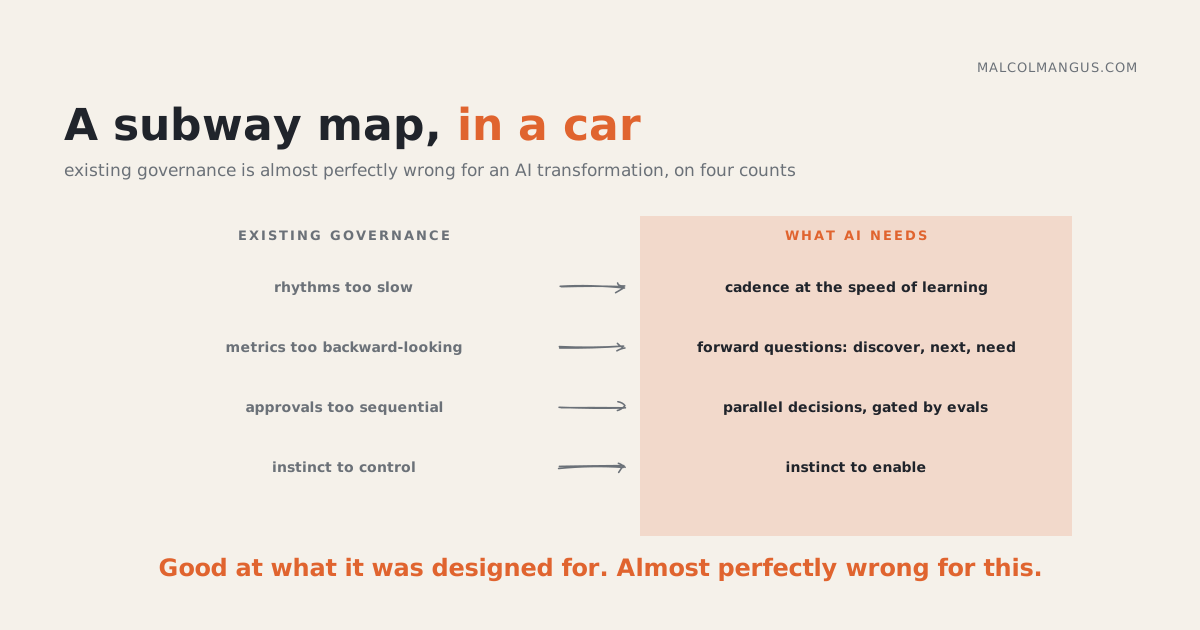
Put simply: existing governance fails AI on four counts, slow rhythms, backward metrics, sequential approvals, and a control reflex. It is not broken; it is specialized for running the business, which is exactly why it cannot govern changing it.
The two-motions answer
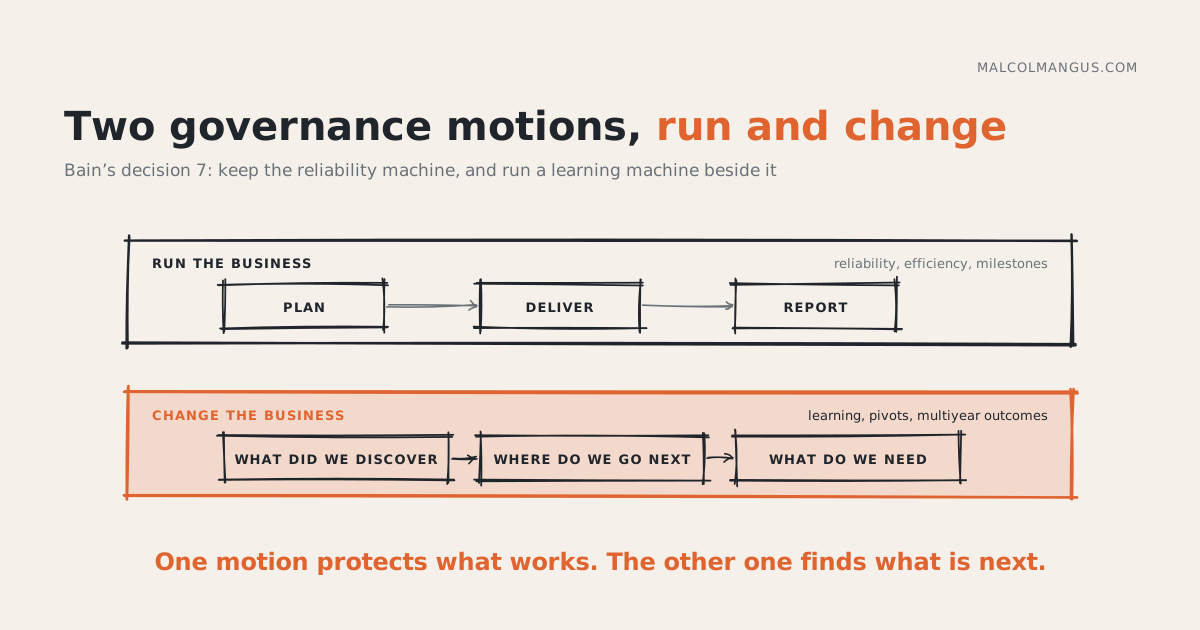
The fix is not to reform run-governance but to stop asking it to do two jobs. Keep the existing motion doing what it does, reliability, efficiency, milestone delivery, and stand up a parallel change-the-business motion "whose rhythm is built around the questions 'what did we discover, where do we go next, and what do we need to get there.'" Those three questions are a complete meeting agenda for a learning system, and they are unanswerable inside a milestone review, which is the cleanest demonstration that the two motions cannot share a forum. This is the same two-motions dimension the AI-native comparison table ends on, and the governance counterpart of the learning system's architecture: decision 6 builds the machine that learns, decision 7 builds the management rhythm that can steer it.
What the piece skips is the collision case, who wins when the change motion wants to ship something the run motion considers a threat to reliability, which is where parallel governance actually gets hard.
Put simply: run two motions: the existing one to protect the business, a new one to change it, meeting on the rhythm of discover, next, need. The piece never says who arbitrates when they disagree, and that omission is the hard part of the whole design.
The meter and the portfolio
Two funding mechanics round out the chapter. First, cost visibility at machine speed: "token costs are the new unit economics of AI operations and must be tracked with the same rigor as any other material cost driver." Every agent action spends compute, and an estate of agents turns that spend into a material line item that cannot be discovered at quarter close. Second, the funding model: stop financing AI through per-project ROI cases and manage a portfolio aligned to the strategic posture, where "funds are released at key points in scaling when economic benefits of testing are better known and large investments are then de-risked. It also means actively managing the reallocation of labor and spending freed up by your agents, so they can be reinvested in the next wave of capability." The reallocation clause is the sharp one: the savings agents produce are the funding source for the next wave, but only if someone actively harvests them instead of letting them dissolve into budgets.
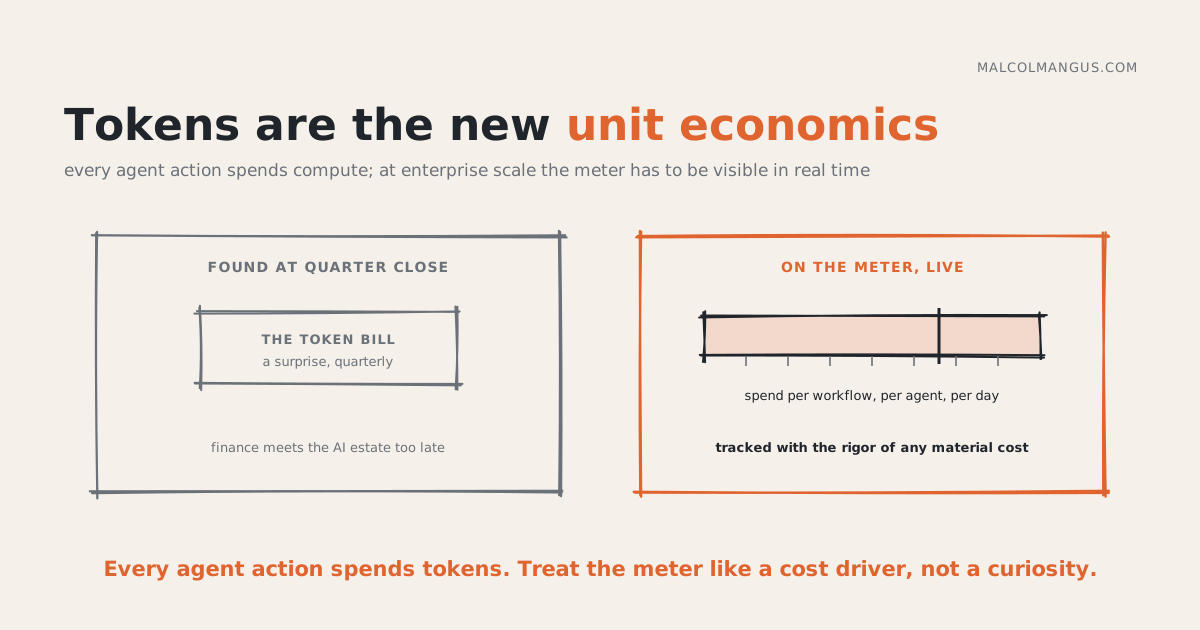
Put simply: put token spend on a live meter with the rigor of any material cost, fund AI as a portfolio that releases money at scaling gates, and actively harvest the labor and spend that agents free up, because that harvest funds the next wave.
The line the series ends on
The accountability demand is the bluntest sentence in the seven decisions: "The CEO must own AI risk. Not monitor it, not receive reports on it, but own it." The elaboration makes the standard concrete: a named individual at the top who understands the risk profile of the AI estate, has explicitly set the risk appetite, and is prepared to be accountable for the outcomes, not a compliance function, not a dashboard, not a black box. It is the governance version of the operating model's CEO-tinkering test: both refuse the executive the comfortable distance of sponsorship. Read as a set, the seven decisions keep arriving at the same design principle from different directions, that in a compounding, probabilistic, continuously acting system, accountability and understanding cannot be delegated below the level where the bets are made.
Put simply: the CEO owns AI risk personally, named, appetite set, accountable, not monitored through a compliance layer. It is the same refusal of delegated understanding as the tinkering test, applied to the downside instead of the upside.