Show notes
Bain: design the transformation to compound
2026-08-22
Decision 6 in Bain's How to Win with AI series, The Learning System, carries the tagline "design the transformation to compound," and one sentence in it carries the whole series' weight: "the operating model delivers today; the learning system defines proprietary intelligence over time." Every other decision provisions something; this one decides whether what gets provisioned accumulates. These are my notes on it; the flagship, the AI-native explainer, the data chapter, the architecture deep dive, and the operating model have their own.
Three layers, and only two are yours
The piece's most useful frame is a decomposition: "continual learning can happen at any of three layers: model, harness (code that drives the agent), or context." The model layer improves on the frontier lab's schedule, for you and every competitor simultaneously, which is exactly why it cannot be the moat. The harness, the scaffolding of tools, evals, and routing that turns a probabilistic model into a working agent, improves whenever you improve it. And the context layer, the memory and history of what was tried and what worked, improves with every interaction the system runs. From that decomposition the conclusion follows almost mechanically, and the piece states it flat: "durable competitive advantage is more likely to come from harness architecture, not model selection." You own the improvement schedule of two layers out of three; advantage lives where you own the schedule.
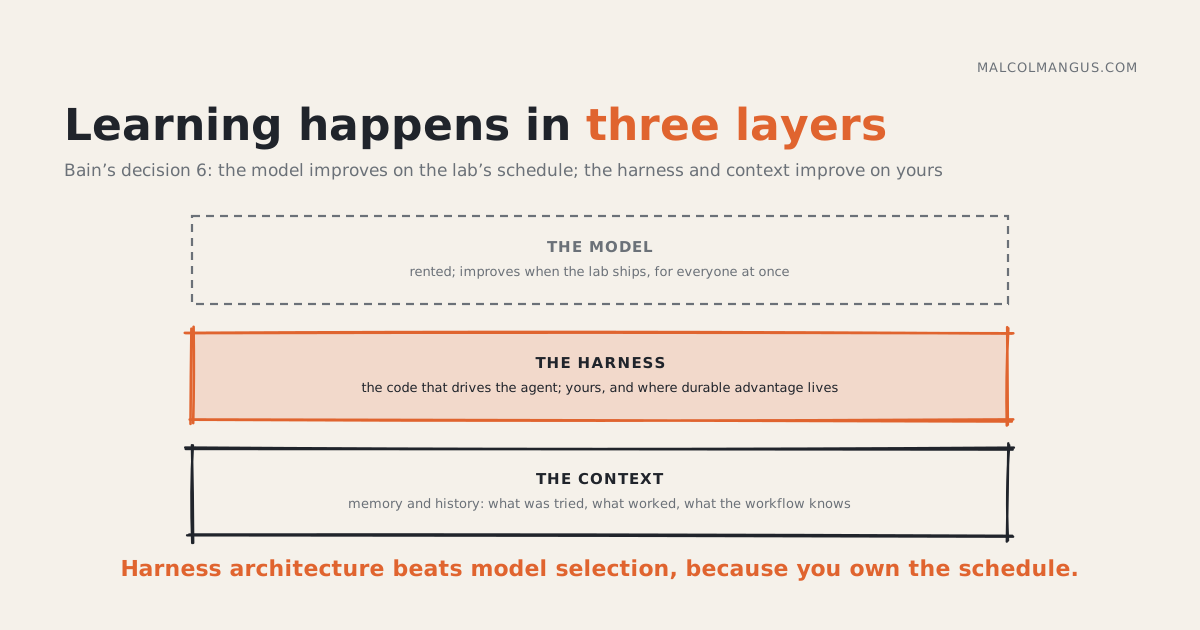
Put simply: learning happens at the model, the harness, or the context. The model improves for everyone at once, so the durable gap comes from the two layers you own, the harness code and the accumulated context, where every improvement is yours alone.
What machine-scale learning buys
The concrete case is a search no human team would run: "in one case, the system ran 400 experiments on a process already considered well-optimized; only one produced a meaningful gain, but that single improvement was one that no human team would have had the time to find." A one-in-four-hundred hit rate is a terrible use of analyst quarters and a fine use of agent cycles, and the example generalizes: a learning system converts cheap iteration into found improvements that were never worth a human's search. The named examples show the storage half. Shopify, in the piece's telling: "the company built a shared internal platform where the data preparation, experiments, and pipelines created by one team are automatically available to every other team that needs them, so the tenth project draws on the foundations laid by the first nine, and the cost and time required to build the next agent fall with every cycle." And Madrigal Pharmaceuticals, in a regulated environment: "Madrigal's agentic platform automatically turns every production failure into a new test case and stores every agent's work in a shared memory layer that the next agent can draw on," with the result that "domain experts flag a flaw in agent reasoning one week and see it corrected the next, and use cases that once took weeks to build now ship in hours."
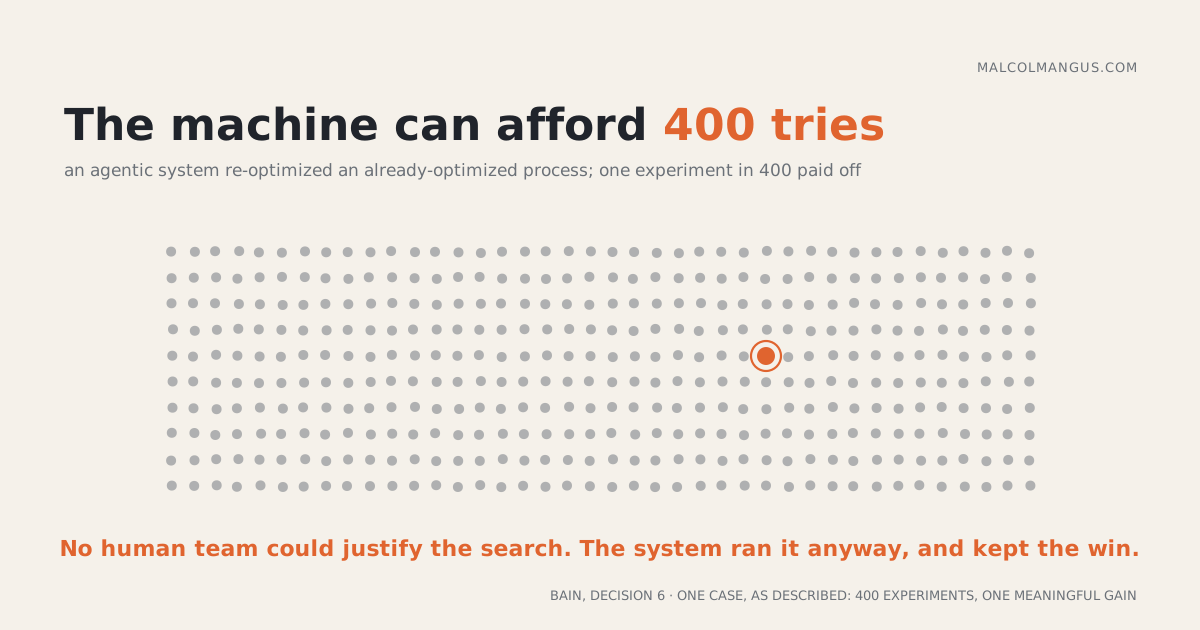
Put simply: machine-scale learning pays twice: cheap search finds wins no team could justify hunting for, and shared memory keeps every win, so failures become test cases and the tenth build starts on the foundations of the first nine.
Easy to describe, hard to build
The architecture is two loops plus a store: per-agent feedback capturing what the agent did and whether it worked, and a shared context and memory layer that turns that signal into institutional knowledge the next agent inherits. The piece adds a social requirement that most architectures forget: "agentic activity must be made socially visible across the organization," in shared channels rather than siloed tools, so people can see what the agents are doing and learn from it too. Its own summary of the difficulty is honest, "easy to describe, genuinely hard to build," and its diagnosis of why is organizational: "most organizations skip this work—not because it's technically impossible, but because it requires architectural discipline that most enterprises have not built." One cost the piece does not price: a memory layer every agent writes to is also a contamination vector, one agent's bad output becoming every agent's context, which is the write-back pollution problem the readiness essay's fourth question exists to catch. Compounding and cascading are the same plumbing.
Put simply: the learning system is per-agent feedback plus shared memory plus social visibility, skipped mostly for lack of discipline rather than lack of technology. Budget for the unpriced risk: a shared memory layer compounds bad writes exactly as efficiently as good ones.
The bottleneck inversion
The closing idea is the best in the series. When the learning system works, when the automatable work is absorbed and each deployment starts smarter, the constraint on progress changes character: "the scarce resource shifts from engineering effort or model capability to the human capacity to pose good problems." The queue of things to build stops being the limit; the queue of well-posed questions becomes it. And the piece is careful to frame what that means for people: "this story is not about removing people from the loop, but about moving them to the part where their judgment compounds." That is the end state the whole seven-decision program points at, an organization where the machines run the searches and keep the memory, and the humans spend their scarce hours deciding what is worth searching for.
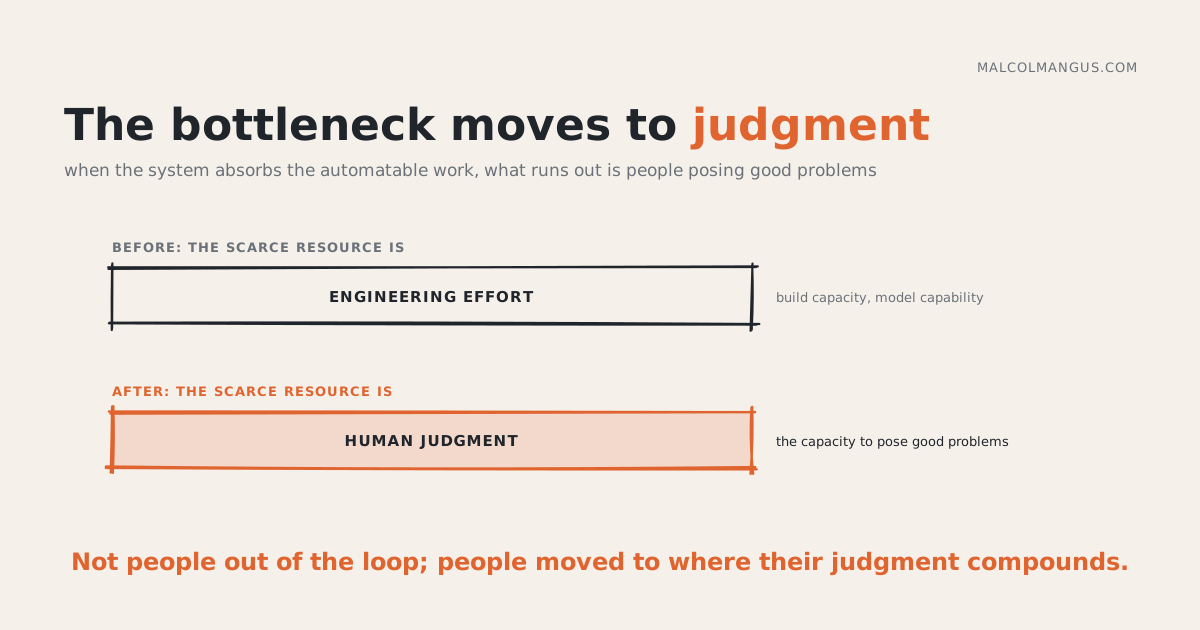
Put simply: a working learning system moves the bottleneck from building to asking. Engineering effort and model capability stop being scarce; well-posed problems become the limit, and the human role concentrates where judgment compounds.