← All essays·July 21, 2026·14 min read
Who actually makes money on a hotel: mostly the hotel
A friend told me hotels don't make money, that it's all a tax trick. That is half right, and the wrong half is the interesting one. Rooms clear roughly 38% gross operating profit and owners keep a real 25 to 35% NOI, so operations are the business. The twist: a hotel is valued as a business, not land, so the building is just the rooms capitalized. The only money that sits off the receipt is the brand's fees and a depreciation shield.
Listen to this page
A friend told me hotels don't really make money, that the whole business is some kind of tax trick. That is half right, and the wrong half is the interesting one.
Take a real room night. About $160, the average US rate in 2025 (STR). The rooms behind that number make money: through the first nine months of the year, hotels kept roughly 38 cents of every revenue dollar as gross operating profit (HotelData.com). A business that keeps 38 cents on the dollar is not a charity, so the "hotels don't make money" claim is wrong at the room level.
But I followed that $160 the way I followed a $38 pound of cheese and a $100 grocery run, and my friend was pointing at something real, just not the thing he thought. The surprise is the reverse of the folk wisdom. People say a hotel is a real estate play with a front desk attached. It is closer to the opposite: a hotel's building is worth almost exactly what its rooms earn, because a hotel is valued as a business, not as land. The genuinely separate money, the part that does not just track the room business, sits in two narrow places a guest never looks: the brand on the sign out front, which collects fees and owns no building, and a tax-deferral shield that rewards the owner for waiting. This is profit pools again, with a twist on the private mint: here the deepest pool is the activity, and only the edges are somewhere else.
The room receipt, decomposed
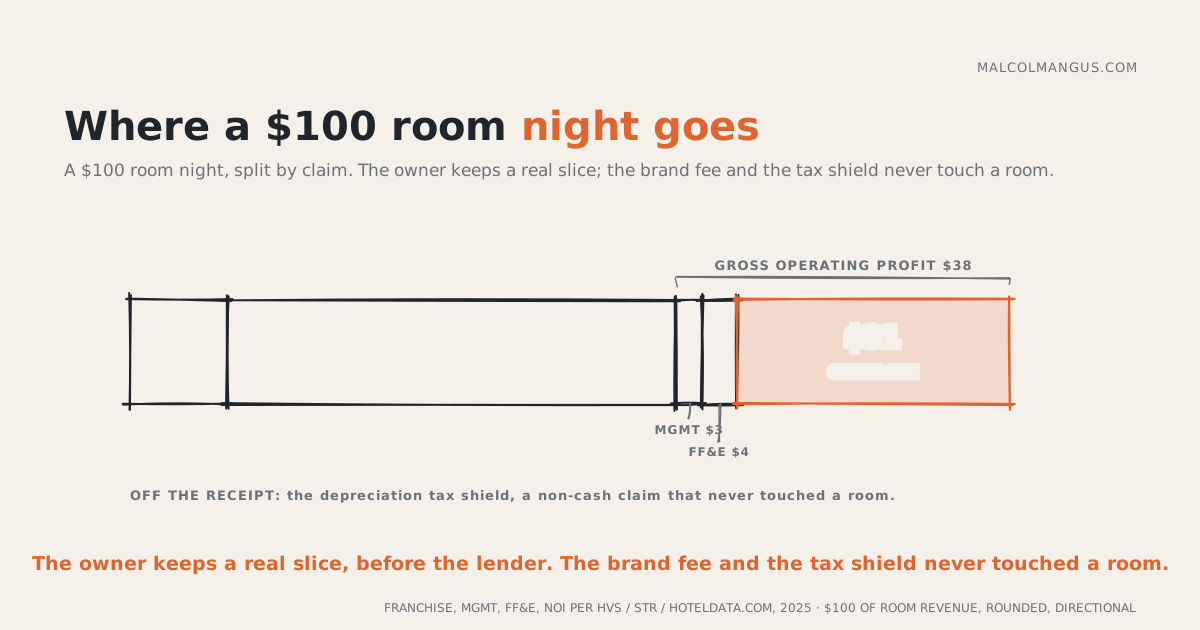
Take $100 of that room revenue and watch where it goes before it reaches the owner.
Roughly, in order of who gets paid:
- The flag takes its cut first. A branded hotel pays the parent a franchise fee: a royalty plus marketing, reservation, and loyalty charges that HVS puts near 11% of room revenue over a hotel's first decade. Hilton's royalty alone runs 5% of room revenue. The guest thinks they paid Marriott. The owner paid Marriott too.
- The operator takes a management fee. Most hotels are run by a management company, not the owner, for a base fee near 3% of revenue plus an incentive fee, commonly 8 to 10% of operating profit (HVS).
- Labor and operating costs are the bulk. This is what the 38% gross operating profit is measured after.
- The FF&E reserve, around 4% of revenue, set aside to replace furniture, fixtures, and equipment, because a tired hotel loses its rate.
- Debt service. Hotels are bought with heavy leverage, and interest is the line that turns a healthy operating margin into a thinner cash return after the bank.
- What's left is the owner's net operating income, and it is real: hotel NOI runs roughly 25 to 35% of revenue, select-service toward the top of that. It sits below the 38% GOP by design, because NOI also absorbs the management fee, property taxes, insurance, and the reserve, and it is measured before debt.
So the room is a genuine, healthy operating business, and the owner keeps a substantial NOI before handing a chunk to the lender. It is also a violently cyclical one: because so many hotel costs are fixed, a revenue drop lands even harder on profit. In 2020 RevPAR fell about 48%, the worst on record (STR), and in the 2009 downturn the hardest-hit properties lost about a third of revenue and well over half their operating profit (CBRE Hotels). What is worth noticing is not that the owner keeps little, but which of these claims are separate businesses in their own right and which just ride on the room.
Put simply: A hotel guest pays one bill that quietly settles four businesses. Gross operating profit is a headline; net operating income, after the manager and the reserve, is what gets capitalized into the building's value. Know which line you actually own.
Three businesses stacked on one building
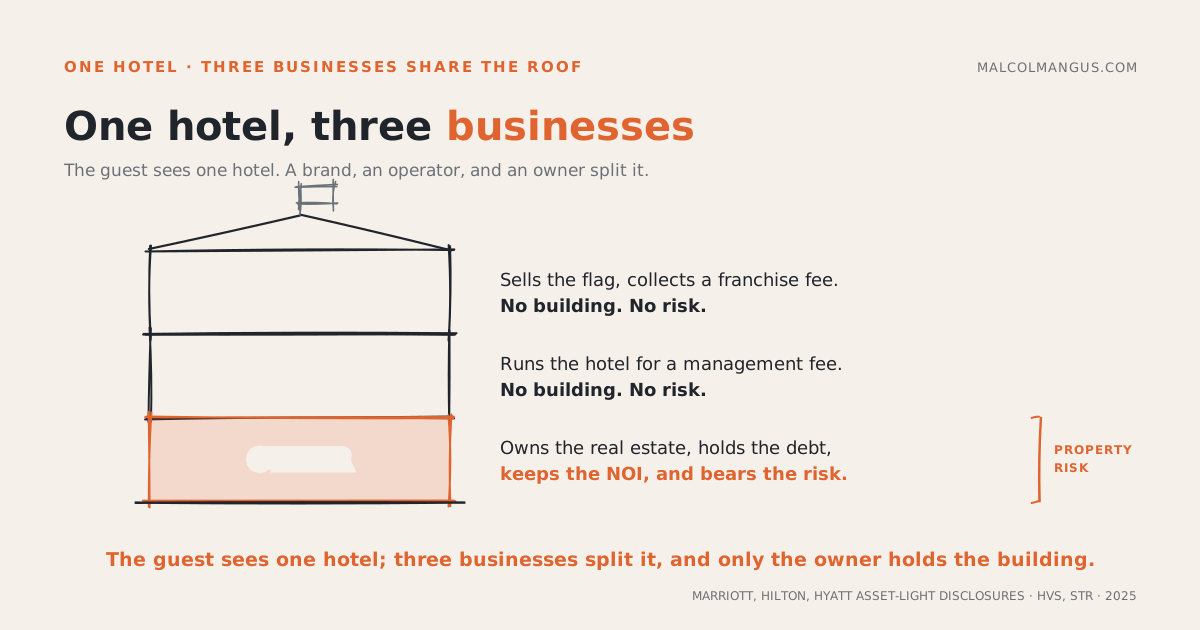
If the owner keeps a healthy NOI, where is the sleight of hand my friend sensed? It is that a modern hotel is three separate businesses wearing one roof, and the two with the cleanest margins got out of owning the roof entirely.
- The brand is an asset-light fee business. Marriott's 2024 annual report lists 9,361 properties and says it owns 51 of them. It franchises about two-thirds of its rooms and owns under 1%. Hyatt owns roughly 2%. The flag collects fees at software-like margins and carries almost none of the real estate risk.
- The operator runs the property day to day for a management fee. Also light on capital, also insulated from the building.
- The owner holds the real estate, the mortgage, and the cyclicality. They took the one job the other two designed themselves out of.
The brands ran the same play the airlines ran when they turned miles into the profit center and the flying into the peg: keep the high-margin, low-capital layer, hand someone else the heavy, cyclical one.
Put simply: If a business can be split into a fee layer and an asset layer, watch who volunteers for which. The brands kept the fees and gave away the buildings on purpose.
The building is not a separate pool. It is the rooms, capitalized.
Here is the part most people get backwards. An apartment building is worth its leases; an office tower is worth its rent roll; both can appreciate on the strength of the location while the tenants stay boring and fixed. A hotel is different. A hotel has no leases. It re-prices every single night, and when someone buys it they pay a cap rate, lately 8 to 10% for hotels, times its net operating income. That is roughly 10 to 12 times NOI, and the building's value is nothing but the room business capitalized at that multiple. So a hotel does not appreciate instead of earning; it appreciates because it earns more, or because rates fall. The real estate is not a pool sitting off the receipt. It is the receipt, discounted.
That reframes the whole "it's a real estate play" instinct. A hotel is an operating business that happens to be priced like real estate, which is why owners obsess over RevPAR and why a bad manager destroys value faster than a bad location. The room is not the loss leader for the building; the room is the building's value, arriving one night at a time.
That leaves the returns an owner earns without the rooms earning them, and they split into two kinds. The market can hand you appreciation the rooms did not create: cap rates fall and the same NOI prices higher, or the land turns out to be worth more redeveloped than as a hotel. Real, but you wait for them; you cannot summon a rate cut. The one separate return an owner can actually manufacture is the tax shield.
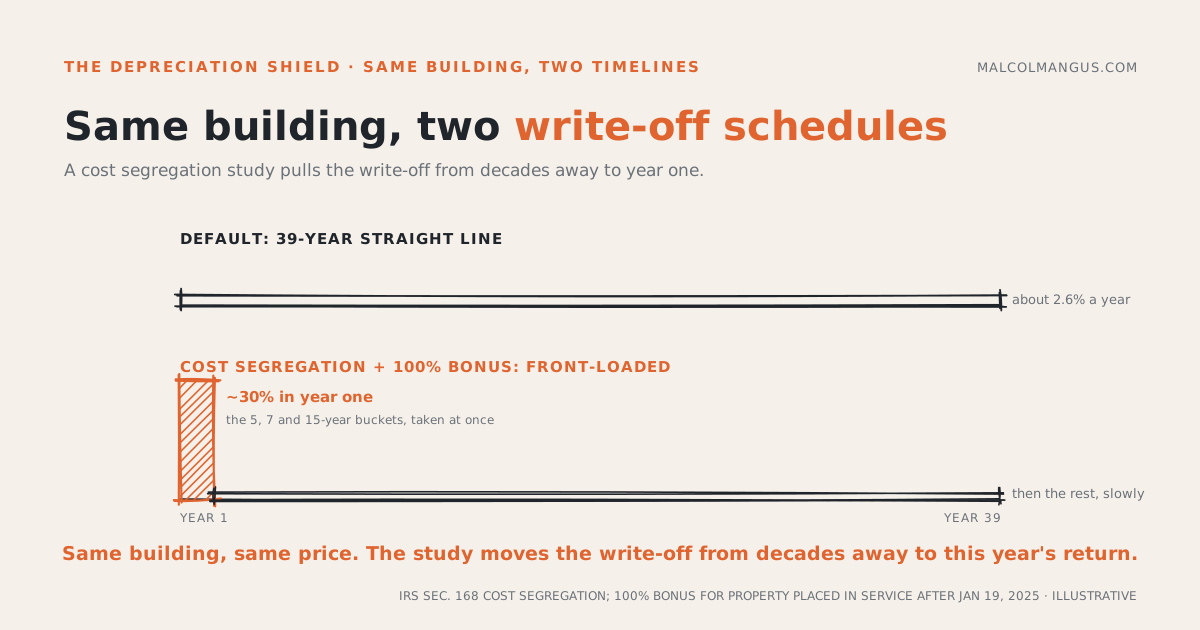
Normally you write a commercial building off slowly, over 39 years, and the tax code excludes the structure itself from any faster write-off. But a hotel is unusually component-dense: per-room heating and cooling units, furniture, fixtures, carpet, signage, pool decks, parking lots. A cost segregation study reclassifies roughly 25 to 35% of the purchase price out of the structure and into 5, 7, and 15-year buckets, the personal property that does qualify. Under the 100% bonus depreciation the 2025 tax law made permanent (the One Big Beautiful Bill Act, signed that July, for property placed in service after January 19, 2025), that whole slice can be written off in year one. The result is a large paper loss while the hotel runs fine on cash. For an owner who qualifies as a real estate professional and materially participates, that paper loss can offset other income: wages, business profit, capital gains. That is the "tax trick" my friend heard about. Unlike the building's value, it truly is separate from the room business, because depreciation is a function of what you paid, not what you earn.
Put simply: A hotel is not real estate that earns; it is earnings that get priced like real estate. Most appreciation is just your NOI capitalized. Falling cap rates or a redevelopment site can add a slice the rooms did not earn, but you wait for those; the one separate return you can manufacture is the depreciation shield.
The catch nobody selling cost segregation leads with
Here is where the honest version parts company with the sales pitch. The depreciation shield is mostly a deferral, not a gift, and cost segregation can quietly raise the bill at the end.
When you sell, the government takes some of the depreciation back. This is recapture. The structural part of a building (Section 1250) is recaptured at a rate capped at 25%. But the personal property that cost segregation creates (Section 1245: the carpet, the cabinets, the equipment) is recaptured at ordinary income rates, up to 37% (KBKG). So the study that front-loaded your write-off also converted a slice of your eventual gain from a 25%-capped rate into an up-to-37% one.
The shield only becomes permanent if you never actually cash out at ordinary terms: roll each sale into the next building with a 1031 exchange, keep deferring, and hold until death, when your heirs get a stepped-up basis and the deferred tax evaporates. Swap till you drop. Absent that, cost segregation is a timing move: a large deduction now, a larger-than-you-remember bill later, worth real money because a dollar deferred for years is worth more than a dollar today, but not the free lunch the brochures imply.
And three honest caveats on who this actually works for. First, the offset-your-wages version needs the owner to materially participate, which large hotels run by management companies usually fail, so this favors owner-operators and smaller properties more than the giant portfolios. Second, it is a private-owner story: a big share of branded hotel real estate is held by REITs (Host, Park, Ryman), which pay no corporate tax to begin with, so a depreciation loss has no wage or business income to shield. The tax shield is a tool for the individual owner, not the public landlord. Third, "loophole" is the wrong word: bonus depreciation is an incentive Congress wrote on purpose to pull investment forward, not a crack someone slipped through.
Put simply: Cost segregation is a loan from the IRS, not a gift from it. You pay it back at sale, sometimes at a higher rate than you deferred, unless you 1031 into the next deal and hold until the basis steps up. Model the exit before you celebrate the year-one write-off.
What an operator can steal from this
You do not own a hotel. Here is the transferable part.
A hotel teaches the opposite of what it looks like it teaches. It looks like a real estate play, so you would expect the money to sit in the land. Instead the building is just the operation capitalized, so the operation is the money, and the only things that sit genuinely apart are the fee layer the brand kept and a tax shield that rewards patience. The brands read this correctly and acted on it: given the choice between running hotels and franchising them, they took the fees and shed the buildings, the same asset-light move a SaaS company makes when it sells software instead of servers.
So when you look at your own business, do not assume the money is in the asset just because there is an impressive asset. Ask what actually gets capitalized when someone buys you. In a hotel it is the room business, which means the unglamorous operating grind is the value, and the "real estate" is a way of pricing it. The separate pools, the fees and the tax edge, are narrow. Find your equivalents before you assume the building is where you win.
Put simply: Do not confuse an asset-heavy business for an asset-driven one. A hotel is priced like real estate but paid like an operating company: the rooms are the value, the building is just their capitalization, and the only truly separate money is the franchise fee and the depreciation shield.

Malcolm Angus
I build 0 to 1 data products: I turn the data a company already has into a decision it wouldn't otherwise make, shipped end to end. I also write about how markets really work, moats, flywheels, and the loops that make companies harder to catch.

The charts in this essay are free to reuse with credit.