← All essays·September 26, 2026·6 min read
Category design, run on myself
I write about category design, so I ran it on my own positioning. The finding: I had written the category into my bio's second sentence and let three job titles own the first. This is the fix, in public. I build 0-to-1 data products, and I write the market analysis of where value actually pools, and those are two outputs of one eye, not a job and its hobby.
Listen to this page
I have spent several thousand words arguing that the durable move in any market is to design a category rather than compete inside one. It is a fair question to turn on the person making the argument: have I done it to myself? So here is category design run on my own positioning, in public, because a framework you will not apply to yourself is a framework you do not believe.
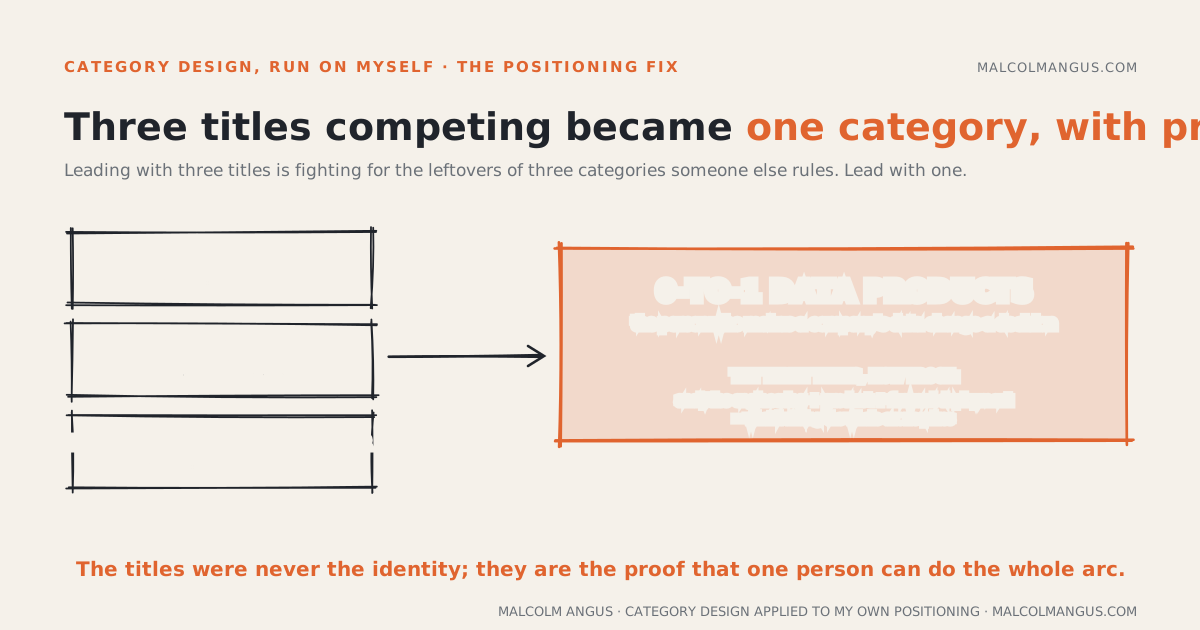
The first pass was uncomfortable, in the useful way. I opened my own bio and found that I lead with three job titles: analytics engineer, data product manager, forward-deployed engineer. Three titles is not range. It is what my own better-trap essay warns against, three times over, because each of those titles is a category somebody else already rules. dbt Labs owns "analytics engineer." Palantir owns "forward-deployed engineer." "Data product manager" is a commodity line on every job board. Leading with all three means a reader files me under whichever one they already have a slot for, and I spend my introduction competing for the leftover share of three categories at once. That is the definition of fighting for the 24%.
The category was hiding in my own second sentence
Here is the part that stung. The category was already there, one sentence later, where I had written that I "own whether the data a company already has changes a decision." That sentence is the whole thing. The three titles in front of it were the noise, and the real position was sitting in the subordinate clause, unclaimed.
So the fix is not to pick one of the three titles. It is to lead with the category and demote the titles to what they actually are: proof. The job I do is take the data a company already has and turn it into a decision it would not otherwise make, shipped end to end, as a product, from zero. Thunderdome, The Aisle Co, LaneRadar, Divisadero: every one is the same arc, latent data made into a decision-changing product, built solo or nearly so. That arc requires analytics engineering and product and forward deployment, and the reason few people do it is precisely that it requires all three. My three titles were never competing identities to choose between. They are the evidence that one person can run the whole arc, which is the category itself.
Put simply: I had done the exact thing I tell everyone else not to do. I led with the crowded titles and buried the category in a clause. The reframe is to lead with the job only I am accountable for, "makes a company's data change a decision," and let the three titles drop to their real job, which is proving I can.
The trap I almost fell into naming it
The tempting mistake, once you see the category, is to coin a clever word for it and defend it. I resisted, because my own rules say clear beats clever and the market mints category names, not the person. "0-to-1 data products" is a phrase people can already say and search, and it is close enough to true to lead with. That is the rare good spot: legible and ownable at once. If a sharper noun ever arrives, it will arrive from someone describing me back to a colleague, not from me announcing it. My job is to keep doing the work that makes the phrase repeatable.
There was a second trap, subtler, that I only caught by arguing against my own first draft. When I first named the category as "builds data products and writes the strategy behind them," I had quietly subordinated the writing to the products, as if the essays were a footnote explaining the builds. They are not. The essays are independent market analysis of companies I have nothing to do with: a teardown of how Xometry makes money, of where the profit pools in the egg cycle, of who really wins the grocery aisle. They are not the strategy behind my products. They are a second body of work.
Put simply: I did not invent a clever word for the category, because clear beats clever and the market mints category names, not the person claiming one. And I caught myself doing the thing I warn against, quietly filing the writing under the products, when it is a peer to them, not a footnote.
Same eye, two outputs
So the honest shape of what I do is two things of equal weight that happen to come from one instinct: an eye for where value actually pools. Point that eye at a company's own data and it becomes a product that changes a decision. Point it at a market and it becomes an analysis of who keeps the money. Same eye, two outputs, and neither is the appendix to the other.
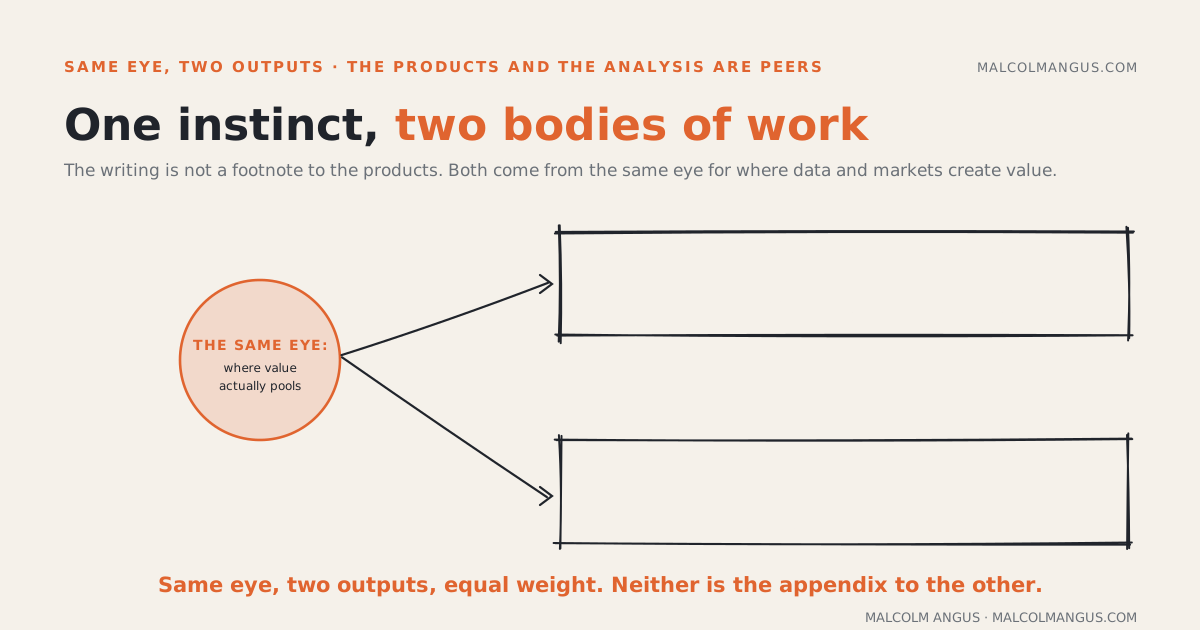
This matters more than it looks, because the multi-hyphenate is usually a weakness, the sign of someone who has not decided what they are. The category-design read flips it: when both outputs come demonstrably from the same eye, the pairing stops being indecision and becomes the differentiation. Plenty of people build data products. Plenty of people write market strategy. The rare thing, the actual category, is doing both from one point of view well enough that each makes the other more credible. The builds prove the analysis is not armchair theory. The analysis proves the builds are not luck.
Put simply: the two halves are peers. Building 0-to-1 data products and writing about where the money pools are not a job and a hobby; they are one instinct pointed at two targets, and the pairing is the moat, not the confusion.
Reality is the moat, which is the only part I cannot fake
The last move is the one I trust most, because it is the one that cannot be languaged into existence. In the AI-flood argument I keep landing on the same line, borrowed and agreed with: reality is the moat. Anyone can now write a confident essay about category design or generate a slick portfolio page. What cannot be generated is the shipped record, the products that are actually live and the analysis that is actually right. The category I am claiming is only claimable because the proof already exists: the products run, the essays hold up, and the plates you are looking at are a visual language nobody else is drawing.
So this post is the declaration, and the declaration is cheap. The site behind it is the reason the declaration is allowed to stand. From today the bio leads with the category and the titles drop to proof, but the thing that earns the category was never the sentence. It was the decade of making a company's data change a decision, and then writing down where the money went.
I build 0-to-1 data products. I write about where value actually pools. Same eye, two outputs. That is the category, and I am going to keep shipping the proof.

Malcolm Angus
I build 0 to 1 data products: I turn the data a company already has into a decision it wouldn't otherwise make, shipped end to end. I also write about how markets really work, moats, flywheels, and the loops that make companies harder to catch.

The charts in this essay are free to reuse with credit.