← All essays·September 20, 2026·10 min read
Xometry makes its money quoting, not manufacturing
How Xometry actually works, starting with the category: custom manufacturing is a $275 billion market with fragmented buyers, thirteen thousand sub-twenty-person machine shops, bespoke goods, and no price discovery, the textbook setup for a market maker. Then the machine built for that seat: the AI quote, the principal model and its spread, the certification wrapper, the Thomas toll booth, the Siemens CAD embed. Financials kept brief, model kept front.
Listen to this page
Xometry is usually filed under manufacturing, and the filing is wrong in an instructive way. The company, founded in 2013 by Randy Altschuler and Laurence Zuriff and public on Nasdaq since June 2021, owns no factories, holds almost no equipment, and never machines a part. What it built instead is a market for a category that never had one, and the right way into the model is through the shape of that category. The numbers below come from the company's Q2 2026 investor presentation and earnings release, plus industry establishment data; the financials get one section near the end, on purpose.
The category: fragmented on both sides, priced by email
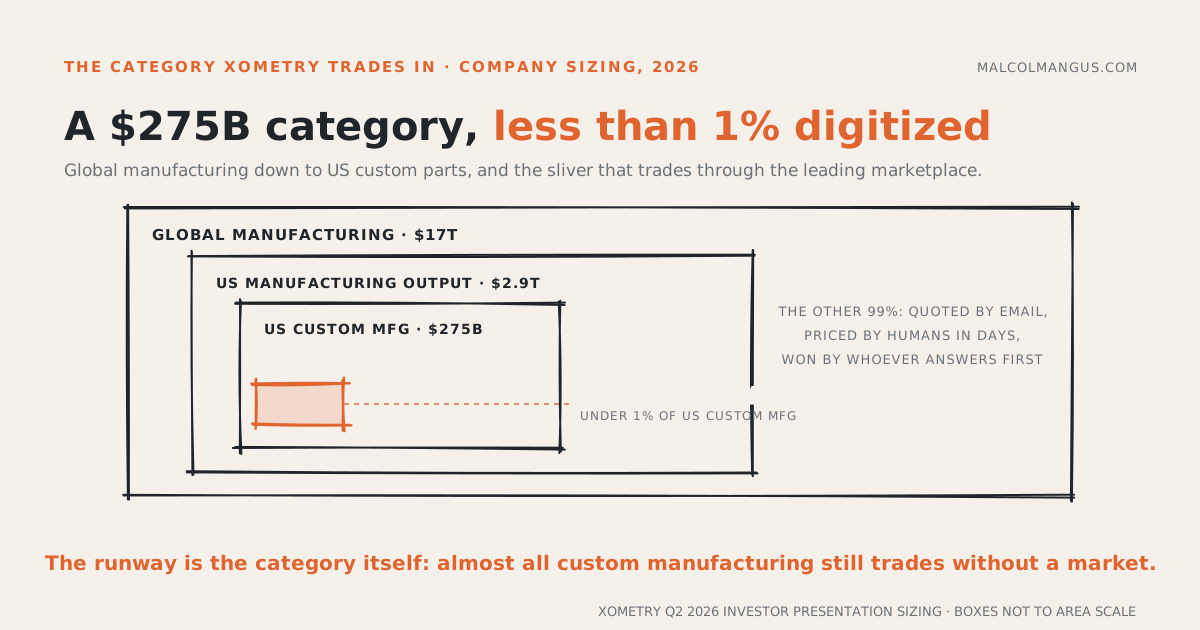
Custom manufacturing is the long tail of industry: parts that exist only as someone's CAD file, machined or printed or molded to order in lots of one to a few thousand. By Xometry's own sizing it is a $275 billion slice of America's $2.9 trillion manufacturing output, inside $17 trillion of global manufacturing, and the striking fact about it is not the size but the structure. The supply side is as fragmented as American business gets: industry counts put US machine shops alone at roughly thirteen thousand active companies averaging fewer than twenty employees, and that is one process among the sheet-metal, molding, casting, and additive shops around it; when Thomasnet writes the long tail down, it runs to more than 500,000 listed suppliers. No shop has a national brand. No shop has a sales force. The demand side is just as scattered, every OEM engineering team and hardware startup in the country, buying episodically, a bracket this month and nothing until spring.
What keeps a market from forming on its own is the good itself. Every part is bespoke, so there is no catalog, no list price, no exchange where capacity can clear; price discovery means emailing drawings to three shops and waiting days for three humans to answer, and every buyer-shop pair has to rebuild trust, quality, and terms from scratch. Fragmented supply, fragmented demand, heterogeneous goods, episodic trades, punishing search costs: these are the textbook conditions that created freight brokers and ad exchanges, and custom parts had them all with no intermediary at scale. A directory, which is what Thomas built starting in 1898, lowers the search cost but leaves every pair to negotiate price and carry risk themselves. An exchange cannot form, because nothing is fungible enough to list. The structure that clears a market like this is a dealer: a market maker that quotes a firm price to the buyer, a bid to the supplier, and absorbs the matching problem into its own book. That seat was empty. Xometry built the machine to sit in it.
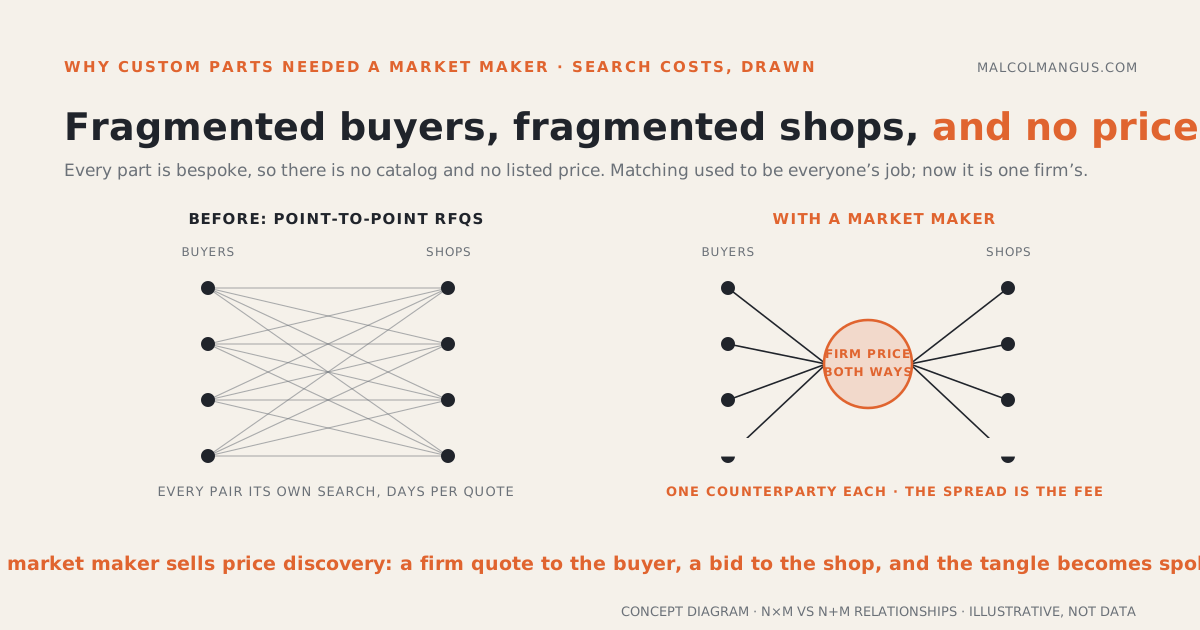
Put simply: custom manufacturing had buyers, sellers, and no market, because bespoke goods defeat catalogs and fragmentation defeats search. The opportunity was never manufacturing anything; it was being the missing middle of a market that could not organize itself, and charging the spread a market maker earns.
What actually happens to an order
An engineer uploads a CAD file. The pricing engine reads the geometry and returns an instant quote across processes, CNC machining, 3D printing, injection molding, sheet metal, casting, with a price and a lead time the buyer can accept on the spot. That instant answer is the product being sold: the alternative, everywhere else in the category, is the days-long email ritual described above. Accept the quote and Xometry itself takes the order, as the seller of record. It then places the work with one of roughly 5,000 active supplier shops, who run their side, job details, operations, cash flow, through its Workcenter app, and it stands behind the result under its own compliance umbrella: AS9100 for aerospace, ITAR for defense, ISO 13485 for medical, automotive quality certification, CMMC for cybersecurity.
That umbrella is a quietly load-bearing piece of the model. A nine-person machine shop is very good at milling and very bad at passing a Fortune 500 procurement audit. Xometry wraps the small shop in big-company paperwork, so an aerospace buyer can send work to a supplier it has never heard of and never needs to hear of. The buyer gets one accountable counterparty, one warranty, one throat to choke. The shop gets to stay anonymous and busy.
Put simply: the buyer is not buying a part so much as buying certainty, a fixed price, a promised date, and someone accountable, and the supplier is not selling parts so much as selling idle machine hours. Xometry manufactures the certainty and subcontracts the parts.
Principal, not broker
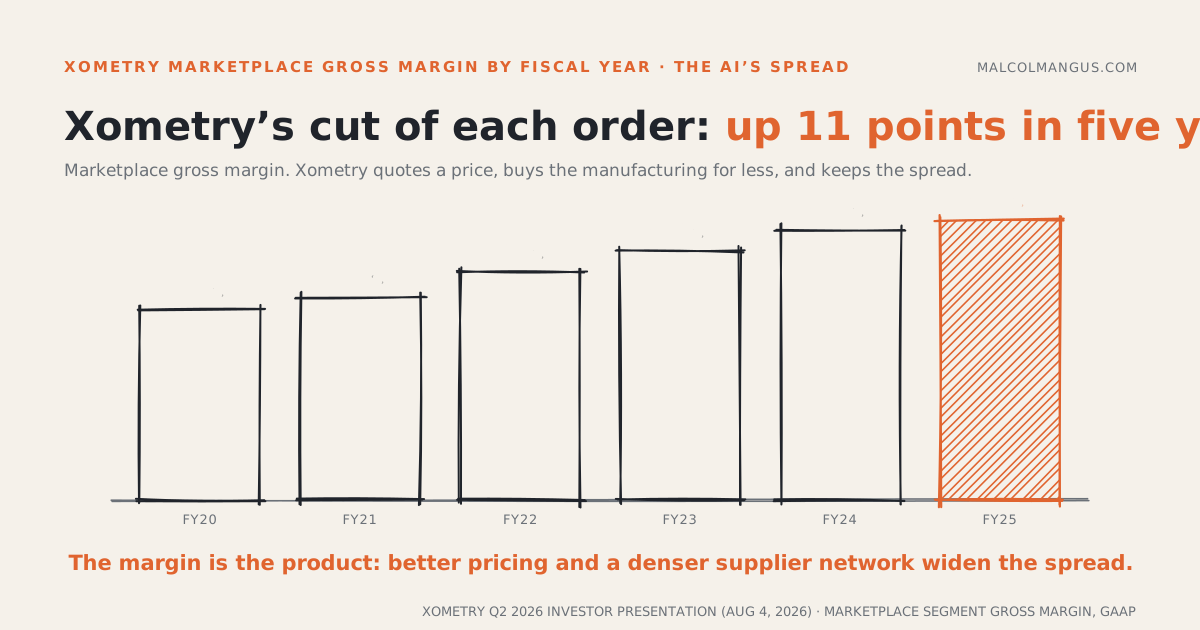
The structural choice that defines everything downstream: Xometry is a principal, not a matchmaker. It does not introduce buyer to shop and skim a commission; it buys the manufacturing itself, at a price it negotiates against its network, after committing to the buyer's price. The take rate therefore shows up as gross margin, and it is earned, not set: the spread between the quote and the sourcing cost is exactly as good as the pricing engine and the depth of the supplier bench. That spread has gone from 23.5% in fiscal 2020 to 34.7% in 2025.
Being the principal has costs that a broker never carries, and they are the honest tax on the model. If the engine misquotes a job, Xometry eats the difference. If a shop botches a part, the failure lands on Xometry's brand and Xometry's warranty. The reward for carrying that risk is control of both prices, which is where the widening comes from: every completed order teaches the engine where it quoted too generously, and every added shop gives the sourcing side another bid to play against the last one. Two learning curves, one spread.
Put simply: a broker's take rate is a negotiation; a principal's take rate is a capability. Xometry chose the version you can compound, and eleven points of margin in five years is the compounding, with the caveat that it eats its own mispricing along the way.
The flywheel runs on quotes, not orders
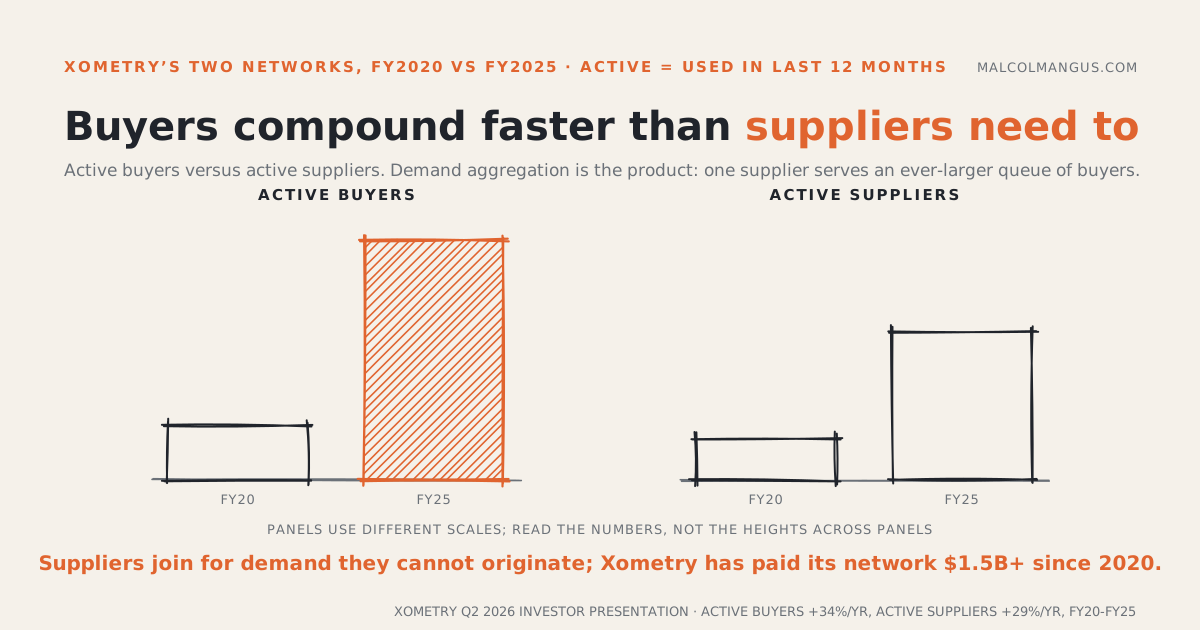
The underrated asset is the quote flow itself. Every upload, including the majority that never becomes an order, tells the engine what buyers asked for, what price they saw, and whether they took it; every placed job tells it what shops actually accepted. More buyers mean more quotes, sharper prices, and better win rates; more shops mean more capacity to source against. The two networks are deliberately lopsided: active buyers grew from 18,846 in fiscal 2020 to 81,821 in 2025, active suppliers only from 1,410 to 4,996, roughly sixteen buyers per supplier. That asymmetry is the design. Buyers are the scarce, expensive thing, and Xometry aggregates demand precisely so that shops, who cannot originate it, will accept its terms to receive it; the network has paid suppliers more than $1.5 billion since 2020.
On the demand side, the wedge becomes infrastructure through workflow: Teamspace for engineering groups, ERP integrations, CAD add-ins, so a company that came for one bracket quote ends up running procurement through the platform. The tell is that 98% of Q2 revenue came from existing accounts, and accounts spending $50,000 or more a year have grown from 389 in 2020 to 2,039 now, with more than 140 above half a million and four above $10 million. That is not a quote site's usage pattern; it is a procurement system's.
Put simply: the moat is a data-and-density loop wearing a marketplace costume: quotes train prices, prices win orders, orders recruit shops, shops deepen capacity, capacity sharpens quotes. Sixteen buyers per supplier is what demand-side gravity looks like drawn as a ratio.
Thomas: the toll booth bought, not yet built
In December 2021 Xometry bought the directory itself: $300 million for Thomas, whose Thomasnet lists those 500,000-plus suppliers across some 80,000 categories. The model logic is clean: the marketplace monetizes custom parts by transacting them, but most of industrial sourcing is not custom parts, and a directory monetizes the rest by selling visibility, sponsored listings, advertising, marketing services, at software margins, 89% gross in Q2. Together with the marketplace it also completes a bill-of-materials story: custom parts from Xometry, standard parts found on Thomas, electronic components via Siemens' Supplyframe.
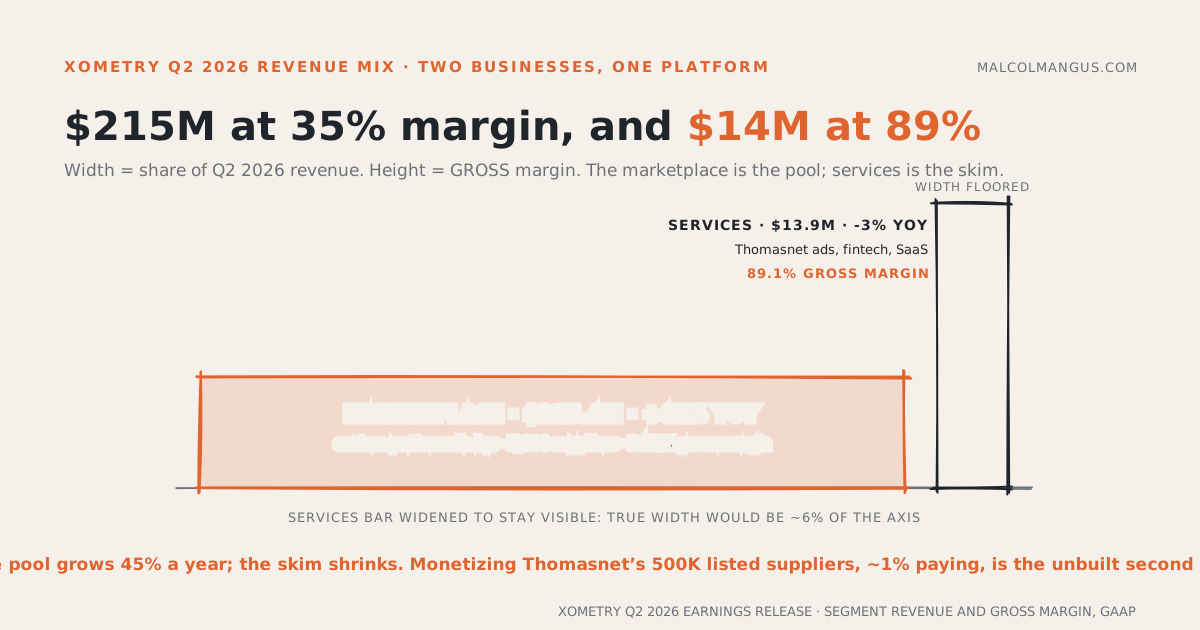
The uncomfortable part is the execution gap. Roughly 1% of those half-million listed suppliers pay to advertise, and services revenue, $57 million across 2025, actually shrank 3% year over year in Q2 while the marketplace grew 45%. Four and a half years in, Thomas remains a toll booth on a busy road where almost nobody has been asked to pay. Read generously, that is the cheapest growth option on the balance sheet: the audience and the inventory already exist, and dynamic ad serving on top of a directory is a solved problem elsewhere on the internet. Read skeptically, a 500,000-listing directory that will not convert its listings after four years of trying is telling you something about how industrial suppliers value visibility.
Put simply: the marketplace charges for transactions it fulfills; Thomas is supposed to charge for attention it directs. The first business works and compounds. The second is still a directory with an ad product attached, and whether it becomes the ad platform of American manufacturing is the model's biggest open question.
The endgame: living inside the CAD
The May 2026 Siemens partnership is the model extending to its logical conclusion. Xometry's pricing, manufacturability feedback, and sourcing get embedded natively into Siemens' Xcelerator and Designcenter, the software where engineers actually design parts, so the quote arrives while the part is being drawn, before the buyer ever thinks of shopping. Design-to-delivery in one workflow, with Siemens' global enterprise reach as the distribution and Siemens buying $50 million of Xometry stock alongside. For a business whose product is an instant answer, the best possible position is to be asked first, and inside the CAD there is no second.
Put simply: every marketplace wants to move upstream of the purchase decision; Xometry is moving upstream of the design decision. If the quote lives where the part is born, the comparison shop never happens.
The financials, briefly
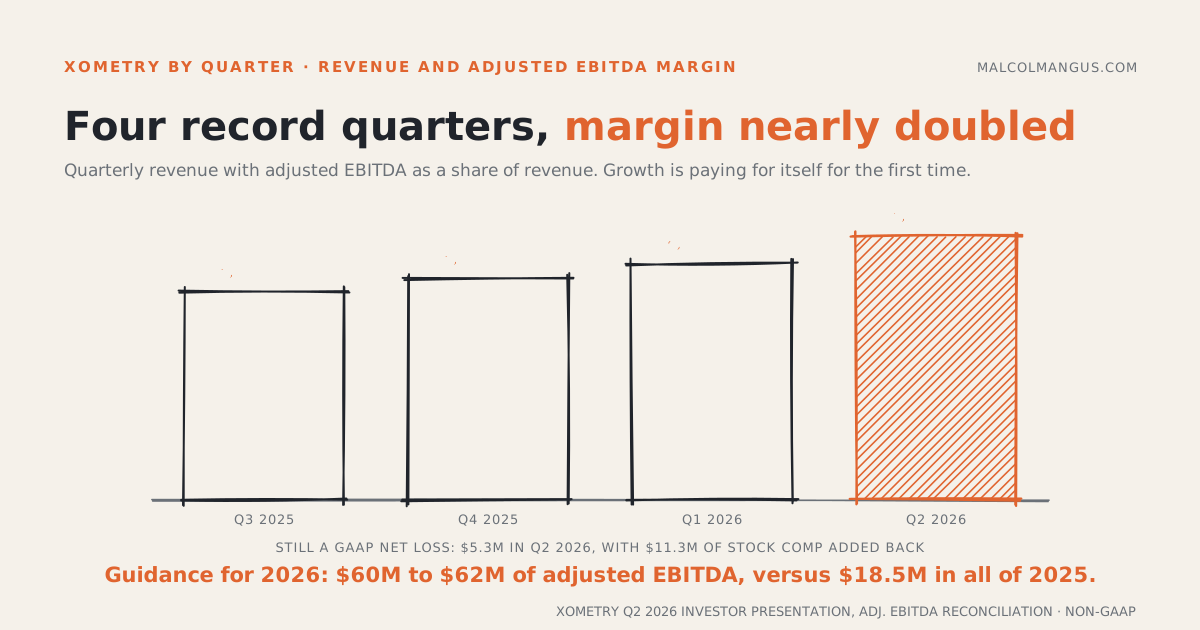
The compressed version, since the model above is what produces it. Trailing-twelve-month revenue is $807.5 million; Q2 2026 revenue of $229.3 million grew 41% year over year, with the marketplace up 45% and international now 18% of marketplace revenue against a 30-40% ambition. The last four quarters show the leverage arriving: revenue up each quarter from $180.7 million to $229.3 million while adjusted EBITDA margin walked from 3.4% to 6.2%, guidance for 2026 raised to $60 to $62 million of adjusted EBITDA versus $18.5 million in all of 2025, and long-term targets of 40-45% gross margin with 20-30% adjusted EBITDA. The caveats: still a GAAP net loss, $5.3 million in Q2, with stock comp of $11.3 million in the quarter doing much of the adjusting; and Q2 marketplace gross margin of 34.7% sat slightly below the prior year's 35.4%, a reminder that mix and competition can wiggle the spread quarter to quarter. The balance sheet is the strong, boring kind: $517 million of cash, minimal capex, asset-light by construction.
What would break the model, rather than just a quarter: a systematic mispricing streak, since the principal eats its own quoting errors; a credible rival quoting engine compressing the spread, Protolabs runs factories plus a network and regional engines exist; and the Thomas stall hardening into proof that the ad layer never converts. Those risks now belong to Sanjeev Singh Sahni, CEO since July 2026 with co-founder Altschuler as executive chairman.
None of it changes the core observation. The category had buyers, sellers, and no market, and it still mostly trades by email; Xometry's actual product is the market itself, a firm price where there was none, and the spread gets healthier as the machine learns. The quote is the product. The factory is somebody else's problem.

Malcolm Angus
I build 0 to 1 data products: I turn the data a company already has into a decision it wouldn't otherwise make, shipped end to end. I also write about how markets really work, moats, flywheels, and the loops that make companies harder to catch.

The charts in this essay are free to reuse with credit.