← All essays·September 24, 2026·18 min read
How challenger brands are re-categorizing the grocery aisle
Category design, applied to the center of the store. Poppi and Olipop did not make a better cola; they reframed soda as gut health and sold for $1.95B and a $1.85B valuation. Quest turned chips into protein snacking. The move, the permission structure behind 'an excuse to eat Doritos,' the derivative's dilemma (can a better-for-you Oreo ever be more than a healthy Oreo?), the incumbent's three footholds, and the GLP-1 wave under all of it.
Listen to this page
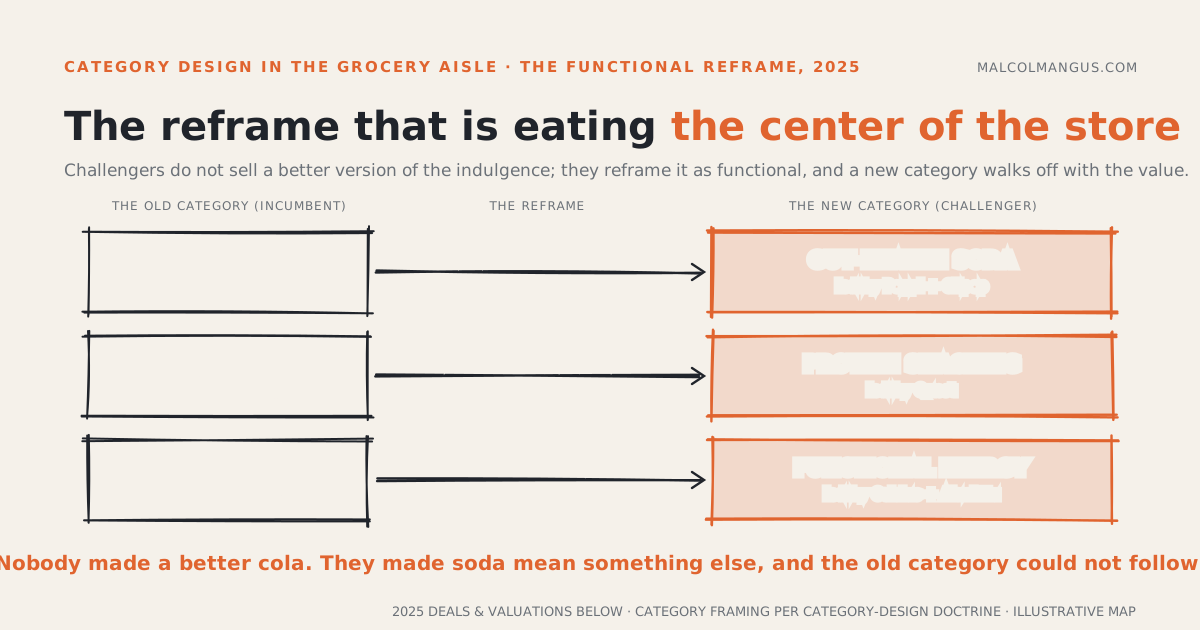
The category-design essay argued that the durable move is not a better product but a reframed problem. The grocery aisle is where that argument is being settled in real money right now, because the center of the store, the packaged food and drink that built Coca-Cola and Frito-Lay, is being re-categorized underneath the incumbents by a wave of challenger brands that never once claimed to make a better version of anything.
The pattern is clean enough to draw. Take a commoditized indulgence with a health liability, reframe the liability as the point, and a new category walks off with the value while the old one watches, unable to follow without admitting its flagship was the problem.
Nobody made a better cola
Soda is the cleanest case. US soda volume has fallen for two decades under a settled story: it tastes good and it is bad for you. A challenger accepting that frame would make a better-tasting or a diet cola, which is the better trap that has swallowed every soda challenger since Pepsi. Poppi and Olipop refused the frame. They did not sell soda that is less bad; they sold a different category, prebiotic soda, where the fizzy sweet drink is now a delivery vehicle for gut health, fiber, and apple cider vinegar. The problem moved from "is this a treat I should feel guilty about" to "is my gut getting what it needs," and on that question a can of Coke has no answer.
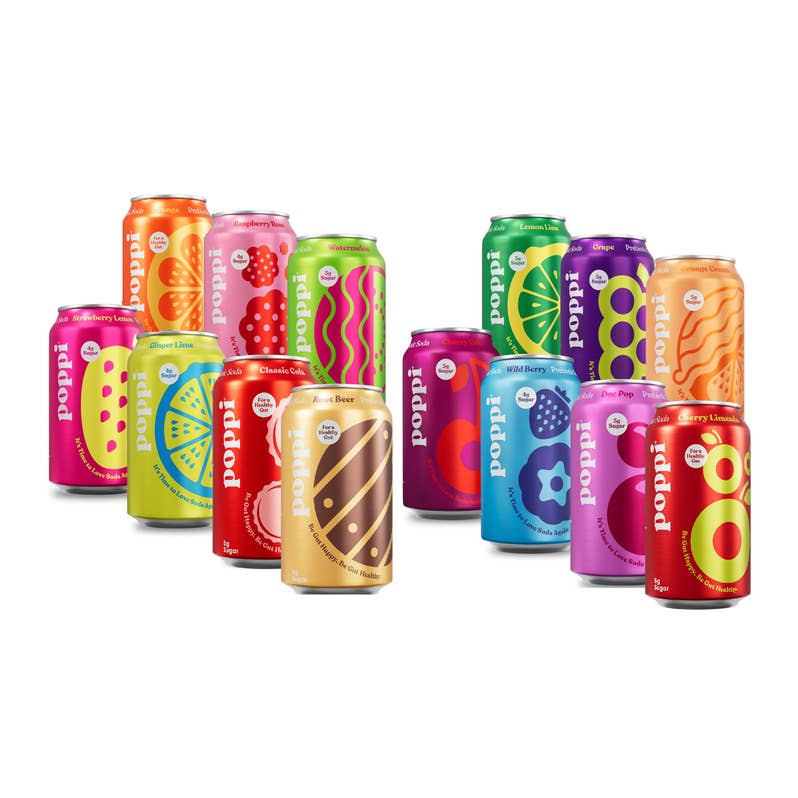
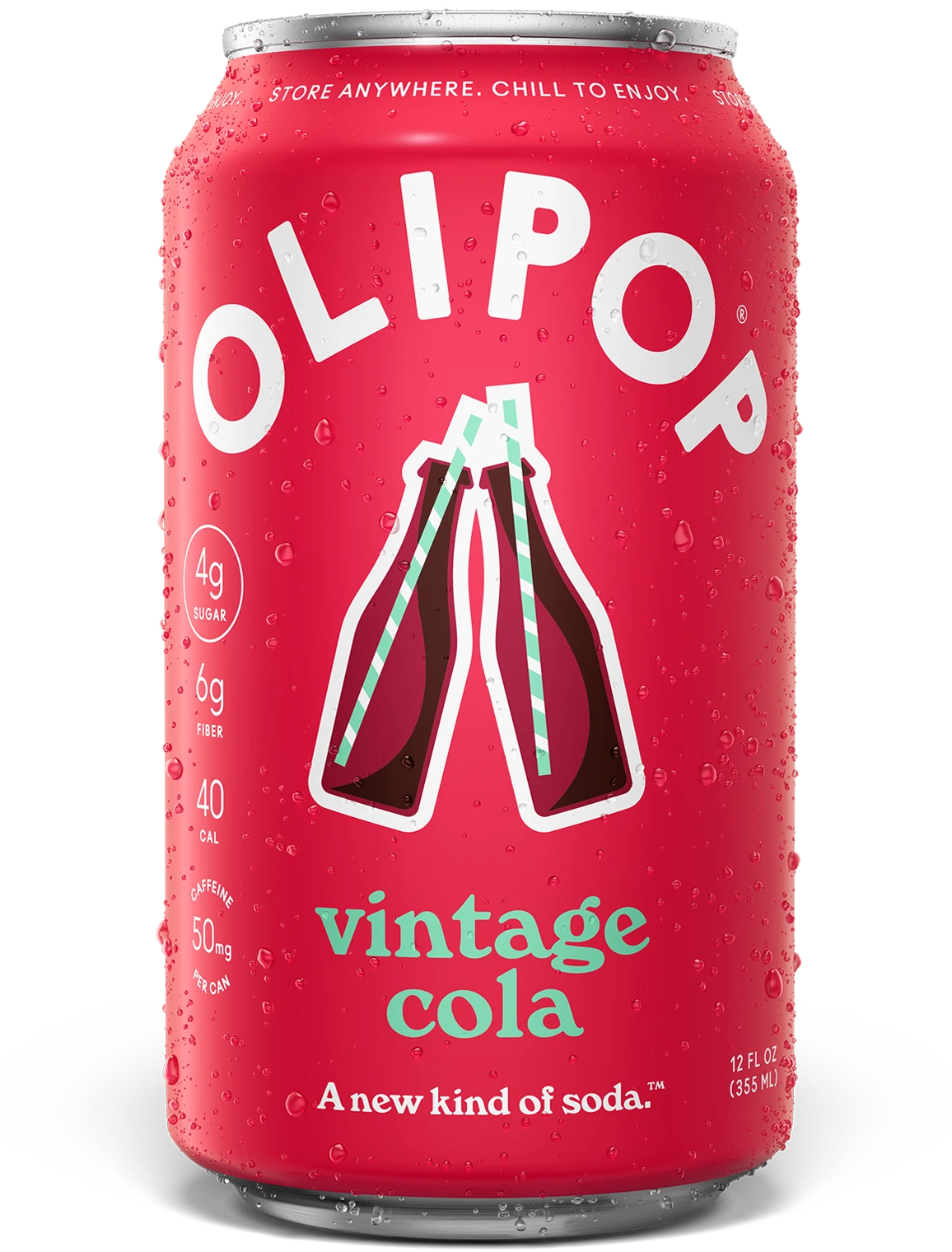
The result is category design's core claim, priced. Olipop reached roughly $400 million of revenue in 2024, doubling year over year, and raised at a $1.85 billion valuation in February 2025 while controlling a reported 60% of the prebiotic-soda category it helped invent. Weeks later, PepsiCo bought Poppi for $1.95 billion. Neither number is available to a company selling a better cola, because a better cola competes for share of a declining category, and a category king collects the value of a rising one.
Put simply: the winning move against a commoditized indulgence is not a healthier version of it; it is a new category in which the old product's greatest weakness becomes your entire reason to exist. Reframe the problem and the incumbent cannot answer without indicting its own flagship.
An excuse to eat Doritos
The chip aisle shows a second, subtler reframe, and it answers a question the soda case does not: what if people do not actually want the healthier thing, they want the indulgence with permission? Quest did not teach anyone to prefer a virtuous snack. Its nacho-cheese protein chips are engineered to deliver the Doritos experience, the crunch, the cheese dust, the flavor you actually crave, while carrying 18 grams of protein and almost no sugar. The category it claims is not "healthy chips," a phrase that promises deprivation. It is protein snacking, which reframes the same act of eating chips on the couch as fueling rather than cheating.
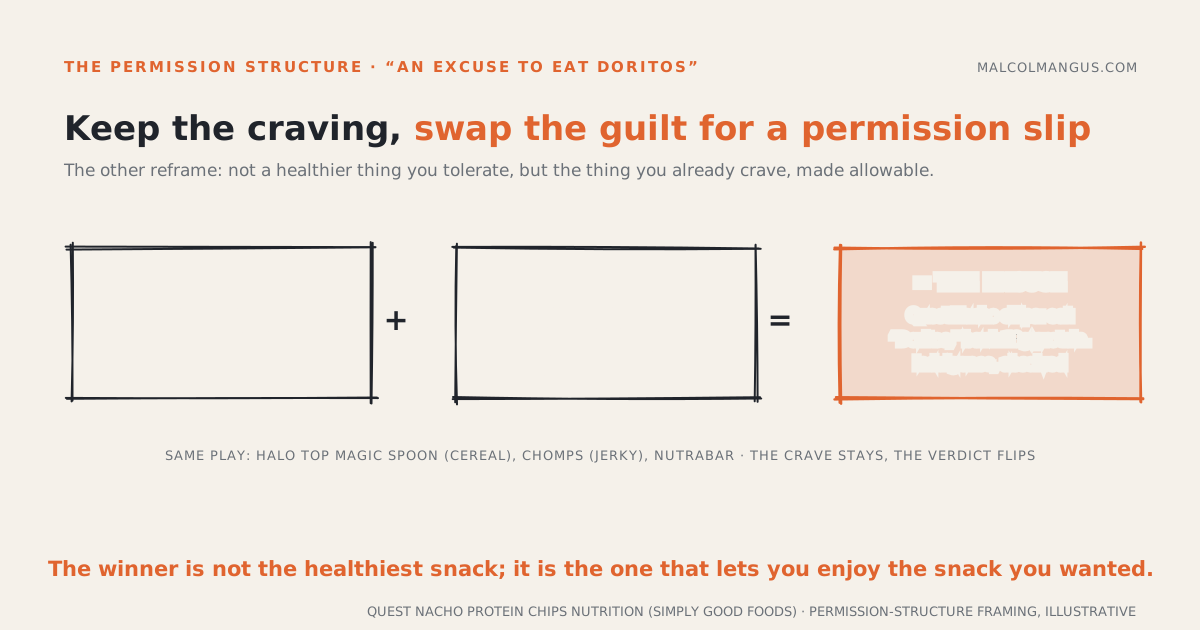
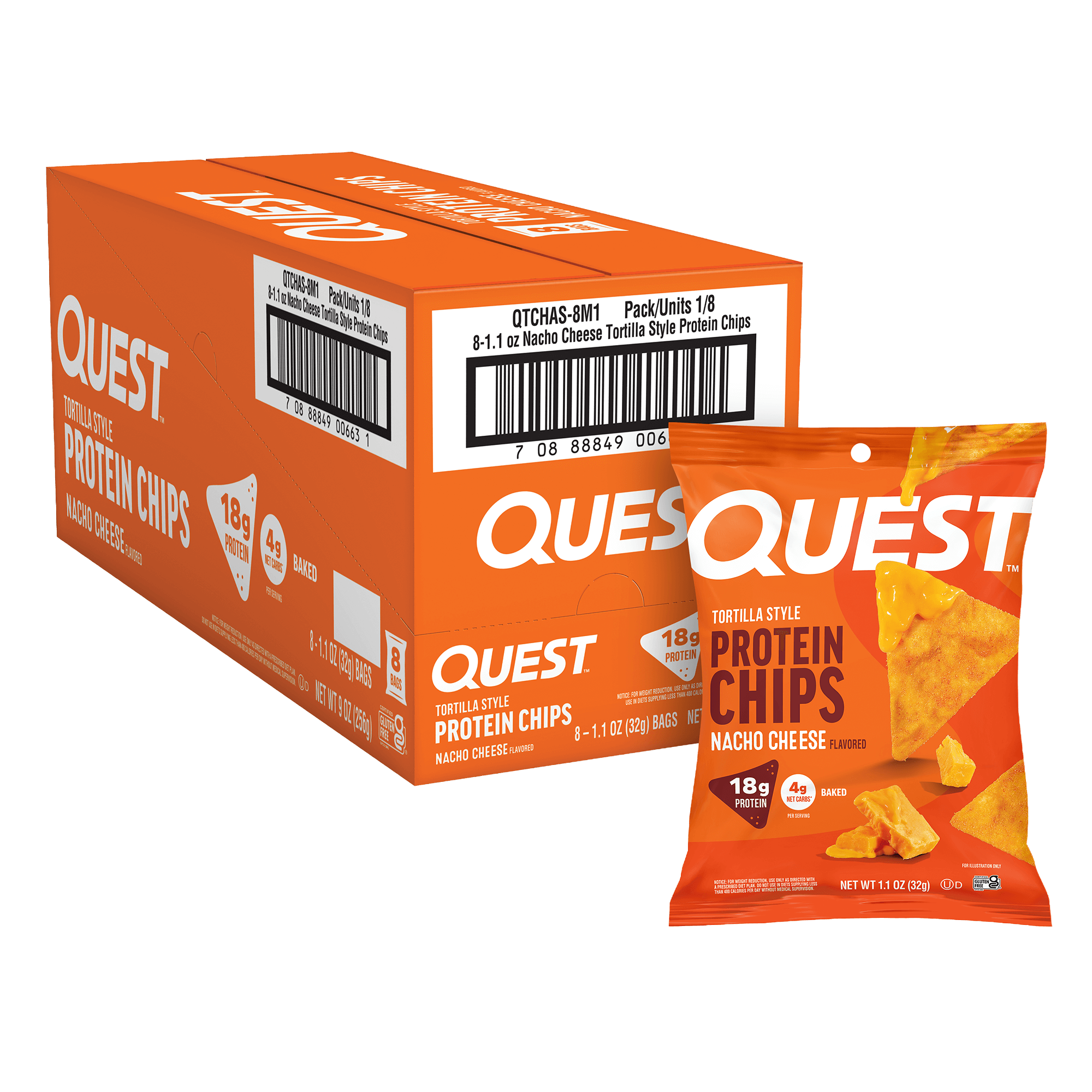
This is a distinct mechanism worth naming: the permission structure. The challenger keeps the exact thing the customer craves and swaps the guilt for a permission slip, protein, prebiotics, no added sugar, so the indulgence is not resisted but absolved. It works because the job the customer is hiring the snack for was never nutrition; it was the craving, and the winner is whoever lets them satisfy it without the verdict. Simply Good Foods, Quest's parent, reports Quest chips now run-rating over $400 million in annual retail sales and its nutritional-snacking category growing 13% in fiscal 2025 while the broader food industry stalled. Magic Spoon did the same to cereal, Chomps to jerky: the crave stays, the verdict flips.
Put simply: for an indulgence, the reframe is not "want something healthier," it is "keep wanting this, here is your permission." Sell the excuse, not the substitute, because the customer's real job is the craving and the category king is whoever absolves it.
The gym bag, not the gas station
Energy drinks are the third case, and the one that shows the reframe can move an entire buyer, not just a formula. Red Bull and Monster built the category on a single job: stay awake. The buyer was a gamer, a trucker, a student cramming, and the product was sugar and caffeine that came with a crash and a reputation for being bad for you. Celsius refused that job. It reframed the problem as fitness: not "how do I stay awake" but "why does my pre-workout come with a sugar crash," and answered with a sugar-free, vitamin-loaded, thermogenic drink positioned as workout fuel. The category it designed is functional energy, and the tell is on the can itself.
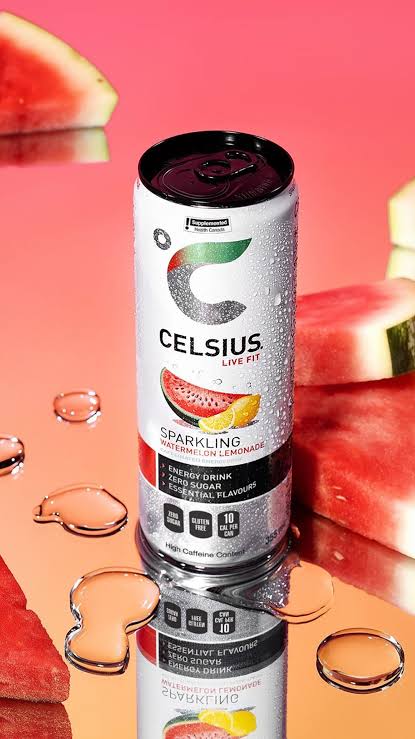
The can says "Live Fit," not "gives you wings." That two-word swap is the whole category: the drink moved from the gas-station cooler to the gym bag, and the buyer moved with it, from the person trying not to fall asleep to the person going to work out. Alani Nu ran the same reframe one identity further, building a female-focused wellness-energy brand where Red Bull had a masculine energy-drink one, which is exactly why Celsius paid $1.8 billion to acquire it and consolidate the category it had helped create. The name of the old category, energy drink, still appears on the Celsius can, the way Otis's "vertical railway" kept the word railway. You draft on the words people know, then defect on the job they name.
Put simply: Celsius did not make a better energy drink; it renamed the job from "stay awake" to "live fit" and moved the buyer from the gas station to the gym. When you can reframe the occasion and the customer, not just the formula, the incumbent's whole brand becomes the wrong shape for the new category.
The derivative's dilemma: can a better-for-you Oreo ever be more than a healthy Oreo?
Here is the hardest version of the question, and it is worth sitting with because most challenger brands get it wrong. Consider Rip Van's Leos, a low-sugar sandwich creme cookie built, unmistakably, to be an Oreo you are allowed to eat.
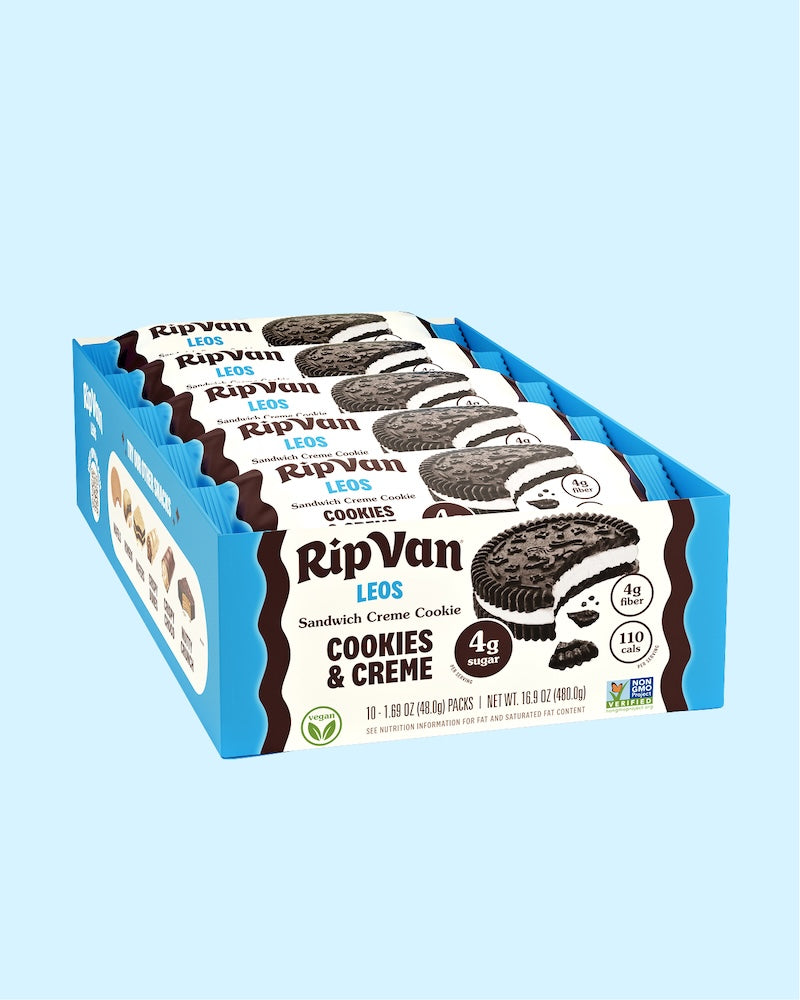
The dilemma is a genuine paradox. To get found, a derivative brand must draft on the incumbent's category: the box says "Cookies & Creme," the cookie is embossed like an Oreo, because a shopper needs the mental shortcut to know what the thing even is. You cannot sell a zero-billion-dollar cookie nobody recognizes. But to win category-king economics rather than premium-niche economics, the brand must eventually escape being "the healthy Oreo," because a modifier on someone else's noun is, by construction, a fight for the leftover 24% of a category the incumbent owns. So which is it: draft on Oreo to be legible, or defect from Oreo to be a category? The answer is that the successful ones do both, in a specific order.
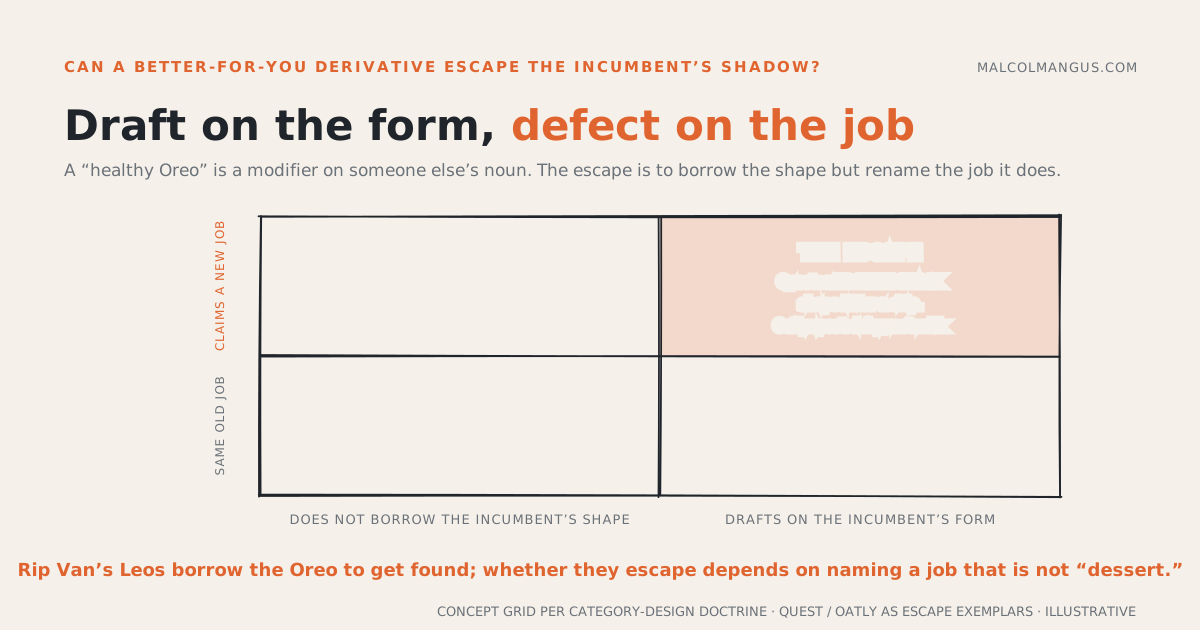
Draft on the form, defect on the job. The form, the sandwich cookie shape and the cookies-and-creme flavor, is the borrowed shelf that makes you legible; keep it. The job is where you must defect. A brand that keeps Oreo's job, "a dessert cookie, but healthier," lands in the healthy-Oreo trap: a real premium niche, and then either the incumbent clones it (Mondelez can ship a reduced-sugar Oreo the moment the segment is proven) or acquires it, and the derivative never becomes a category. The escape is to draft on the form while renaming the job. Quest looks like a chip but its job is protein, so its category is protein snacking, not "healthy Doritos," and Frito-Lay cannot clone it away because the job is not Frito-Lay's. Oatly looks like milk and pours like milk but its job is a post-dairy identity, so it is not "healthier milk," a claim dairy could match, but a different category dairy cannot occupy.
So, concretely, what could Rip Van's Leos be other than "healthy Oreos"? Not a better dessert cookie, that is the trap. It has to name a job that is not dessert: the low-sugar snack for the GLP-1 or diabetic pantry (a medical job Oreo cannot claim), or the kids' lunchbox treat parents are allowed to pack (a permission job, the chip move applied to cookies), or the protein-cookie occasion if the formula can carry it. The form stays Oreo-shaped so the shopper knows what it is; the category becomes something with the shape of a cookie but the job of a protein snack, a diabetic-friendly treat, or a guilt-free lunchbox staple. Will it displace Oreo? Almost certainly not, and it does not need to, the same way Poppi did not displace Coke; it needs to king a new category alongside it. And there is a hundred-year-old lesson sitting in the same aisle: Oreo itself launched in 1912 as a near-copy of Hydrox, the 1908 original, and won by distribution and marketing so thoroughly that most people now assume Hydrox was the knockoff. The incumbent is not safe because it was first. But Oreo did not win as "a better Hydrox"; it won by out-committing on everything downstream. Being derivative is survivable. Staying a modifier is not.
Put simply: a better-for-you derivative must borrow the incumbent's form to be understood and defect from the incumbent's job to be a category. "Healthy Oreo" keeps Oreo's job and stays a niche the incumbent can clone or buy; the escape is a cookie-shaped thing whose real job, medical, permission, or protein, Oreo cannot claim.
The soda shelf did not shrink, it shattered
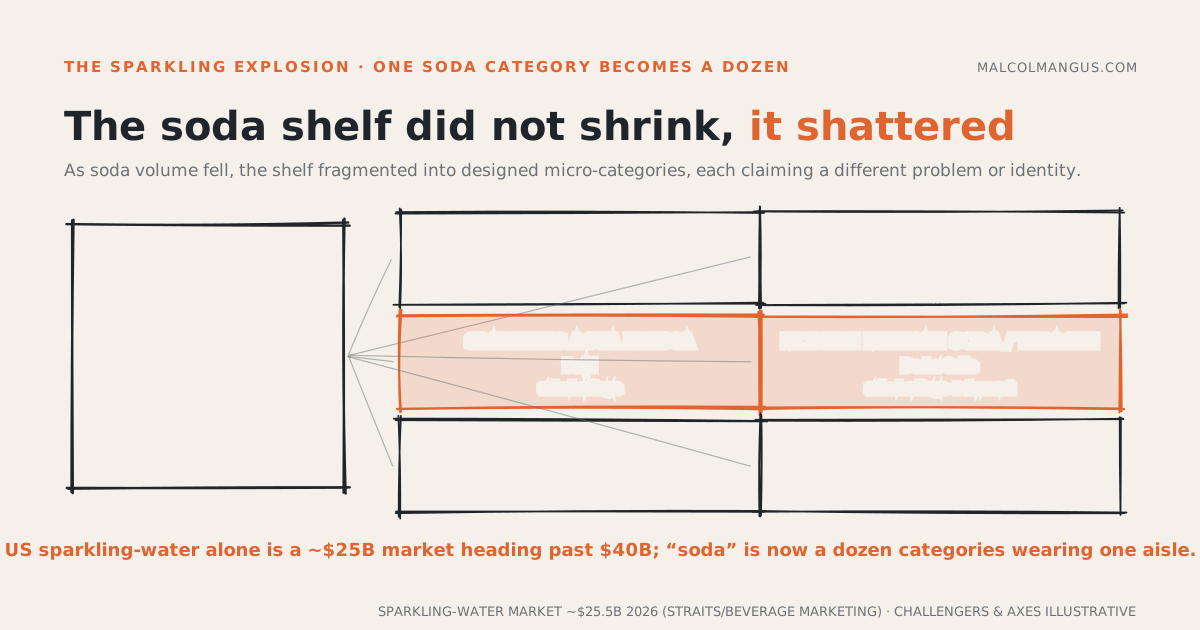
Zoom out from any single brand and the deeper event is visible: the soda category is not just losing volume, it is fragmenting into a dozen designed micro-categories, each claiming a different problem or identity. US sparkling water alone is roughly a $25 billion market heading past $40 billion, premiumizing toward functional variants with vitamins, adaptogens, and electrolytes, and that is only one shard. LaCroix reframed carbonation as a diet-soda replacement and took about 30% of sparkling water on roughly $640 million; Spindrift reframed it as real-squeezed-fruit clean-label; Liquid Death reframed water itself, the least differentiable product on earth, as punk-rock identity in a tallboy. What used to be one word, soda, is now a shelf of separately designed categories wearing one aisle.
The most interesting shard is the one that answers a question the functional brands cannot: what if the reframe is not function at all, but heritage? Consider De La Calle and Bawi, two Mexican-heritage challengers, and note carefully that they are in the same trend but different categories. De La Calle sells tepache, a 3,000-year-old fermented-pineapple street beverage, framed explicitly as "modern Mexican soda," a category that is functional (it is fermented, so it rides the gut-health current) and heritage at once. Bawi sells sparkling agua fresca, the canned version of the fruit-water sold from Mexican street carts, framed as one of the first better-for-you Hispanic beverages, a category that is clean-label and cultural but not fermented. Same shelf, same buyer, same cultural-authenticity reframe, but tepache and agua fresca are genuinely different categories, the way Greek yogurt and skyr are different, and each brand is claiming its own name rather than fighting for share of the other's.
And this heritage axis is a fourth escape from the derivative's dilemma, cleaner than the ones above. A "healthy Oreo" drafts on the incumbent's form and struggles to escape the incumbent's shadow. Tepache and agua fresca draft on a form that is older than Coca-Cola, a traditional category the incumbent never owned, so there is no incumbent shadow to escape at all. You cannot be dismissed as "the healthy Coke" when your category is a fermented drink the Aztecs made. The lesson generalizes: the strongest category to draft on is not always the incumbent's, sometimes it is a genuine tradition the incumbent was never part of, which hands you authenticity and a name in one move.
Put simply: the reframe axis is not only function or permission; it can be heritage. De La Calle and Bawi share the trend but design different categories, tepache and agua fresca, and both draft on traditions older than the incumbent, which is the cleanest escape of all: you cannot be a knockoff of a brand when your category predates it by centuries.
The pattern completes: ask the yogurt aisle
The natural objection to all of this is that Poppi and Quest are early, and being acquired or valued highly is not the same as displacing anyone. Fair. So look at a displacement that already finished, one aisle over. In 2007, Greek yogurt was about 1% of US yogurt sales. Chobani launched that year not as a better yogurt but as a different category, thick, high-protein, strained, and by 2013 Greek yogurt was 44% of the entire category. It has settled at roughly a third of all US yogurt revenue since, which means "regular" yogurt, the thing that was the category in 2006, is now the sub-segment.
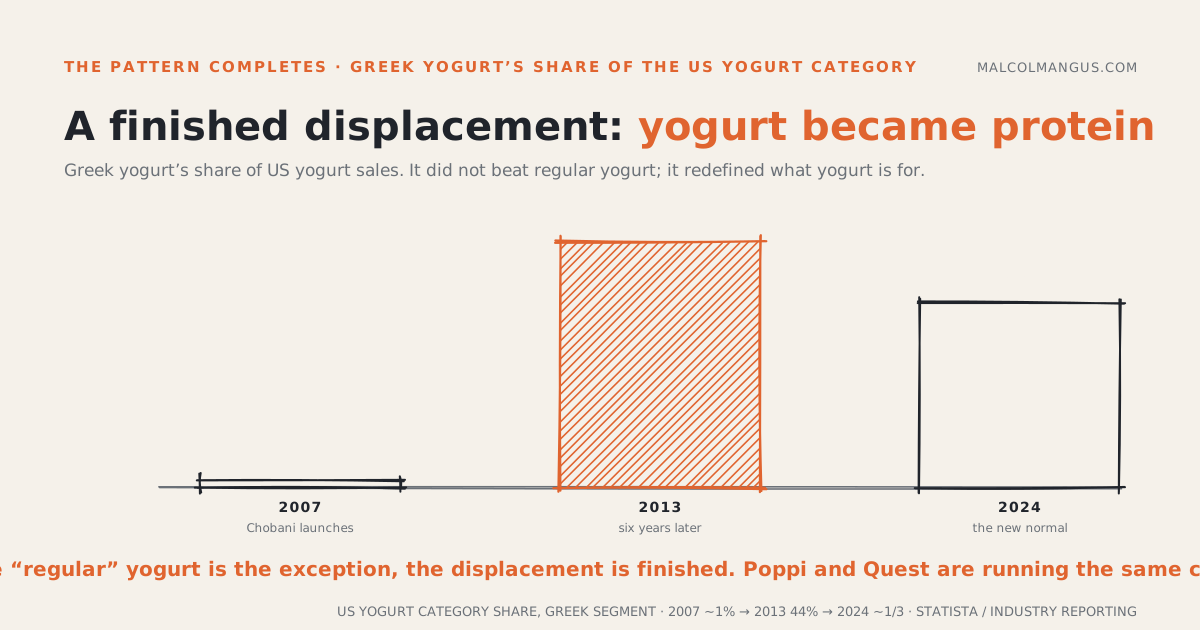
That is the whole thesis with the clock run out. Greek yogurt did not win by being a tastier or cheaper yogurt; it reframed yogurt from a sweet dairy snack into a protein delivery vehicle, and once enough shoppers accepted that frame, the old definition became the niche. Chobani taught the category what yogurt was for, and General Mills' Yoplait, the incumbent king, spent years launching Greek versions that never recaptured the frame Chobani had already claimed. Oat milk is running the same play against dairy right now, a category that barely existed a decade ago and is compounding double digits while fluid-milk volume declines. The functional reframe is not a 2025 fad; it is a repeatable mechanism with completed examples, and the soda and chip aisles are simply earlier on the same curve.
Put simply: the displacement finishes. Greek yogurt took a decade to turn "regular" yogurt into the exception, and it did it by reframing the job, not out-tasting the incumbent. When someone asks whether Poppi can really displace Coke, the honest answer is: ask the yogurt aisle, which already did exactly this to itself.
The incumbent's three footholds
When a challenger frames a new category, the giant with the national shelf space and the distribution trucks is not helpless. It has exactly three plays, and 2025 ran all three in public.
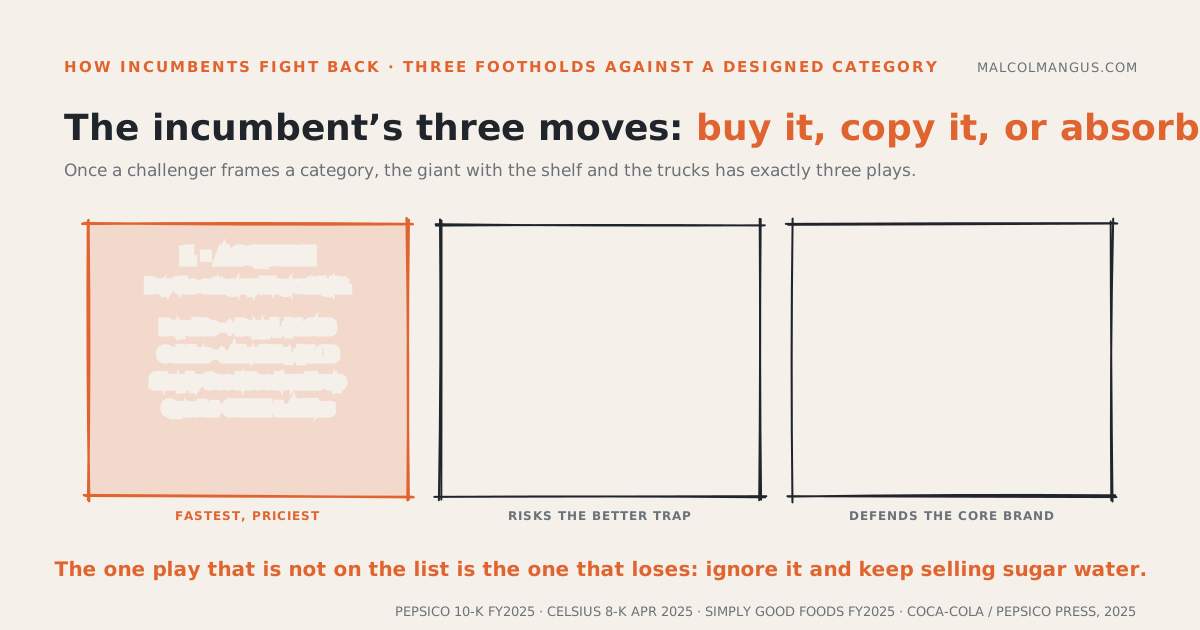
Acquire is the fastest and the priciest: buy the category king before you become the déclassé incumbent. PepsiCo bought Poppi for $1.95 billion; Celsius, itself a functional-energy challenger, bought Alani Nu for $1.8 billion in April 2025 to consolidate the fitness-energy category into a roughly $2 billion portfolio; and Simply Good Foods has rolled up Quest, Atkins, and OWYN into a house of functional brands where Quest and OWYN alone are now over 70% of net sales. Clone is cheaper and riskier: launch your own version and let your distribution muscle do the work, which is what Coca-Cola did in February 2025 with Simply Pop, a prebiotic soda with 6 grams of fiber aimed straight at Poppi and Olipop, but a clone competes on the challenger's frame, which is the better trap turned inward. Absorb defends the mothership: put the new category's claim inside the flagship itself, which is PepsiCo's other 2025 move, Doritos Protein, 10 grams of protein in the actual Doritos, refusing to cede that the reframe requires a new brand at all.
Put simply: an incumbent facing a designed category can buy it, copy it, or fold its claim into the flagship, and the giants are doing all three at once. The only losing play is the fourth one, ignore it, which is how you become the category the reframers were designed to replace.
Why the giant cannot simply win
The three footholds all sound like the incumbent has options, but there is a structural reason acquisition keeps being the move: the incumbent is trapped by its own flagship. Every can of Simply Pop that Coca-Cola sells to a health-conscious shopper is, in the best case for Coke, a shopper who would otherwise have bought a Coke, which trades a high-margin flagship dollar for a lower-margin challenger dollar. That is the cannibalization trap, and it is why a giant cannot push its own clone as hard as a challenger pushes its only product. The challenger has nothing to protect; the incumbent has everything to protect. This is the classic innovator's dilemma wearing a beverage label, and Coca-Cola has run the experiment before: Vanilla Coke cannibalized the core without growing overall share and was pulled. A clone that succeeds eats your flagship, and a clone that fails wastes the launch, so the rational incumbent under-commits to its own clone by design.
Which reframes the whole acquisition wave as the honest admission it is. PepsiCo paying $1.95 billion for Poppi is not PepsiCo failing to build a prebiotic soda; PepsiCo can obviously build one. It is PepsiCo recognizing that owning the challenger's independent brand, run outside the flagship's cannibalization logic and free to attack sugary soda without attacking Pepsi, is worth more than a clone it would be structurally afraid to scale. The category king's independence is the asset, which is why the giants buy the brand rather than just copy the formula, and why "absorb it into the flagship," Doritos Protein, defends the core but rarely designs the category. The reframe is safest in the hands of a company with no old category to betray.
Put simply: the incumbent cannot fully win because winning means cannibalizing its own flagship, so it under-commits to clones and overpays for acquisitions. The challenger's structural advantage is having nothing to protect, and that is precisely what the acquisition price is buying.
The tailwind under all of it
None of this would be moving at 2025's speed without a macro force that is doing the challengers' problem-education for them. GLP-1 drugs, Ozempic and its kin, suppress appetite and reshape the basket toward exactly what the functional reframers sell.
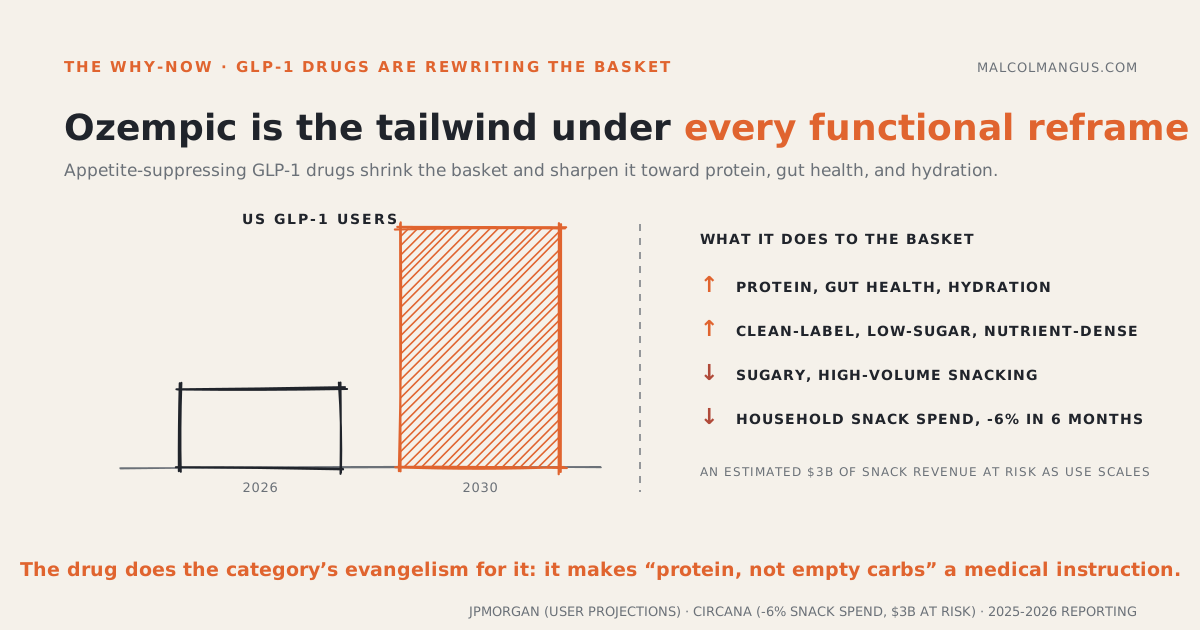
The numbers are a category designer's dream tailwind. JPMorgan projects US GLP-1 users rising from around 10 million toward more than 30 million by 2030. Circana finds household snack spend among users dropping about 6% within six months of starting, with an estimated $3 billion of snack revenue at risk as use scales, and the spend that remains skewing hard toward protein, gut health, hydration, and clean labels. The drug turns "protein, not empty carbs" from a marketing slogan into a medical instruction, and it shrinks the very high-volume, high-sugar categories the incumbents were built on. Every functional reframe on this page is riding that same current.
Put simply: the reframe is not just fashion, it has a pharmacological tailwind. GLP-1 drugs suppress the appetite for volume and sharpen it toward function, doing the challengers' evangelism at population scale and eroding the incumbents' core categories at the same time.
What the reframe is worth
The honest summary is what the market paid. In 2025 alone, PepsiCo bought Poppi for $1.95 billion, Celsius bought Alani Nu for $1.8 billion, and Olipop raised at a $1.85 billion valuation while clearing over $400 million of real revenue on a category it named. Different measures, one signal: the incumbents and the capital markets are both pricing the reframe as the asset.
And the skeptic's asterisks belong here too, the same ones I put on any hot number. Some of this is froth: functional-food valuations in 2025 carry a bubble premium, prebiotic soda is one clinical study away from a bad headline, and the GLP-1 projections are estimates that assume a trajectory nobody has run yet. Being acquired is also not the same as winning, it is often the category king selling before the incumbent's clone-or-absorb response compresses the premium, which is a rational exit, not a coronation. But the durable point survives the discount. Olipop cleared real revenue, not just a valuation, on a category it named. The incumbents are paying category-king multiples because they believe the reframe is the asset, not the recipe. And the mechanism is the same one the whole category-design canon describes, playing out in the one aisle where the score is kept weekly in dollars: nobody made a better cola, and the better cola was never the point.

Malcolm Angus
I build 0 to 1 data products: I turn the data a company already has into a decision it wouldn't otherwise make, shipped end to end. I also write about how markets really work, moats, flywheels, and the loops that make companies harder to catch.

The charts in this essay are free to reuse with credit.