← All essays·September 24, 2026·16 min read
Category design: damming the demand
Show notes on category design, drawn from six sources: the Play Bigger authors, Christopher Lochhead's Category Pirates, and the practitioners who teach it today. What the famous 76% category-king statistic really proves. Why better products like Threads and the Fire Phone still died. How new words let Starbucks charge three dollars for a ten-cent coffee. A six-step process for designing a category, with tests that can kill a bad one. And the punchline: category design is itself a designed category.
Listen to this page
Category design has one book at its root and a decade of retellings on top, and hearing them together is the best way to see both the insight and the sales pitch. The root is Play Bigger, whose four authors, Al Ramadan, Dave Peterson, Christopher Lochhead, and Kevin Maney, sat for a Churchill Club panel the week the book launched in 2016. Lochhead has since become the discipline's loudest evangelist, and his two-hour conversation with Lenny Rachitsky plus a live Category Pirates workshop are the richest versions of the current doctrine. Around them sits the interpretation layer: a brand agency's tidy distillation, a medtech investor's application of the numbers, and a Figma-trained designer's rebuild of the idea as vision, advocacy, and alignment. The firm itself keeps a working blog of cases, which supplies this post's coda on what happens to a king whose category stalls.
The standing disclosure applies twice over here. Everyone in these sources sells the discipline they describe: books, workshops, a Substack, advisory stakes, an agency's brand-audit funnel. And, more deliciously, category design is itself a designed category, framed, named, and claimed by the people who wrote its founding study. That is not a reason to dismiss it. It is the best live demonstration the idea has.
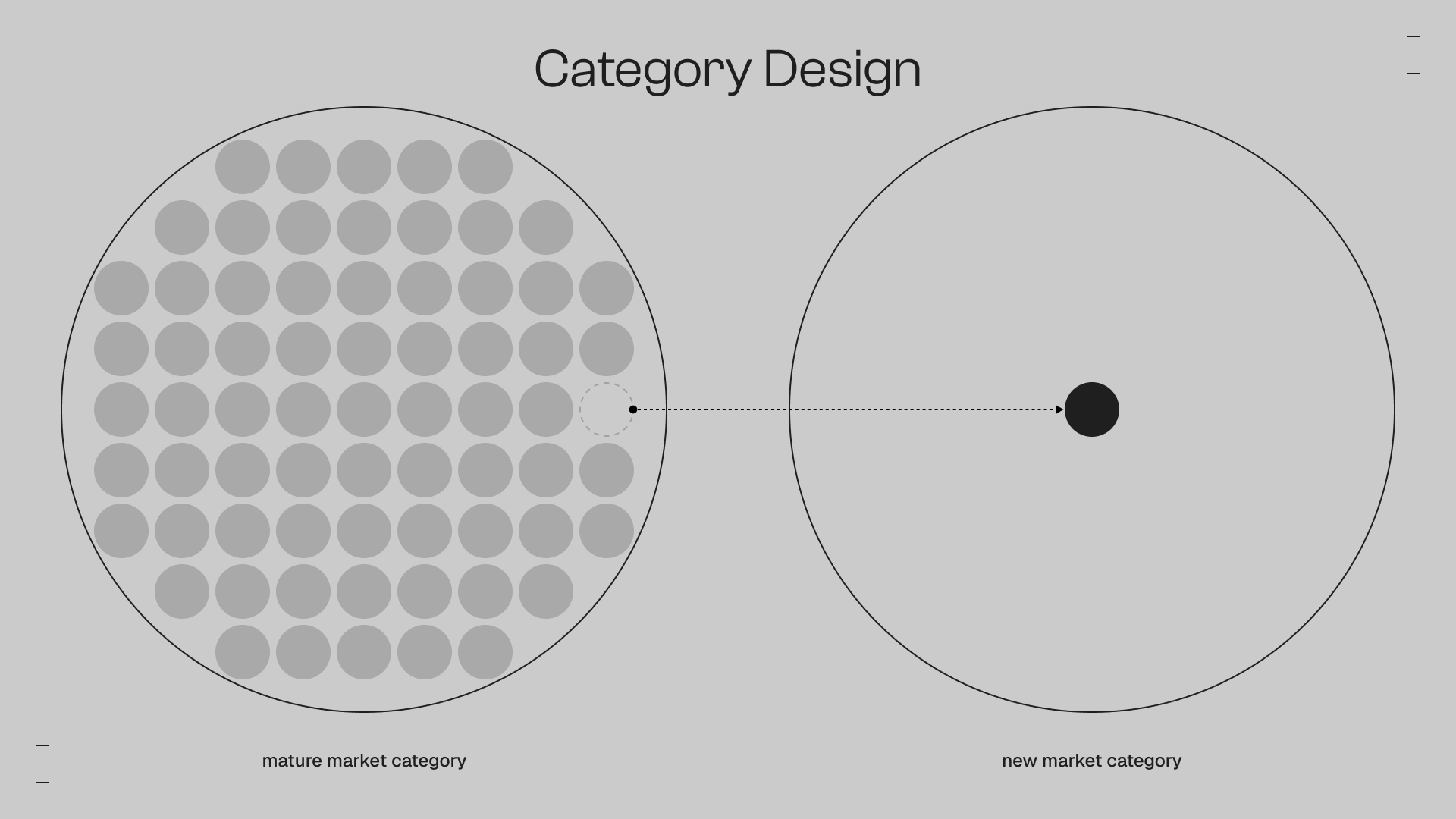
The whole idea fits in one picture, and the cleanest version of it is Corey Lee's:
The claim: one company takes two-thirds
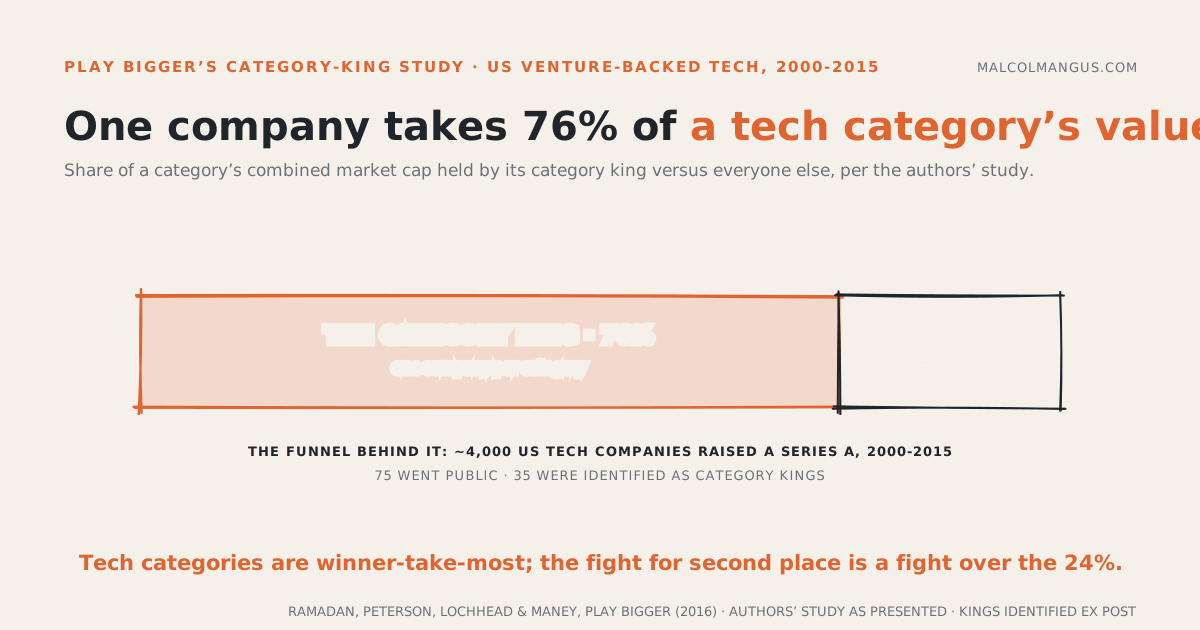
The study underneath everything, as the authors tell it, looked at every US venture-backed tech company founded from 2000 to 2015: roughly 4,000 that raised a Series A, of which 75 went public, of which 35 were identified as category kings. Those kings held 76% of the combined market cap of their categories, a result the authors say was peer-reviewed on its way into Harvard Business Review, and their Fortune 500 work adds that established category designers trade at four to five times comparable growth companies.
Hold the number to the same standard as any number on this site and it says less than the podcasts claim. The kings were identified after the fact, so 76% measures how concentrated tech outcomes are, which power-law investors already knew, and not the success rate of any recipe; nobody has run the forward test where a cohort adopts category design and a control group does not. What the number does establish is the stakes: in technology markets, the modal outcome of competing is fighting over the leftover quarter. The discipline is best read not as a proven formula but as an argument about which fight to enter.
Put simply: the data proves tech is winner-take-most, not that a playbook makes you the winner. What the 76% buys you is the right question: am I designing the field, or applying for the 24%?
The better trap
The sharpest teaching across all the sources is a failure pattern. Threads launched with what Lochhead calls the greatest distribution advantage any software product has ever had, a billion-user platform, a top-ten brand, free, one tap to join, aimed at a rival everyone claimed to hate. It cratered, because it attacked a known problem with a copied answer and told the world the copy was better. He stacks the shelf with the same corpse in other aisles: Amazon's Fire Phone, Red Bull Cola, Microsoft's Apple-clone retail stores, and, for a century and counting, Pepsi. The world does not accept better in an existing market. It accepts different.
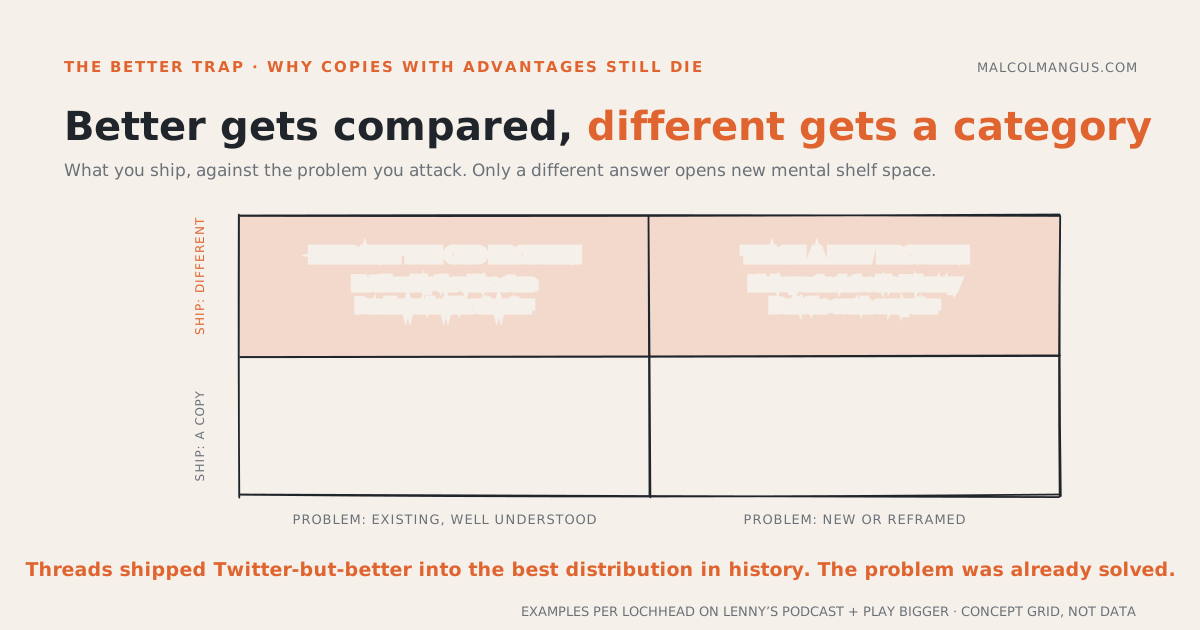
The mechanism, in the doctrine's own compression: problems make categories, and categories make products. The clean worked example is Gojo Industries, which reframed hand-washing twice. First the problem was not "wash my hands" but "wash my hands without a disgusting shared bar of soap," and the answer was a new category called liquid soap. Decades later the problem became "wash my hands where there is no water," and the answer was hand sanitizer, where the brand on the bottle, Purell, still rules the category its parent framed. Neither move was a better bar of soap.
Put simply: a copy with advantages still loses, because demand attaches to problems, not products. If the problem you attack is already well understood and well served, your product is an answer to a question nobody is still asking.
Teach the problem and the market pulls
The founding parable is Clarence Birdseye, who watched fish flash-freeze on Arctic ice and came home to a world with no frozen-food aisle, no freezer cases, no refrigerated rail cars, and no belief that frozen food was food. He had to build the infrastructure and, harder, teach the problem: you cannot get fresh vegetables in February. Once the world accepted that sentence, the market pulled the product out of him, and the panel's line for it is the discipline's best sentence: when people get the problem, they suck the solution out of the company. A century later the brand still leads the category.
The same shape repeats at every scale in these talks. Steve Jobs introduced the iPad not with specs but with a gap he held up between a laptop and a phone until the room saw it. Five-Hour Energy declined to be a better energy drink, framed tiredness-without-thirst as its own problem, and became an energy shot, a different shelf, sold at the register. Lomi, the Category Pirates' favorite current client, sells a countertop machine by teaching that food waste would be the world's third-largest greenhouse-gas emitter if it were a country, and that waste itself is a human invention. And the panel's investors make the uncomfortable version explicit: the categories worth designing start as zero-billion-dollar markets, which is exactly why Don Valentine could fund Apple off a use case he thought was stupid. The size was invisible because the category did not exist yet. The sharpest statement of this idea is not from a category-design book at all but from Jensen Huang, who describes NVIDIA as a company that goes after zero-billion-dollar markets: if the market already has a number, you are late, and the whole discipline is a method for building the thing before the total addressable market can be measured. It is also why the category king so often looks, in year one, like a company chasing a market that is not there.
Put simply: for a genuinely new thing, education is not marketing overhead; it is the product's missing half. Evangelize the problem, not the features, and let the solution be pulled rather than pushed.
Languaging: words are pricing power
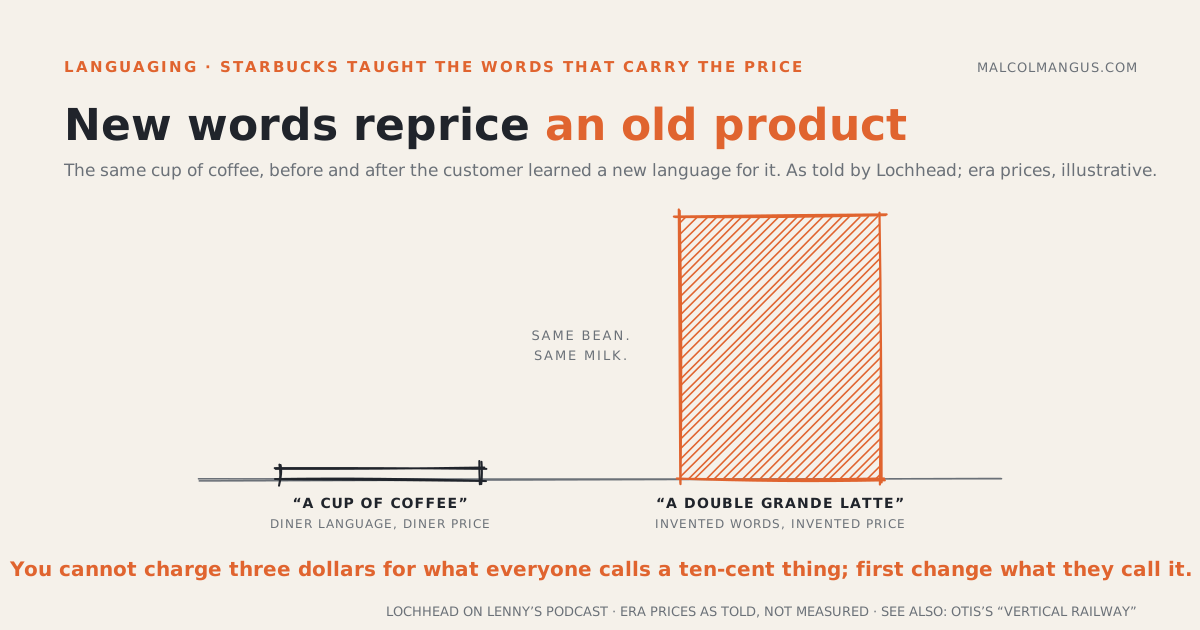
The doctrine's most practical tool is what Lochhead calls languaging, the strategic use of words to move value. Elisha Otis demonstrated a "safety elevator" to shrugs, because it answered a problem nobody had; the frame that worked was "the vertical railway," which let people see a new category of building. Starbucks could not charge three dollars for a ten-cent cup of coffee, so it taught customers a new vocabulary, and a double grande latte carries a price a cup of coffee never could. OpenAI seeded "large language model" and "training data" into the world's mouth, and the companies that write a category's language tend to own the category that speaks it.
The workshop adds the craft rules. Clear beats clever: a category name should evoke the problem and point at an action, not win an award. Do not trademark the category name, because the moment competitors adopt your language they are, in Lochhead's phrase, venmo-ing you their marketing budget: every dollar they spend saying "smart waste" or "inbound marketing" builds the category whose king you are. And the whole discipline fits on a sandwich board. Lochhead's favorite recent artifact is a farmers-market sign reading SHEEP YOGURT POPSICLES, $4 EACH, with an arrow, and no farm name anywhere: the category huge, the premium stated, the brand discovered only after the purchase, at eight times the average popsicle's price.
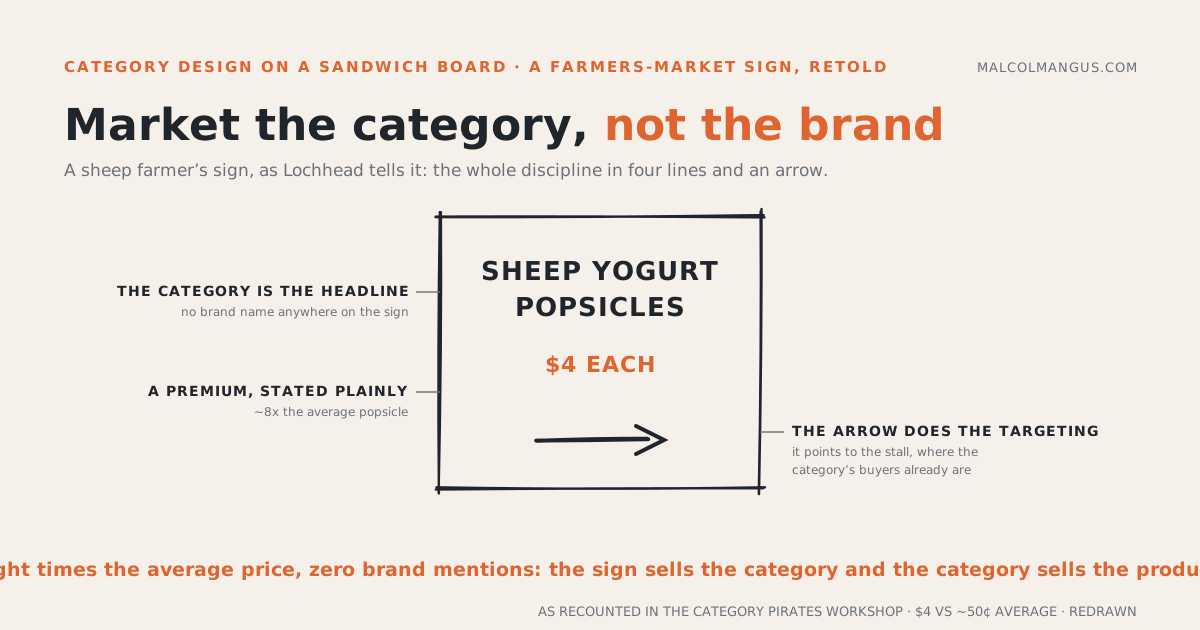
Put simply: language is the cheapest repositioning instrument that exists. New words create new mental shelf space, and the price a thing can carry is set by what the customer calls it, which is why the category's author should write the dictionary and give it away.
Compete with the status quo, not the rival
Category designers, in this telling, do compete, just never product against product. The enemy is the way things are. The exercise-bike lineage is the tidy case: spinning did not sell a better bicycle, it dammed road cycling's demand with "why risk your life?"; Peloton did not attack spinning studios, it dammed them with "why drive to the gym?" Netflix never claimed better shelves than Blockbuster; it made the trip itself the villain and the market moved. Lochhead's word for the mechanics is damming the demand, and his corollary is that new categories usually grow the whole pie rather than kill the old one, the way the electric guitar expanded music without retiring the acoustic, which is why he thinks "disrupt" teaches the wrong reflex: it keeps your reference point in the past.
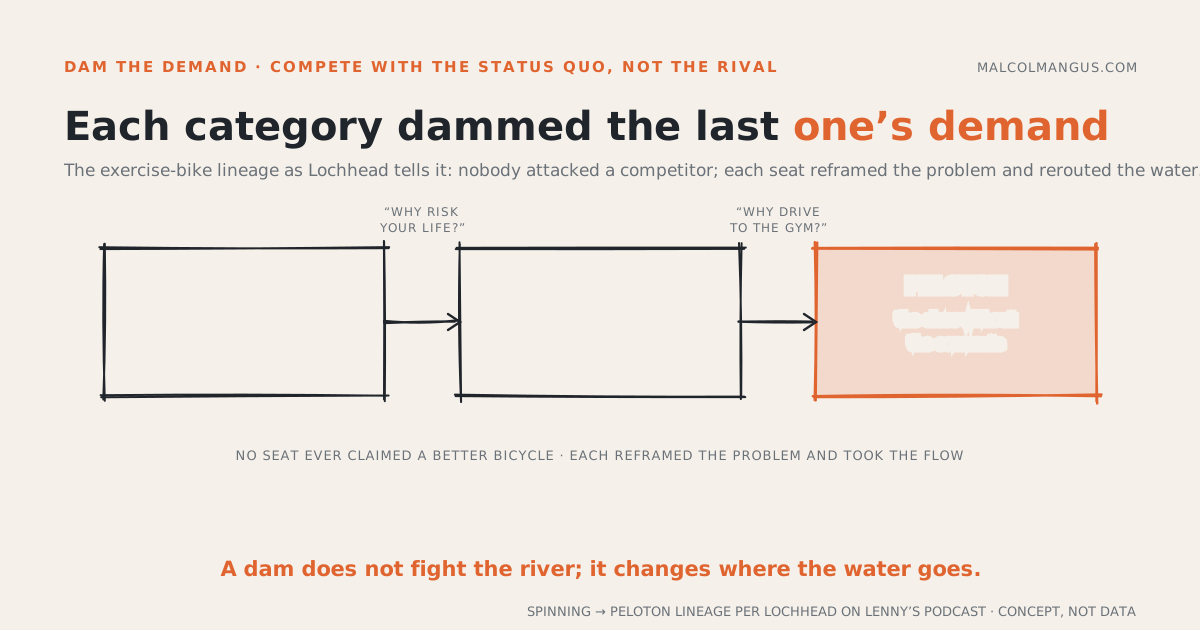
This is also where the doctrine gets spicy about the standard toolkit. Positioning, Lochhead says, has come to mean positioning against competitors, which concedes the frame before the first slide: it is, in his words, category design for cowards, a plan for winning the 24%. And the Gong-versus-Clari story carries the warning for winners: picking a tight niche early is exactly right, but a company that stays niched while a rival frames the bigger category wakes up boxed in, because your category is the ceiling on your company, and someone else just built the room.
The ceiling has a floor-side twin the firm's own blog names existential decline: the quiet drift that begins when the category you created stops creating demand. Their exhibit is DocuSign, king of an eSignature category that commoditized into a bundled feature by 2020, growth stalling while the original problem read as solved. The escape, in their telling, was another act of category design at age twenty-something: quantify a bigger villain, the "Agreement Trap," with a commissioned Deloitte study claiming 92% of organizations struggle to pull data out of their agreements and roughly $2 trillion of annual value lost, then declare a new category, Intelligent Agreement Management, in 2024. The firm reports 18% of revenue coming from the new category within a year and the stock up by half since the reframing, numbers to hold at case-study distance since the storyteller sells the surgery. The line worth keeping is theirs: kings only stay kings if they evolve the game.
Put simply: the competitor is the status quo, and the weapon is a reframed problem, not a feature list. Dam the demand, grow the pie, and keep redesigning your own category upward before somebody designs it around you.
The playbook, compressed
Strip the six sources to their working parts and the discipline is about five moves. A point of view that frames, names, and claims a problem, written in from-to form: from the way it is, to the different future, because backcasting from that future, in Mike Maples's framing, is what frees you from incremental thinking, and the workshop's version is to reject the premise entirely, like the design-school exercise of drawing a bicycle that cannot be ridden. A magic triangle kept in balance, because product design, company design, and category design are claimed as equally weighted, and most failures are triangle failures where a real product ships into an undesigned category. Superconsumers, the 8-to-10% of buyers who drive most of the profit and all of the zeitgeist, as the audience for everything. Lightning strikes instead of peanut butter: one or two Hollywood-style concentrated launches a year that make you undeniable to those supers for a week, rather than reach-and-frequency spread thin across four quarters. And word of mouth as the actual output, since a category point of view is precisely the sentence you equip other people to repeat.
The retail-tier sources earn their seat here: the brand agency's six steps and the designer's vision-advocacy-alignment triad are honest simplifications of the same machine, and their consistency across tellers a decade apart is itself evidence the framework compresses well.
Put simply: the execution loop is one sentence: teach a reframed problem to the few buyers everyone else copies, in concentrated strikes, in words designed to be repeated without you in the room.
The process, end to end
The sources gesture at a process; here is the whole machine assembled into one sequence, with the steps the canon supplies and two additions this post makes: an exit ramp at the front and measurement at the back.
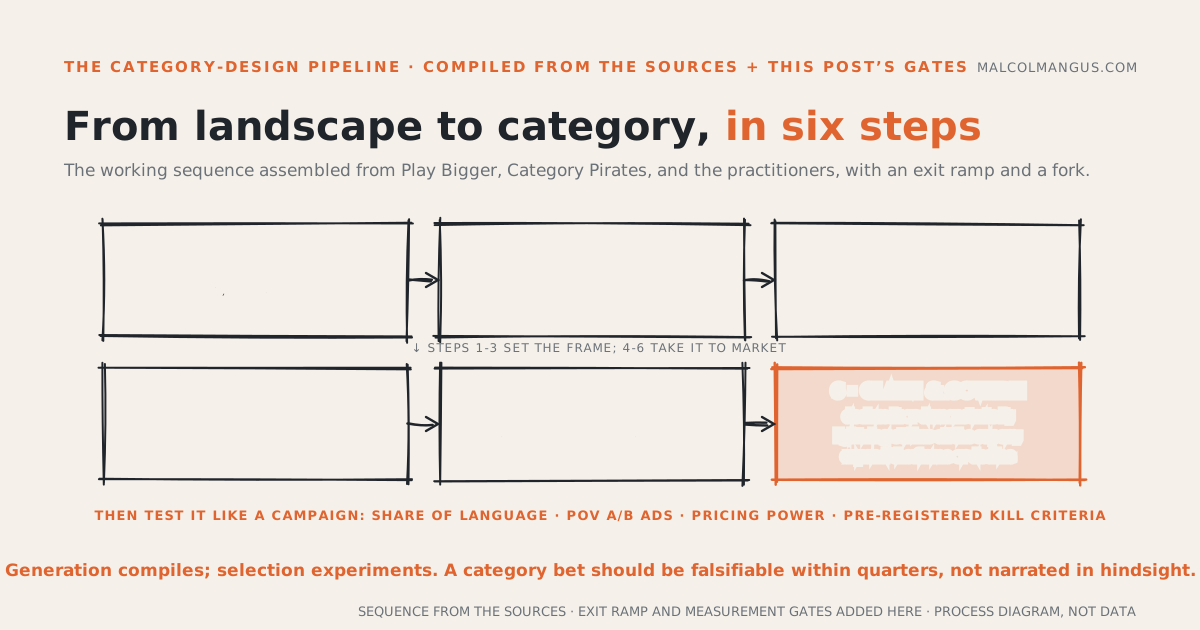
1. Diagnose, with an honest exit. You have a category problem if sales run on comparison, your own copy says better, buyers arrive with RFPs you did not shape, and price pressure is chronic; the cleanest commodity test is whether a customer would pass a nearer competitor to reach you. But the sources, all sellers of the discipline, never state the exit: if an existing category has healthy demand and you can hold a defensible, profitable niche of the 24%, riding it is a legitimate strategy and category design is expensive theater. Take the ramp deliberately or not at all.
2. Backcast before you interview anyone. Reject the premise that the future extends the present, write the won-category future as if standing in it, and work backwards, the Maples move. Doing discovery first quietly re-anchors you to the present, which is the exact error the whole discipline exists to avoid.
3. Excavate the problem from the supers. Interview the 8-to-10% of buyers who drive the profits and the zeitgeist, and collect their words verbatim. Then run the reframing operators the Gojo story teaches: solve it without X, at time Y, for person Z, at a different scale, before or after the job. Each operator generates a candidate problem; the filter is whether a super, hearing the reframe once, nods and retells it.
4. Write the point of view as a from-to with a quantified villain. Old world, named villain with a price tag on it, the why-now shift that makes it urgent, new world, and the new kind of thing, one page, written to be repeated by someone who is not you. DocuSign did not say fragmented agreements; it commissioned a study that priced the Agreement Trap.
5. Name the category by the rules. A noun phrase for the kind of thing, never the brand; one familiar anchor plus one new move; clear over clever; speakable customer to peer; untrademarked so competitors adopting it work for you; and in B2B, a name that promotes the person who buys it.
6. Claim it, then govern it. Choose declare or demonstrate: the Lochhead route names the category and campaigns it in lightning strikes aimed where the supers already gather, while the unbranded route, the Linear and Vercel pattern, lets an opinionated product teach the category without announcing it. Either way, publish the category's map before an analyst does. Then run the standing watches: expand the frame before a rival frames a bigger one over you, hold the category before diversifying out of it, and treat stalled category demand as the existential alarm it is.
And then measure it like a campaign, which is the part nobody in the canon practices. Share of language: do prospects, press, and competitors use your words back, unprompted? Reframe response: run the POV as paid creative against a feature-led control and let click-throughs falsify the framing before the roadmap bets on it. Pricing power: the category is working when the premium holds without comparison. Search shape: the category term should grow with your brand dominant inside it, not your brand term alone. And pre-register the kill criteria: decide in advance what two quarters of non-resonance looks like, because a framework that explains everything after the fact needs its falsifiability installed before.
One ceiling, stated plainly: these gates make a category bet testable, not the theory provable. Even a fully instrumented winner cannot separate the category design from the product underneath it, because the control-group company that skipped the category work does not exist. What the gates buy is the difference between conviction and evidence on a decision you were going to make anyway.
Put simply: compile the frame in six steps, then submit it to experiments with kill criteria instead of to your own enthusiasm. The sources supply the compiler; the discipline they skip is the measurement.
What survives the sales pitch
Read skeptically, the doctrine has a familiar weakness: it explains every outcome after the fact. Threads failed because the better trap; the Segway failed because nobody framed its problem; every success was a king. A framework that can absorb any result is a lens, not a law, and the 76% is a measurement of concentration wearing the costume of a recipe. That is the same standard I applied to the water-treatment operators, and category design's sellers, to their credit, are more charming about their incentives than most.
But the durable parts survive the discount. Concentration is real, so the choice between designing a field and applying for its leftovers is real too. Problem education genuinely precedes demand for genuinely new things, which every founder who has watched a "10x better" launch die already knows. Language demonstrably moves price and perception at near-zero cost, the most testable claim in the canon. Markets do get remade by reframing rather than by feature superiority often enough that "who is the status quo and what dams it" belongs in any strategy review, including the ones I run on companies here: Xometry is a category design story wearing a marketplace costume, a market maker that framed, named, and priced a category that could not organize itself. And the recursive proof remains the best one: four authors framed a problem called competing in existing markets, named a discipline, claimed it with a study, taught its language until strangers repeat it on YouTube a decade later, and now collect the premium on a category where they are, precisely as designed, the only choice. The sign works. The sign is the pitch. Sheep yogurt popsicles, four dollars, this way.

Malcolm Angus
I build 0 to 1 data products: I turn the data a company already has into a decision it wouldn't otherwise make, shipped end to end. I also write about how markets really work, moats, flywheels, and the loops that make companies harder to catch.

The charts in this essay are free to reuse with credit.