← All essays·September 20, 2026·13 min read
The $8,000 water softener is a sales process, not a product
Six YouTube videos, one market: an operator selling $2,699 whole-home water systems under the incumbents' $8,000 price umbrella, an industry veteran who says his own industry earned the distrust, and a salt-delivery annuity sitting on twenty million installed softeners. Aggregate show notes, with the operators' numbers drawn out and their incentives labeled.
Listen to this page
Six videos about residential water treatment crossed my feed telling one story from four different seats, and together they make a better market case study than any of them makes alone. Parker Jay Smith, a home-service operator in Raleigh, supplies three of them: why the market has almost no real competition, what his first month selling water systems looked like, and a step-by-step playbook for copying him. He then sits for a long interview on Chris Koerner's podcast where the real unit economics come out. From the other side of the counter, Richard Garcia, who has sold and serviced water softeners for seventeen years at Superior Water Softeners, spends a podcast hour on why his own industry deserves its reputation. And Connor Gross interviews Michael Jensen of EZsalt about the layer nobody glamorizes: delivering the salt those systems eat forever.
One disclosure before the notes, because it changes how much weight the numbers deserve. Every person on screen is selling a shovel. Smith runs a partner program that takes a stake in operators who copy his playbook. Koerner sells the episode back to you as a $19 business plan. Jensen sells the sensors his delivery model runs on and mentions a course. Garcia is positioning his company against the industry he critiques. Nothing below is audited; it is what practitioners chose to say in public, cross-checked against each other where possible. That triangulation is the value: when the raider and the incumbent describe the same market defect independently, the overlap is probably real.
A market with a missing middle
Smith's market thesis is structural. On one end sit mom-and-pop water shops, thirty or forty years old, surviving on word of mouth and repeat customers, with little or no web presence, no advertising, and a customer base aging out alongside them. On the other end sit the national brands homeowners can actually name: Culligan, Kinetico, EcoWater, charging $7,000 to $12,000 per system behind a sales process he walks through in detail. Between those two camps, in his telling, almost nobody runs paid advertising with a real price attached, quotes over the phone, and installs at a price an average homeowner can reach.
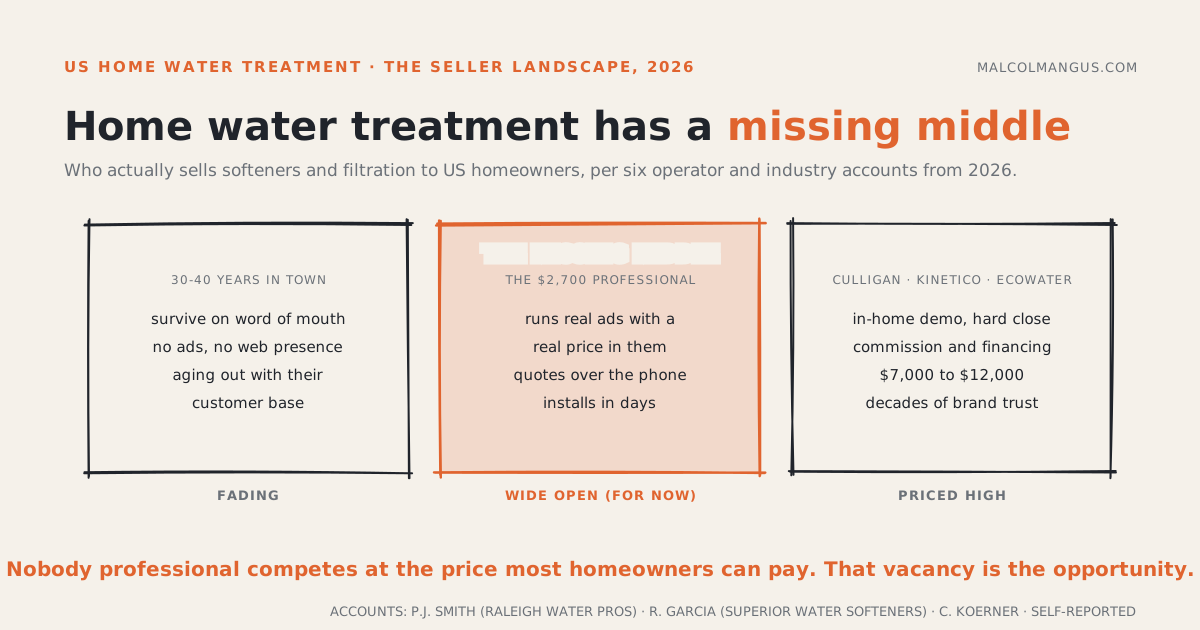
His analogy for what that does to demand is the best passage in the three videos: imagine the only car dealership in town is a Lamborghini dealership. You need a car, they quote $500,000, and you conclude that personal transportation is not for you and keep walking. Homeowners quoted $9,000 for clean water do not buy a cheaper system; they conclude clean water is a luxury and keep drinking what the tap gives them. The demand does not show up in any competitor's win rate, because the customer left the market. He prices at $2,699 installed and describes customers who cannot understand how his quote is a third of the one they already have in hand.
Put simply: the gap is not a better product at the same price, it is the same product at a price that re-admits everyone the incumbents priced out of the market entirely. The missing middle is full of customers who stopped shopping.
The price is a cost structure wearing a price tag
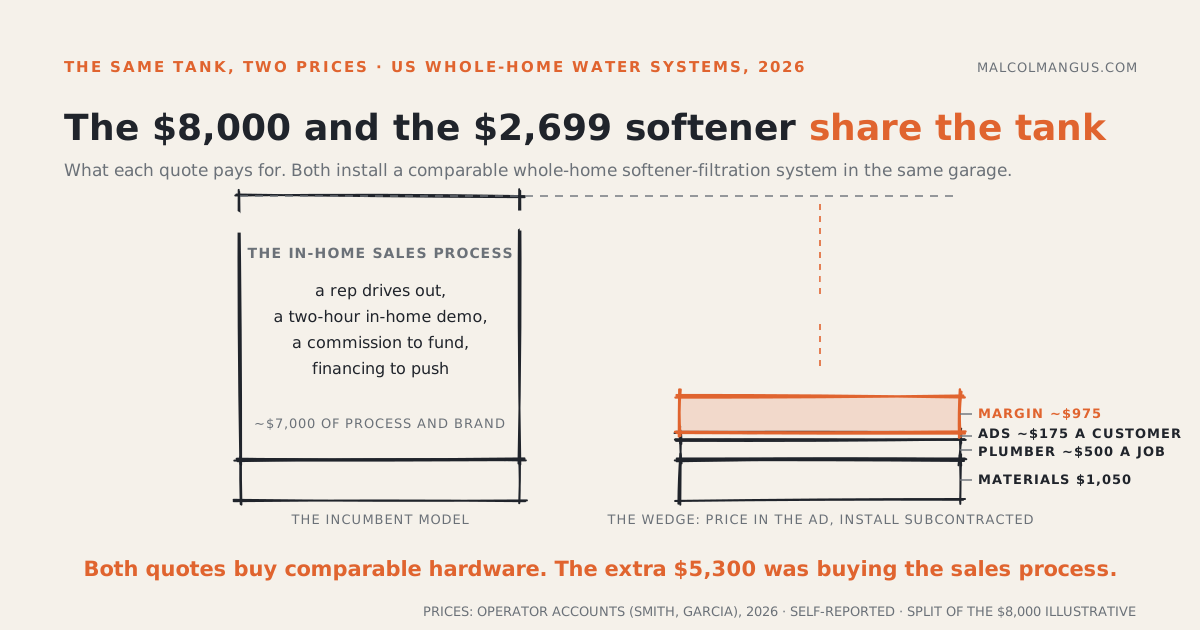
The mechanism behind the $8,000 quote is the part worth keeping, because it transfers to other industries. When a homeowner calls a big brand, a rep schedules an in-home visit, drives out, runs a water test, performs a demo that can last hours, and closes hard on the spot with manufactured urgency, pushing financing if the number lands badly. Every layer of that process costs money, and the price carries all of it: the truck roll, the two hours, the commission, the brand. Smith's model deletes the layers instead of competing under them. The price goes in the ad itself, a static image reading "$2,699 installed"; his first customer closed on $41 of ad spend. The in-home water test gets replaced by EWG's public tap-water database, which lets him read a customer their municipal water report on the phone and call the incumbent's test what he thinks it is, a sales gimmick. And the price anchoring is done for him by the competition: he describes it as opening a Chevy dealership next to a Ferrari dealership. More than a third of his buyers, he says, already had a competitor's in-home visit and a water test in hand before they ever saw his ad.
Garcia, arguing from inside the industry, lands on the same diagnosis with none of the arbitrage motive: he calls much of what his competitors sell 1950s technology at $8,000, and his sales advice to consumers is that if somebody is trying to sell you a water softener, run. Two people with opposite incentives agreeing that the price umbrella is process and brand, not product, is as close to verification as this genre gets.
Put simply: an administered price protects everyone who charges it and feeds anyone who undercuts it. The $8,000 was never the cost of clean water; it was the cost of the way clean water was sold.
The unit economics, in the operator's own numbers
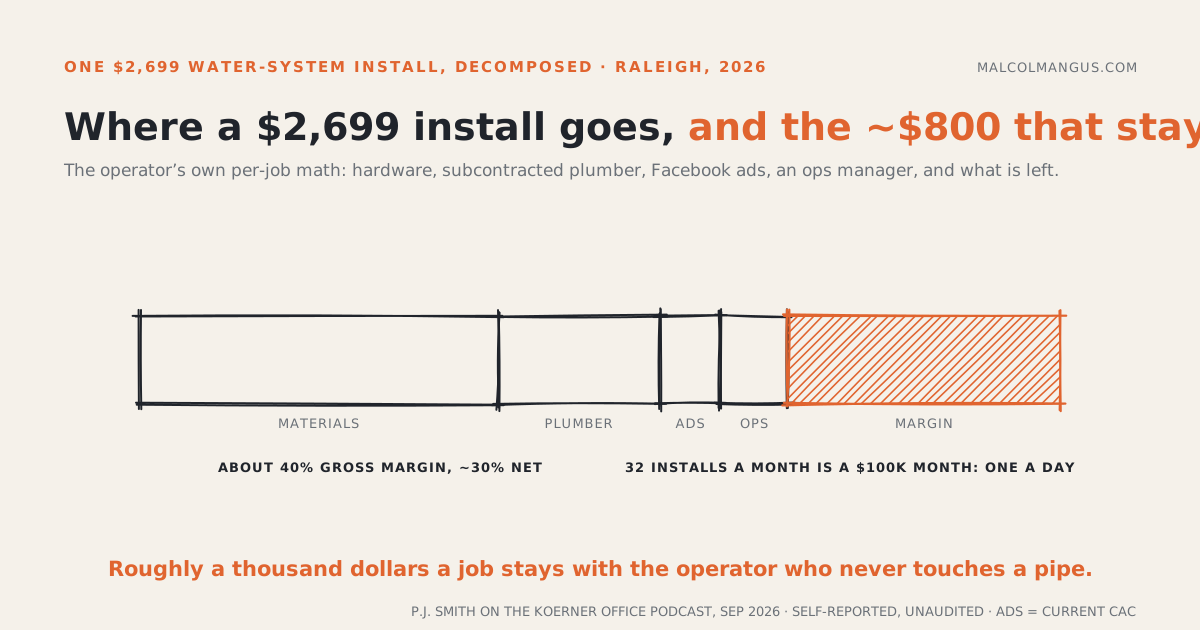
The Koerner interview is where the thumbnail claims get itemized, and the itemization is more credible than the thumbnails. Smith's flagship is a single 10x54 mixed-bed tank, resin and carbon, plus a reverse-osmosis drinking-water system under the sink, sold at $2,699 with tax and install included. Per job, by his telling: about $950 of core hardware, another $100 of fittings and miscellany, $450 to $650 to a licensed plumber who subcontracts the four-hour install, customer acquisition around $175 on Facebook leads at $30 to $40 each, and $200 flat to his operations manager per closed job, deliberately not a commission so nobody sells what a customer does not need. Call it $800 to $1,000 of margin per install, roughly 40% gross and about 30% net.
The trajectory he reports: launched June 8 after about $500 of setup on a website he built with Claude, a CRM, a scheduling tool, and a liability policy; roughly $15,000 installed in the partial first month; just under $50,000 in July; $81,000 in August, with $54,000 already booked for September and a $150,000 target. Worth noting against his own channel's headline, which says $60,000 in month one: that number is bookings and cash under contract, while the installed figure he gives Koerner for June is $15,000. Both can be true. Only one belongs in a thumbnail, and the fact that the itemized version is smaller is exactly why the itemized version is the one I trust more. The operational lessons he volunteers are the believable kind: he lost the entire second week of August to a stockout, waiting on freight while ads ran, and now deliberately overstocks a $125-a-month storage unit his plumbers open with their own smart-lock codes. Hiring took four days of a sponsored Indeed post to find three licensed plumbers who wanted steadier work; the first one has gone from maybe two jobs a week to nine.
Put simply: the model is a coordination business wearing a plumbing costume. The operator owns demand, inventory, and follow-up; the license, the truck, and the wrench belong to a subcontractor who is happier busy. About a thousand dollars a job accrues to whoever holds the customer relationship.
The sale is the follow-up
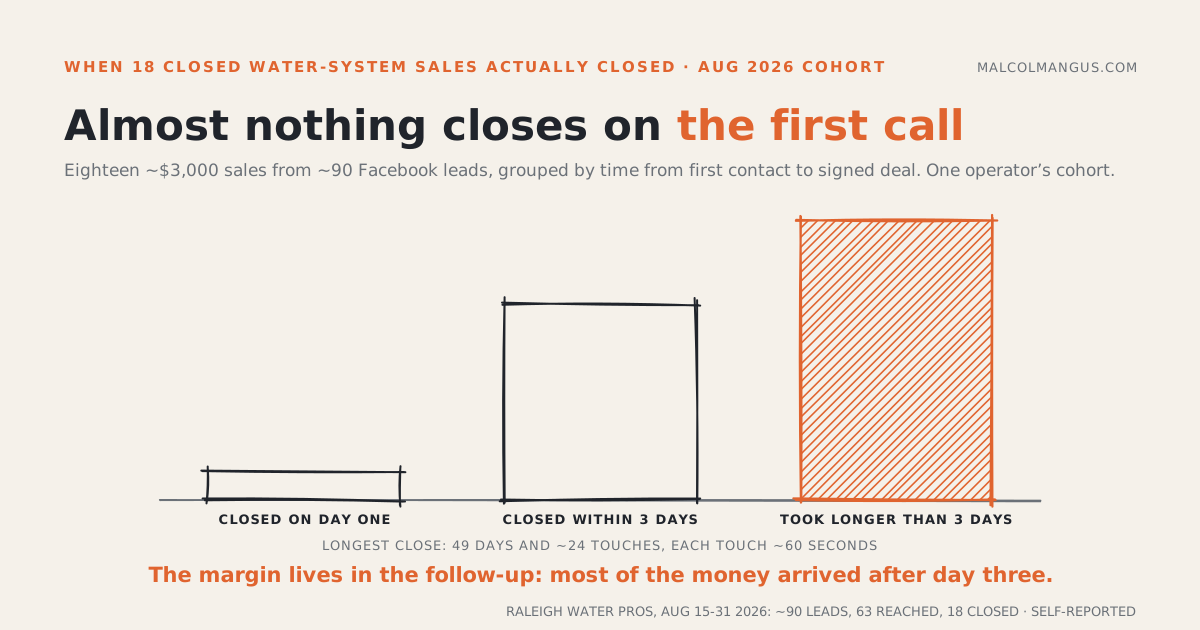
The most useful data in any of the six videos is a small cohort table Smith reads out from the second half of August: roughly 90 leads, about 70% ever reached by text or phone, 18 to 20 closed, a lead-to-sale rate around 25% at a $3,300 average ticket. Then the detail that reorganizes how you would staff this: exactly one of those closed sales signed on the day it came in. Seventeen needed multiple touches. Ten closed more than three days after first contact, and his longest close ran 49 days and roughly two dozen touchpoints. His rule is that a lead gets contacted within sixty seconds, by text first, and then never leaves the follow-up cycle until it says yes, no, or leave me alone. A non-answer costs sixty seconds; even the 49-day customer consumed maybe an hour of total labor for a thousand dollars of margin.
The same discipline runs downstream of the install: he describes himself as a maniac about Google reviews, trading salt drop-offs for them, and reports 52 five-star reviews in his first 80 days, enough to rank first for water filtration on his side of Raleigh. That, not the ad account, is the part a later entrant cannot copy quickly, and he knows it; his stated window before the niche gets crowded is about six months, which is also, conveniently, an excellent reason to buy his partner program today. Both things can be true at once.
Put simply: at a $3,000 ticket, persistence is the funnel. Nearly all the margin sits behind the second call, so the business is really a queue of sixty-second touches, and anyone who quits a lead at day three is donating it to whoever does not.
The incumbent who agrees with the raiders
Garcia's hour is the industry seen from inside, and it is bleaker about the industry than the outsiders are. He got in the way many customers do: quoted $8,000 at his own door, appalled, recruited into selling for a big brand, then out on his own when the systems he sold kept failing. His technical indictment, which I am reporting as his claim rather than settled science: most softeners collect dirt they were never designed to flush, the dirt hosts a biofilm that slowly chokes the valve head, and the industry ships 8% crosslink resin that dies in four to six years for a family of four when 10% resin, costing a few hundred dollars more, lasts six to twelve. The fix exists and mostly is not sold, he says, because it adds five to seven hundred dollars of cost per household that does not show up in a brochure.
What he built instead is the trust-side answer to the same market failure Smith attacks on price. He opens every presentation with his own seventeen-year-old failures, educates instead of pitches, and then, in his words, shuts up. His distribution is preferred-vendor relationships he calls castles: realtor offices like a Keller Williams branch that took him on after a chance Airbnb stay, corporate HR departments that let him present at employee discounts, and a veterans program that donates $250 per install to a vetted nonprofit. His recurring revenue is service plans that cap what a customer ever pays again, including a roughly half-price replacement when a system finally dies. It is slower, older, and heavier on relationships than Smith's Facebook engine, and it monetizes the exact same input: an industry that taught homeowners to distrust everyone who knocks.
Put simply: distrust is a market condition, and there are two businesses in it. Smith arbitrages it with a price in the ad; Garcia farms it with education and service plans. Both are answers to the same incumbent, and the incumbent built the condition itself.
The annuity on top: salt
The Gross and Jensen conversation adds the layer that makes the installed base interesting after the install. A softener eats salt forever, the bags weigh forty pounds, and the people who own softeners include plenty who should not be hauling them down basement stairs. Jensen's reference customer is an operator in Houston charging a flat $40 a month for white-glove service, sensor-monitored refills and annual filter changes included, with about 300 subscribers, which is $12,000 a month of recurring revenue for running a delivery route. The structural gift is that the incumbents want no part of it: a water-treatment company rolling a plumber's truck to deliver eight bags of salt spends something like $500 to collect $100, so, in Jensen's telling, they do it grudgingly as charity and will happily hand the whole chore to a partner. His suggested first move for anyone curious is to call every water-treatment company in the area and offer to take salt delivery off their hands, which is a customer list someone else spent decades assembling.
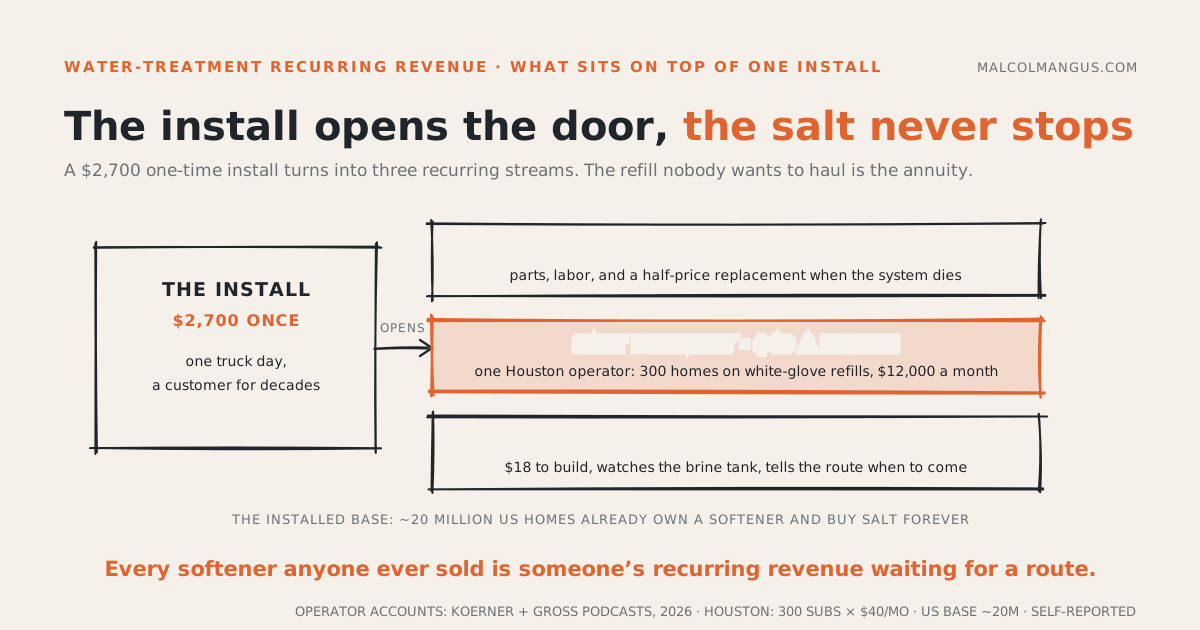
EZsalt itself is the picks-and-shovels business one level down: a laser sensor in the brine tank, about $18 landed cost, retailing near $80 and wholesaling in volume around $40 to $52 into the same water-softener companies that hate the delivery chore, with distribution deals up the chain. Twenty million US softeners is the number Jensen cites for the installed base, before Europe. And his best general-purpose line is not about salt at all: when you want to know what to sell next, stop theorizing in your bedroom and go talk to your customers. He built the product roadmap out of exactly that.
Put simply: every one-time install anyone has ever sold created a small forever-liability, and forever-liabilities are subscription businesses waiting for an operator. The unglamorous refill is where the durable margin hides, and the incumbents are actively trying to give it away.
What actually transfers
Smith says the quiet part himself near the end of the Koerner interview: the model has nothing to do with water filtration. Skilled trades are losing workers faster than they gain them, private equity has rolled up service brands, and the result is a set of administered prices that reflect who the five local providers happen to be rather than what anything costs. He offers main-panel electrical upgrades at $10,000 as the next example and Koerner reaches for the Bezos line, your margin is my opportunity. The template all six videos share: find a trade where the going rate is a cost structure wearing a price tag, put a real price in the ad, subcontract the licensed labor, answer leads in sixty seconds, and never stop following up. Then, once an installed base exists, sell it the refill.
The counterweights belong in the same paragraph. Every number here is self-reported by someone monetizing the telling, the $60K headline quietly becomes $15K of installed June revenue under Koerner's questioning, and Smith's own six-month-window claim doubles as urgency copy for his partner program. Garcia is the useful control: seventeen years in, no arbitrage to sell, and his picture of the industry, overpriced, undertrusted, and allergic to its own service obligations, is the one fact every seat in these six videos independently confirms. The umbrella is real. How long it stays open for any one operator in any one city is the number nobody on camera has an incentive to estimate honestly.
Fine market, honestly mapped. Bring your own skepticism about the weather under the umbrella.

Malcolm Angus
I build 0 to 1 data products: I turn the data a company already has into a decision it wouldn't otherwise make, shipped end to end. I also write about how markets really work, moats, flywheels, and the loops that make companies harder to catch.

The charts in this essay are free to reuse with credit.