← All essays·July 31, 2026·13 min read
Who actually makes money on your insurance
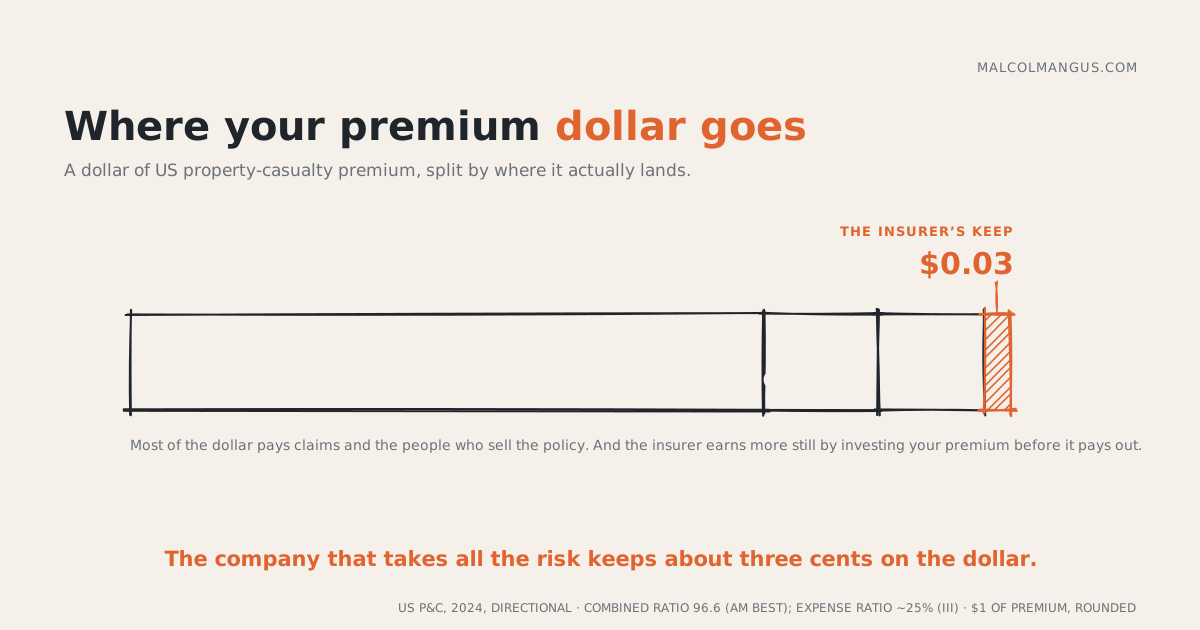
A dollar of premium mostly pays claims and the people who sell the policy. The company that takes all the risk keeps about three cents. The reliable money sits in the float, the broker's clean cut, and the capital markets that rent out catastrophe.
Listen to this page
You buy insurance to move a risk off your own shoulders. Someone has to pick it up, hold capital against it, and pay when the bad thing happens. So the intuitive story is that the company taking that risk must be the one making the money. It is the opposite of the truth. Follow a premium dollar the way I followed a $100 bottle of wine and a $100 room night, and the company that takes all the risk turns out to keep almost none of the dollar. The reliable money is somewhere else.
The premium dollar, decomposed
Take a dollar of US property-casualty premium and watch where it goes. Most of it, about seventy-two cents, is paid back out as claims and the cost of handling them. Another twenty-five cents or so covers expenses: the commissions to sell the policy, plus acquisition and administration. What is left, the insurer's actual underwriting profit, is about three cents. In a good year. In 2023 the industry ran an underwriting loss, paying out more than it took in, and was profitable only because of what it did with your premium in the meantime.
That ratio has a name: the combined ratio, the loss ratio plus the expense ratio. Below 100 the insurer made an underwriting profit; above 100 it lost money on the insurance itself. The whole US industry ran about 96.6 in 2024, its best year in over a decade, and it still only kept about three cents on the dollar. This is a business that takes enormous risk to earn a rounding error.
Put simply: The party that carries the risk in a transaction is not automatically the party that keeps the money. Before you assume the risk-taker is the winner, decompose the dollar and see how thin its slice actually is.
The real money is the float, not the underwriting
So how does an insurer make a real return on three cents of margin? It does not. It makes money on the money. Premiums come in before claims are paid out, sometimes years before, and in the meantime the insurer gets to invest the pile. That pile is called the float, and it is the actual engine. In 2024 the US industry earned roughly eighty-five billion dollars of investment income, close to four times its entire underwriting profit. The insurance is almost a pretext for getting to hold and invest your money.
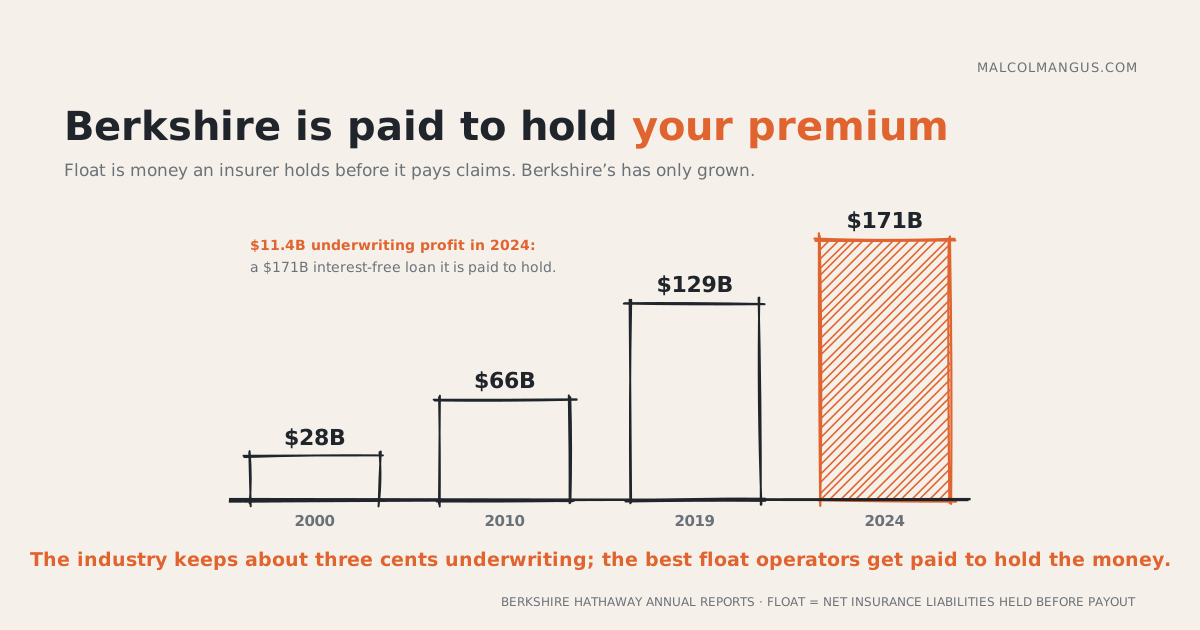
Nobody understood this earlier or exploited it harder than Warren Buffett. Berkshire holds about $171 billion of float, and because its insurers run at an underwriting profit, that float costs less than nothing: Berkshire is effectively paid to borrow a $171 billion interest-free loan and invest it. It is the same trick as an airline's unredeemed miles, just the largest and purest version: hold other people's money, and earn on it before you owe it back.
Put simply: When a business collects cash long before it owes anything, the money it holds can be worth more than its stated product. Ask what a company gets to do with your money between when you pay and when it pays you.
The broker takes none of the risk and keeps the best cut
Now look at the party that took no risk at all. A broker or agent sells you the policy, collects a commission, and walks away before a single claim is filed. No reserves, no catastrophe exposure, no capital to hold. That is a wonderful business, and the stock market knows it. The big brokers run operating margins around thirty percent with none of the balance-sheet risk, and investors pay them roughly twice the earnings multiple they pay the carriers whose risk they place.
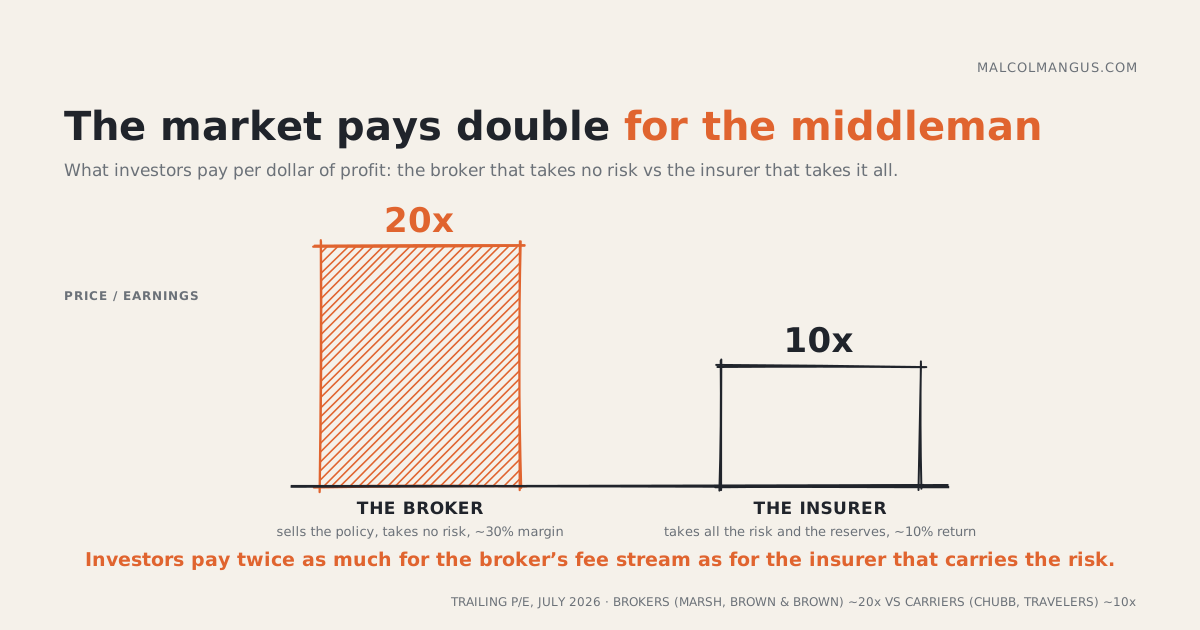
This is the same asset-light move the hotel brands made when they franchised the buildings and kept the fees, and the same one the wine distributor makes sitting in the middle of the chain. The person who arranges the risk transfer, and holds none of the risk, gets the cleaner and steadier margin. The market's own verdict is that the middleman is worth double the risk-taker.
Put simply: In any risk-transfer chain, find who carries the risk and who only arranges it. The arranger, capital-light and fee-based, usually has the better business, and the market will pay up for it.
Which corners actually make money
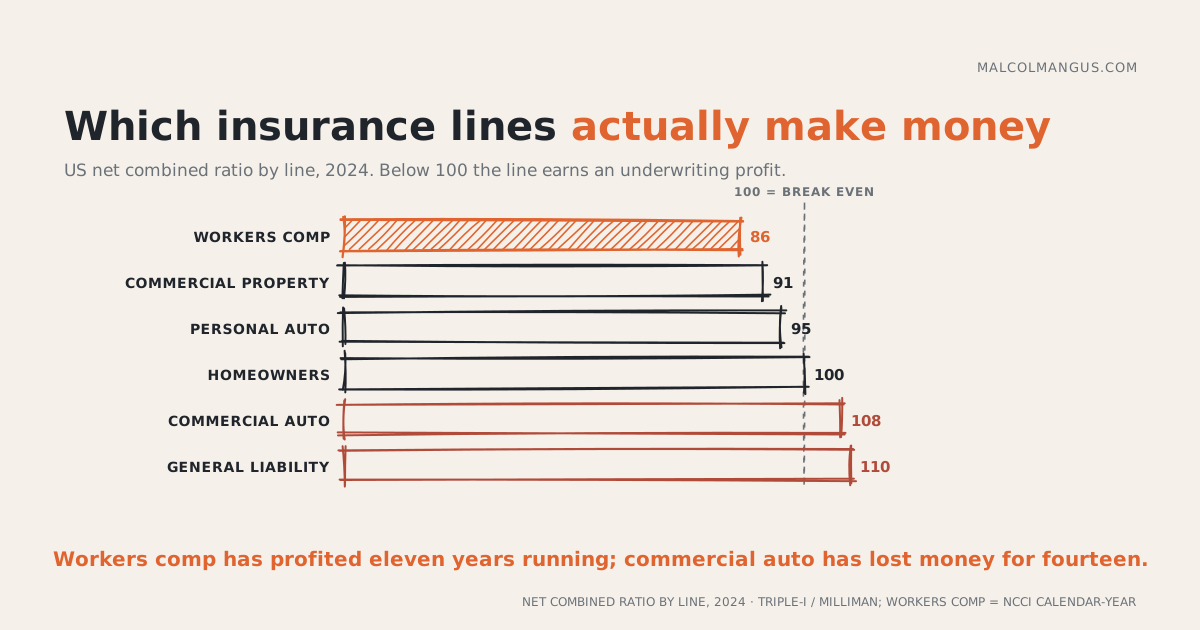
"The insurer keeps three cents" is an industry average, and averages hide the real story. Some lines of insurance are quietly excellent and some are structurally doomed, and the difference is not size but how predictable the losses are. Workers compensation has earned an underwriting profit eleven years running, because workplace injuries keep getting less frequent and prices stay ahead of claims. Commercial auto has lost money for fourteen straight years, because jury verdicts inflate faster than any rate increase regulators will allow.
The most profitable corners are stranger still: they are the ones that barely pay claims at all. Title insurance pays out about five cents of every premium dollar in claims; the rest is a fee for a records search, wrapped in a thin insurance shell. Force-placed insurance, surety bonds, extended warranties: the pattern is that the best insurance businesses are the ones where the loss ratio is tiny and the premium is mostly a fee, or where someone else, like the federal crop program, quietly absorbs the tail.
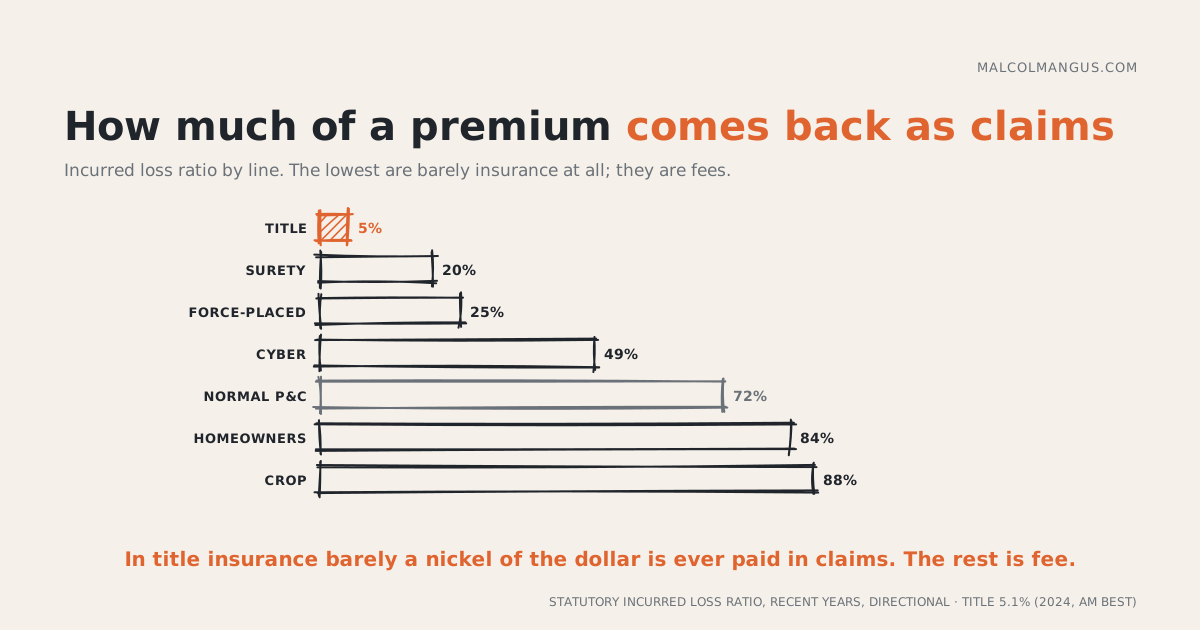
Put simply: Profit in insurance tracks the predictability of the loss, not the size of the market. The best corners are the ones where you barely pay claims, or where someone else eats the catastrophe. Look for who is really carrying the tail.
The risk climbs a tower
The insurer does not actually hold all the risk it sells you either. It keeps the small, frequent losses and hands the rare, giant ones up a tower. It buys reinsurance to cover the big year; the reinsurer buys retrocession to cover its own big year; and the very top of the tower, the once-in-a-generation catastrophe, increasingly gets sold to the capital markets. Each layer takes a smaller, rarer slice of loss for a slice of the premium.
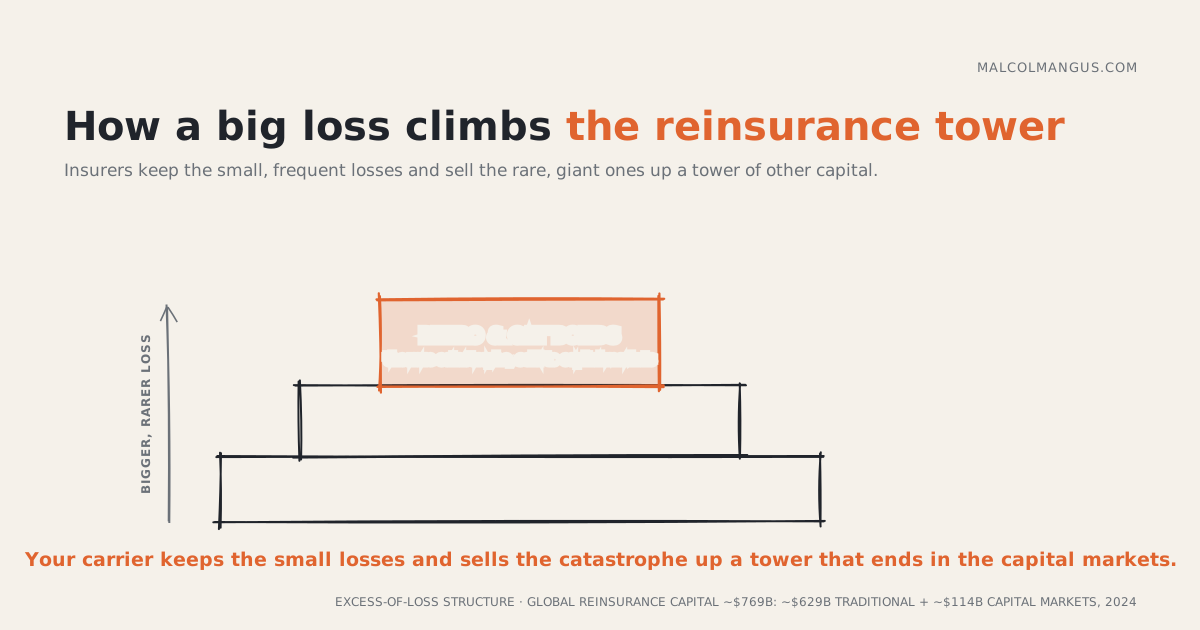
This is how a single hurricane can be paid for by a Swiss reinsurer, a Bermuda retrocessionaire, and a Dutch pension fund at once. It also has a dark history: in the 1980s, London syndicates reinsured each other in a loop until a single loss circled the market many times over, and the resulting spiral nearly destroyed Lloyd's. Risk that looks diversified is sometimes the same risk, passed around a small room.
Put simply: The company that sold you the policy is rarely the one holding your worst-case loss. Follow the risk up the tower to find who actually pays when the catastrophe comes, and whether it is really spread or just circling.
Reinsurers make their money right after the catastrophe
Reinsurance is where the real risk-takers sit, and their profits run in a brutal cycle. When a big catastrophe wipes out capital, prices spike, because capacity is suddenly scarce. When Hurricane Ian hit in 2022, global property-catastrophe reinsurance rates jumped about twenty-seven percent at the following renewal, the hardest market in a generation. Then the high returns pull new capital in, and within two years the same prices are falling.
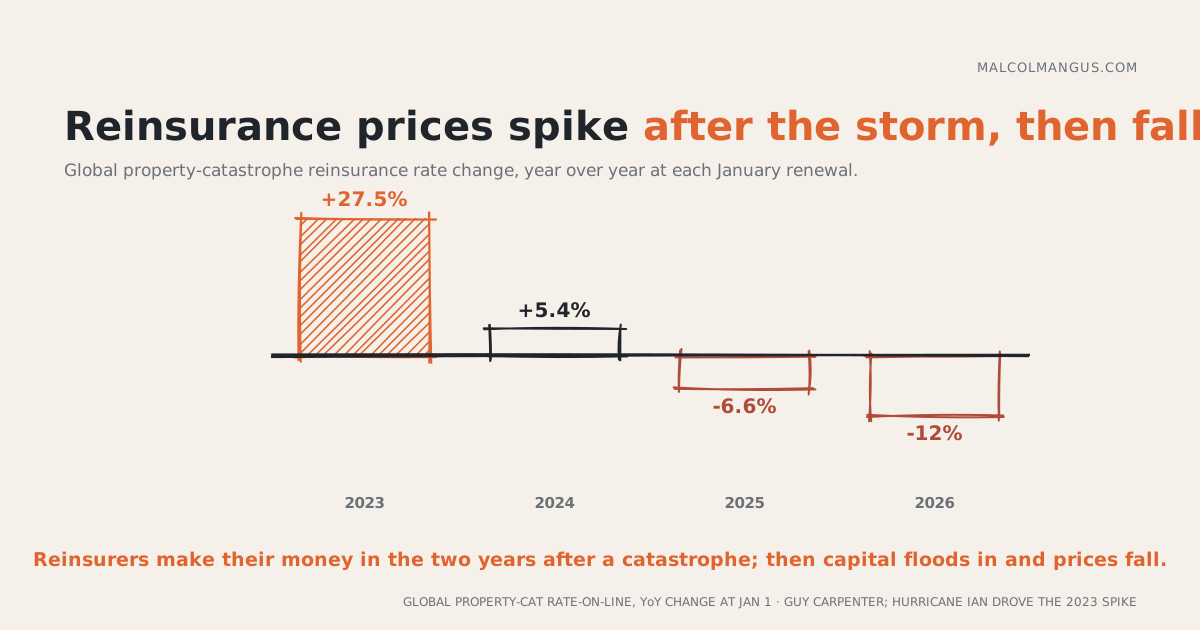
So a reinsurer's fortune is timing. The best returns come in the eighteen months after a disaster, when everyone else is licking their wounds and the survivors can name their price. By the time the memory fades and the capital returns, the edge is gone. It is the closest thing in finance to a business that is paid for other people's short memories.
Put simply: In a cyclical, capital-driven market, the money is made right after the shock, when supply is scarce and prices spike. The steady-state price is competed away; the abnormal profit lives in the window before capital returns.
The capital markets are renting out the catastrophe
The newest players in the tower are not insurers at all. A catastrophe bond lets a pension fund take hurricane risk directly: it puts up collateral, collects a fat coupon, and loses its principal only if a defined disaster strikes. The appeal is that a hurricane does not care what the stock market did, so the returns are uncorrelated with everything else the fund owns. And the returns have been remarkable: cat bonds paid investors about twenty percent in 2023 and seventeen in 2024, against a normal year of five to eight.
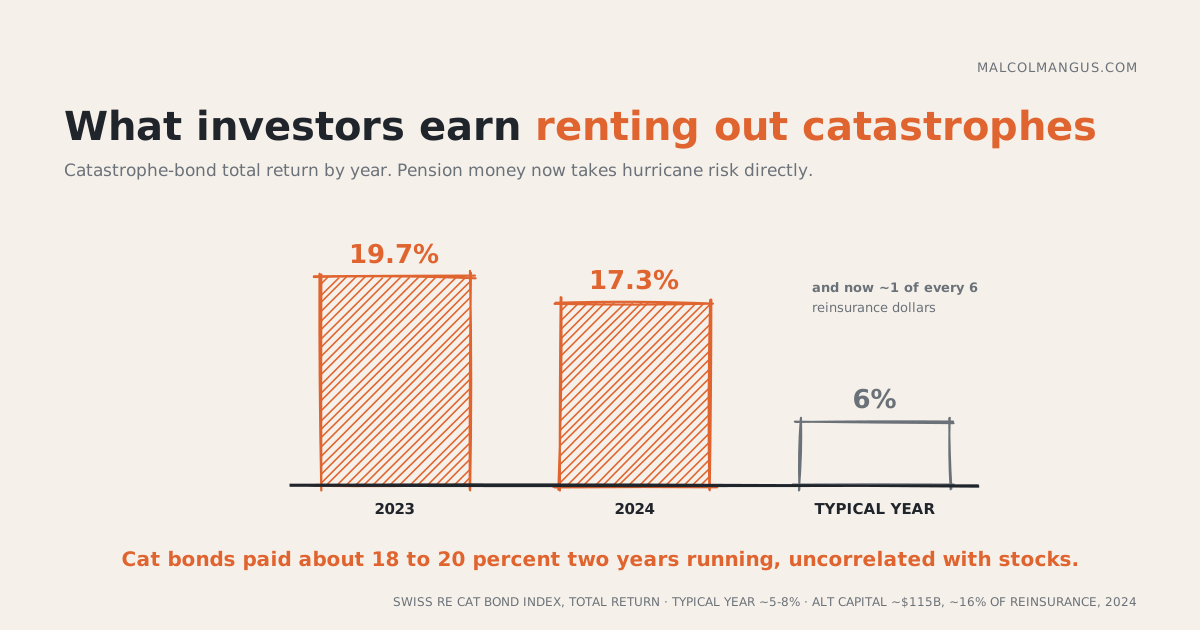
That performance has pulled real money in. Alternative capital, mostly pension and institutional money, is now about one in every six dollars of reinsurance capital, and it was the main source of new capacity in 2024. The end of the tower, the rarest and largest losses, is quietly being disintermediated by people who never wanted to be insurers, just investors looking for a return that has nothing to do with the economy.
Put simply: When a risk can be packaged into a security with uncorrelated returns, capital markets will come for it and price it more efficiently than a balance sheet can. Watch for the layer of any business that is being turned into a tradable instrument.
The newest players are betting they can widen the three cents
Everything so far says the money is at the edges, not in bearing the risk. A wave of AI-native carriers is making a different bet: that the thin center can be made to pay, if you go after the twenty-five cents of expense instead of the seventy-two cents of claims. The clearest example is Corgi, a full-stack, AI-native insurance carrier built for startups, which has raised about $378 million and reached a roughly $2.6 billion valuation in 2026, and says it is already profitable.
Look at where that bet lands on the premium dollar. The seventy-two cents of claims is the actual risk, and no model makes a hurricane cheaper. The twenty-five cents of expense is another story. Corgi's playbook is to embed the insurance directly into the software its customers already use, which removes the broker and the commission that comes with it, and to run underwriting and claims on automation rather than headcount, which chips at the overhead. It even launched its own AI-assisted claims operation to handle the back end. None of it touches the claims; all of it targets the expense around them.
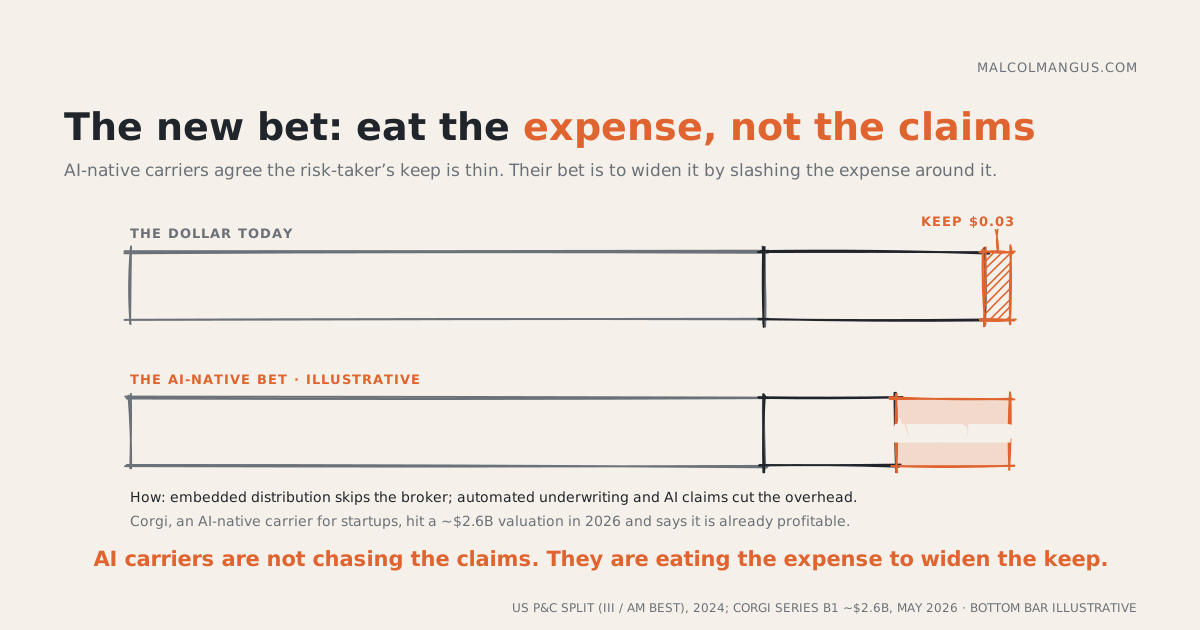
Read cynically, this does not refute the essay; it confirms it. The AI-native carriers agree the risk-bearing center is thin. They are just running the broker's move from inside the carrier: take the cost out of arranging and administering the policy, and keep the difference. And it is still a bet. A $2.6 billion valuation is investors pricing the possibility of a fatter keep, not a realized one. The three cents stays three cents until the expense ratio actually falls and holds through a bad claims year, when the seventy-two cents you cannot automate away comes due all at once.
Put simply: When your core is a thin-margin commodity, the frontier move is to attack the cost stack around it with automation, not the commodity itself. But a valuation is a bet on the expense ratio, not proof of it; judge it after the first bad year, when the risk you could not automate shows up.
What an operator can steal from this
You do not run an insurer. Here is the transferable part. Insurance looks like a business about bearing risk, and it turns out the risk-bearing is the thin-margin commodity at the center; the money is at the edges, in the float, the fee, and the securitized tail. The players who win are the ones who found a way to touch the premium without owning the worst-case loss: the broker who arranges it, the investor who holds float, the fund that rents out the catastrophe for a coupon.
So when you look at your own business, do not assume the money is where the obvious risk and effort are. Ask who holds the cash between the sale and the delivery, who takes a clean fee for arranging the transaction, and which slice of your risk could be sold to someone who prices it better than you do. The insurer that takes all the risk keeps three cents. Everyone who figured out how to stand next to that dollar without carrying the risk keeps more.
Put simply: Do not confuse the party doing the scary, capital-intensive thing for the party making the money. In insurance the risk-taker keeps three cents; the float, the fee, and the securitized tail keep the rest. Find your equivalents.

Malcolm Angus
I build 0 to 1 data products: I turn the data a company already has into a decision it wouldn't otherwise make, shipped end to end. I also write about how markets really work, moats, flywheels, and the loops that make companies harder to catch.

The charts in this essay are free to reuse with credit.