← All essays·July 21, 2026·20 min read
Who makes money on AI?
Four companies spent over $400 billion building AI infrastructure in 2025, and the two most valuable AI startups on earth lost money selling what it produces. I mapped the margins from the sand to the seat: the toolmaker at 35%, the foundry walking its gross margin to 68%, the chip designer at 56% net, and everything below the chip financed by the layer above it. The pool is real. It is just not where the spending is.
In 2025, Microsoft, Alphabet, Amazon, and Meta put more than $400 billion of capital expenditure into the ground, most of it for AI, and their 2026 guidance stitches together to roughly $700 billion more. In the same year, the company whose product all of that concrete and silicon exists to serve reported $13.1 billion of revenue against a $20.9 billion operating loss, per its leaked audited financials. A buildout running at hundreds of billions of dollars a year is being paid for at one end of a chain and lost, on paper, at the other.
So who makes money on AI? I traced the margins from the sand to the seat, the same way I traced the egg dollar and the rest of my profit pools series, using fiscal 2025 and 2026 disclosures wherever a real one exists and labeled reporting where one does not. The map that came back has something none of my other chains have: a cliff, right in the middle, so clean that the map needs two charts.
The map: a cliff in the middle of the chain
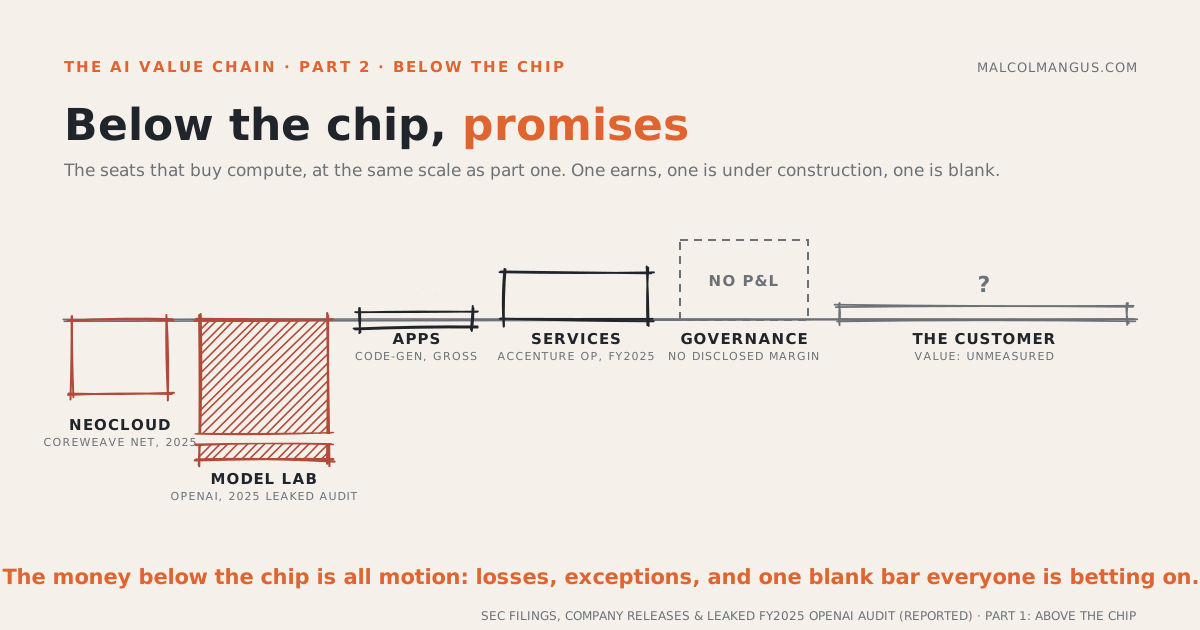
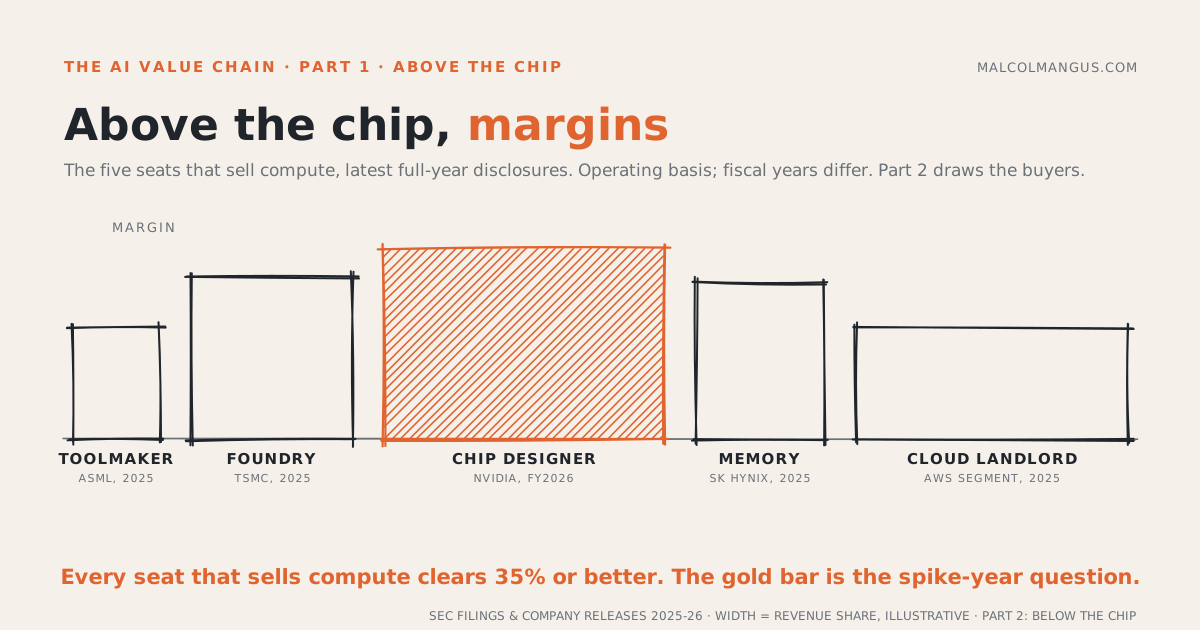
Every seat in the first chart sells something scarce: lithography, wafers, accelerators, memory, or rented racks. Every seat in the second buys that scarcity and resells it, marked down, as intelligence. The sellers run operating margins between 35% and 60%. The buyers run from minus 23% to minus 160%, and the final seat, the enterprise customer, does not yet have a number at all. One bar in the second chart earns anyway, and it is the exception that proves the mechanism; another is drawn in dashes because it has no numbers to plot yet. Both get their own sections below.
A profit pool map is supposed to show you where the money settles. This one shows the money flowing through three loss-making layers, and one unmeasured one, on its way back up to five profitable ones.
Put simply: In this chain, margin is a function of altitude. Before you build anything on AI, know which side of the chip line your business model sits on, because the side that buys compute is collectively subsidizing the side that sells it.
Above the cliff: sell shovels, own the toll road
The most protected seat in the chain belongs to ASML, the Dutch lithography maker, and it is the same seat the egg essay found at Hartmann, the carton maker: picks and shovels, twice over. ASML is, in its own audited words, the world's only manufacturer of extreme ultraviolet lithography systems, the machines every advanced AI chip depends on. In 2025 it did €32.7 billion in sales at a 52.8% gross margin and about a 35% operating margin, and €8.2 billion of that revenue was service and field options: the recurring annuity on machines it already sold. In July it raised its 2026 outlook from €34-39 billion to €43-45 billion, and raised its margin guidance at the same time. The toll booth repriced upward in the middle of the boom without taking on any of the boom's risk.
TSMC, the foundry that fabricates nearly every advanced AI chip, shows what the toll looks like when it compounds. Its gross margin walked from 59.9% for full-year 2025 to 62.3% in the December quarter to 67.7% in the quarter ended June 2026, with operating margin crossing 60%, per its filings. High-performance computing went from 43% of its revenue in 2023 to 58% in 2025. Price increases on advanced nodes have been reported by trade press at 3 to 10% for 2026; the margin walk is the harder evidence, and it says the foundry can reprice at will.
And then there is the seat everyone stares at. NVIDIA's fiscal 2026, which ended in January 2026, came in at $215.9 billion of revenue, up 65%, with a 71.1% gross margin and $120.1 billion of net income, a 55.6% net margin. Data center is about 90% of the company. The quarter ended April 2026 ran $81.6 billion, up another 85% year over year, with guidance assuming zero data center compute revenue from China. One company, at one link in the chain, is collecting a margin that history says belongs to a spike year.
Put simply: The durable seats above the cliff monetize the machines and the fab, not the boom. If your customers are all losing money and your margin is at a record, the strategic question is not how to grow; it is which number moves first.
The pendulum precedent
Is NVIDIA's margin a pool or a pause? The chain already contains the answer, one seat over, because the memory business has run this experiment for forty years.
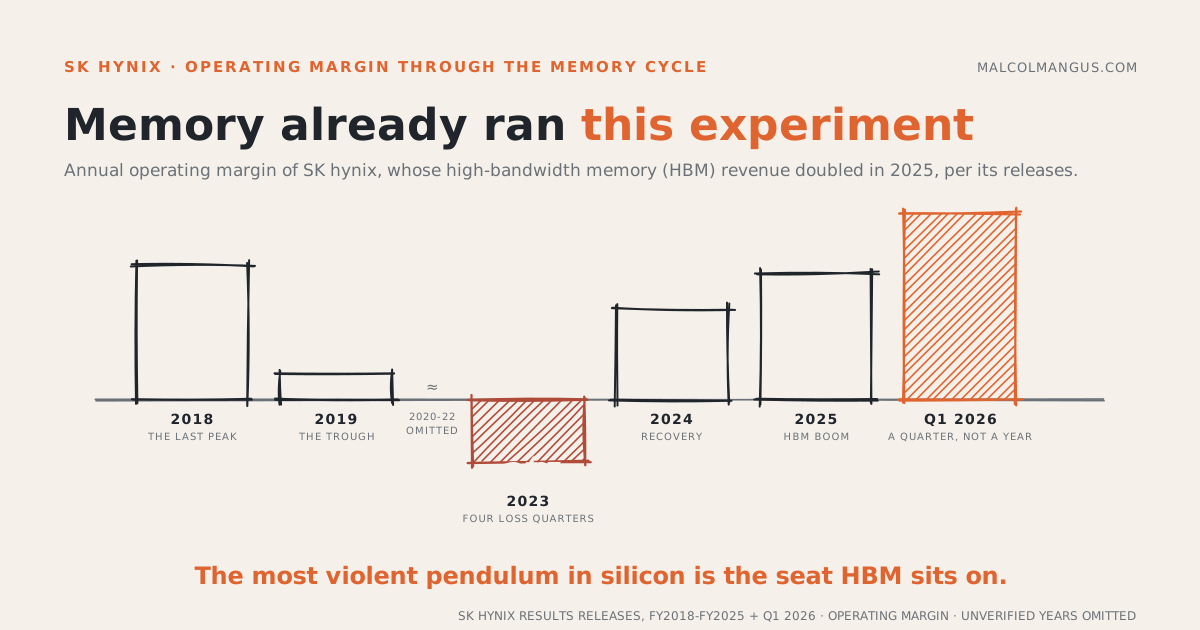
SK hynix, the Korean memory maker, posted a 52% operating margin in 2018, 10% in 2019, and a minus 24% operating margin in 2023 after four straight loss-making quarters. Then AI demand hit the same commodity: 49% for 2025, with high-bandwidth memory revenue more than doubling, and a 72% operating margin in the first quarter of 2026. That is not a different industry from eggs. That is the same pendulum with a fab attached: the swing from 52% to minus 24% and back to 72% is what a scarcity-priced commodity does, every cycle, to whoever owns the capacity.
The challengers are already at the door of the gold bar. Broadcom's custom AI silicon, the chips Google and others design to replace the general-purpose GPU, grew 143% year over year to $10.8 billion in its May 2026 quarter, with $16 billion guided for the next one. Amazon's CEO says its Trainium chips passed a $20 billion annual run rate with $225 billion in commitments, figures worth reading as company statements rather than audited segments, but not as zero. AMD signed a six-gigawatt deal with OpenAI. None of this has dented the 75% gross margin yet. The memory chart is what "yet" looks like on a long enough axis.
Put simply: A record margin on a cyclical commodity is a timestamp, not a property of the business. Underwrite the seat, not the spike: ask what the margin was the last time supply caught demand, because that number is coming back.
Below the cliff: the contract farmer
The first seat on the wrong side of the line is the neocloud, the new class of cloud built to rent out GPUs and nothing else, and CoreWeave is its public exhibit. The shape of its business, per its SEC filings: $5.1 billion of 2025 revenue, up 168%, against a $1.2 billion net loss. Total debt nearly tripled in a year to $21.4 billion, then reached $24.9 billion by March 2026. Microsoft alone was 67% of its 2025 revenue. In the first quarter of 2026 it spent $7.7 billion on equipment, most of a year's worth of its own 2025 capex, in ninety days. Its backlog reads spectacularly, $99.4 billion of committed contracts, and that is exactly the egg contract farmer's deal: the barn debt is yours, the flock is committed to somebody else's brand, and the fee is fixed while the asset depreciates. The stock has round-tripped from a $40 IPO to $183.58 in June 2025 to the mid $70s.
How fast the asset depreciates is now a half-trillion-dollar accounting question, and 2025 produced a perfect controlled experiment. Meta extended the useful life of most of its servers to 5.5 years and booked $2.92 billion less depreciation, which added $2.59 billion to net income, per its 10-K. Amazon went the other way in the same year, shortening server lives from six years to five, explicitly citing "the increased pace of technology development, particularly in the area of artificial intelligence," and ate a $1 billion hit to net income for it. Michael Burry's much-covered claim that extended lives will understate industry depreciation by $176 billion through 2028 is an investor's estimate, not a measurement; the two audited entries above are measurements, and they point in opposite directions on the same year's books.
The hyperscaler cloud itself, notably, stays above the line. AWS ran a 35% disclosed operating margin on $128.7 billion in 2025; Google Cloud's margin walked from 14% to 24% in two years. Renting compute is a fine business. Renting it with somebody else's balance sheet and one customer is not the same business, whatever the pitch deck says.
And the datacenter itself, the thing all that capex actually buys? Its operators are already on the map: the cloud landlord and the neocloud are the same building run on two different balance sheets, one funded from cash flow and one from debt. The building's suppliers collect either way. Vertiv, which sells the power and cooling systems inside, ran a 20.4% adjusted operating margin in 2025, per its results, and guided to roughly $13.5 billion of 2026 sales; the International Energy Agency projects datacenter electricity demand roughly doubling to about 945 terawatt hours by 2030, around Japan's entire consumption, a projection worth labeling as one. The shell, the switchgear, and the substation are the boom's quietest toll booths: paid on construction, not on whether the models inside ever earn their keep.
Put simply: A backlog is not a moat; it is a mortgage with better branding. When you evaluate an infrastructure partner or an infrastructure business, price the debt, the customer concentration, and the depreciation schedule before you price the growth.
The brands that print growth, not money
The model labs are the premium brands of this chain, and like the egg essay's premium brand, they escaped the commodity by absorbing its volatility. The leaked OpenAI audit, first published by Ed Zitron and corroborated by the Financial Times and Fortune, shows 2025 revenue of $13.07 billion against $34 billion of costs: a $20.9 billion operating loss. You will see a $38.5 billion net loss circulating; most of that is a one-time, non-cash charge from the for-profit conversion, and quoting it as burn is how numbers get laundered. The operating loss is bad enough on its own. Growth, meanwhile, is real and violent: from a $6 billion run rate in 2024 to over $20 billion exiting 2025, per its CFO, to a reported $25 billion by February 2026, with 900 million weekly users and an initial public offering confidentially filed at a reported trillion-dollar target.
Anthropic tells the same story steeper. Company-stated run-rate revenue went from about $9 billion at the end of 2025 to $14 billion in February to past $47 billion in May 2026, with roughly 80% of it from enterprises, and Claude Code alone above a $2.5 billion run rate. Two caveats belong next to those numbers, and the essay keeps its own rules: a run rate is the most recent month multiplied by twelve, not a fiscal year, and The Information reported that Anthropic cut its projected 2025 gross margin to 40% on higher-than-expected inference costs, reported and not disclosed. The premium brand grows tenfold and still hands nearly half its ticket back to the layer above the cliff. Vital Farms held a 38% gross margin through the egg cycle; the AI premium brands would recognize that constraint immediately, because compute is their feed cost.
Put simply: Revenue growth tells you the product works; gross margin tells you who it works for. When a vendor quotes you a run rate, ask what month it annualizes and what their compute bill did that same month.
The financing web
None of the losses below the cliff would be possible at this scale without the most distinctive structure in the whole chain: the sellers are financing the buyers.
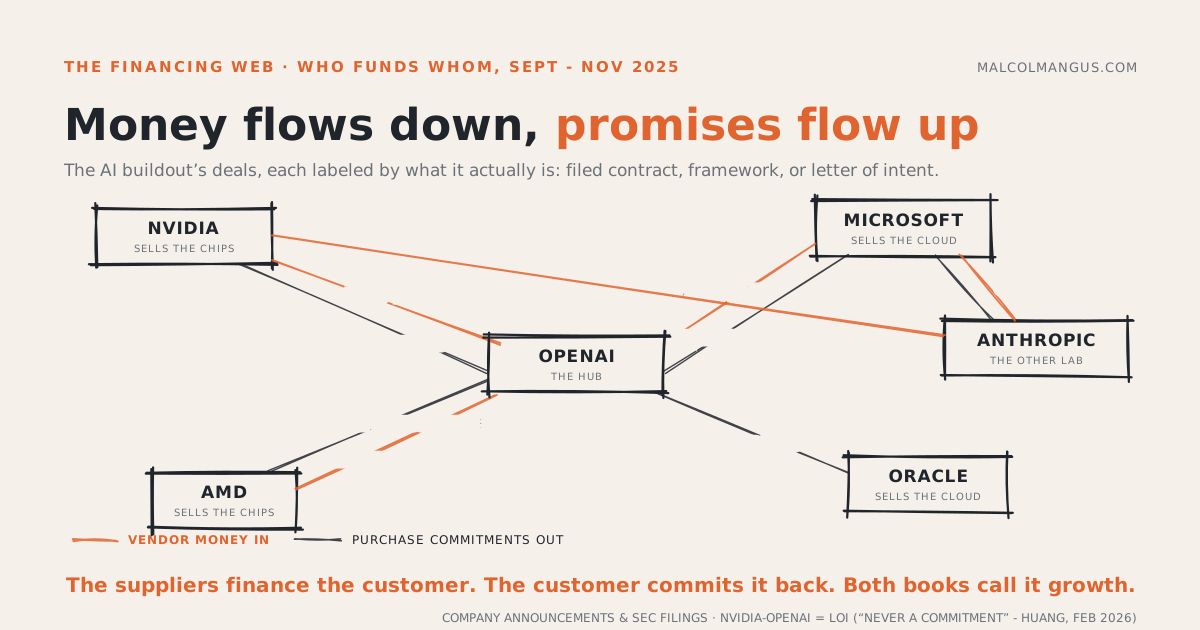
Read the edges by their legal weight, because they are not equal. The AMD deal is the real thing: a definitive agreement in a filed 8-K, six gigawatts of GPUs, and a warrant for 160 million AMD shares at one cent each that vests as OpenAI deploys, with the last tranche priced against AMD stock reaching $600. Microsoft's is disclosed on its own blog: a stake valued around $135 billion, about 27%, alongside OpenAI's commitment to buy $250 billion of Azure. NVIDIA's famous $100 billion into OpenAI is neither: it is a letter of intent, and by February 2026 Jensen Huang was telling reporters "it was never a commitment". Oracle's reported $300 billion compute contract has never been confirmed by either company at that number; what Oracle disclosed is that its remaining performance obligations jumped 359% to $455 billion, counterparty unnamed. Sam Altman himself put OpenAI's total compute commitments at about $1.4 trillion over eight years, a figure that blends filed contracts, frameworks, and letters of intent into a single headline. Anthropic's version is more modest and more concrete: $30 billion committed to Azure, with NVIDIA and Microsoft investing up to $15 billion combined.
Telecom investors have seen this movie: in the late 1990s, equipment vendors financed their own customers' network buildouts, booked the sales as growth, and discovered in 2001 that the receivables and the demand were the same thing. The AI version is bigger, better collateralized, and run by more profitable companies. It is still the same loop: money flows down the chain as investment, flows back up as committed purchases, and appears on both books as momentum.
Put simply: When your supplier invests in you so you can buy from them, the revenue is real but the demand signal is not independent. Discount any market-size claim that rests on commitments the committing parties describe, under oath or to reporters, as flexible.
The bottom of the chain: the apps and the customer
At the retail end sits the app layer, selling intelligence the way the grocer sells eggs: at or below cost, for traffic. Cursor, the coding-assistant leader, went from a reported $500 million annualized to a company-announced $1 billion in five months of 2025, while running, per Newcomer's reporting, negative gross margins: its power users cost more in compute, paid mostly to Anthropic, than they paid in subscriptions. One investor quote from TechCrunch's survey of the sector covers the whole shelf: margins on code-generation products are "either neutral or negative... absolutely abysmal." The escape attempts define the category now. Cursor shipped its own model to stop paying retail for tokens and reached slight gross profitability on enterprise accounts; Windsurf was carved up in a week, with Google paying $2.4 billion essentially for the team; and in June 2026, SpaceX agreed to buy Cursor for $60 billion in stock, which is one way to stop worrying about gross margin. The prompt-to-app cousins ride the same physics: Lovable went from $100 million of annual recurring revenue in its first eight months to a reported $500 million run rate by June 2026, Replit re-raised at $9 billion six months after $3 billion, and a leaked Lovable deck reported by Sifted had it targeting 65% gross margins by late 2026, which is a target, and an admission about the present.
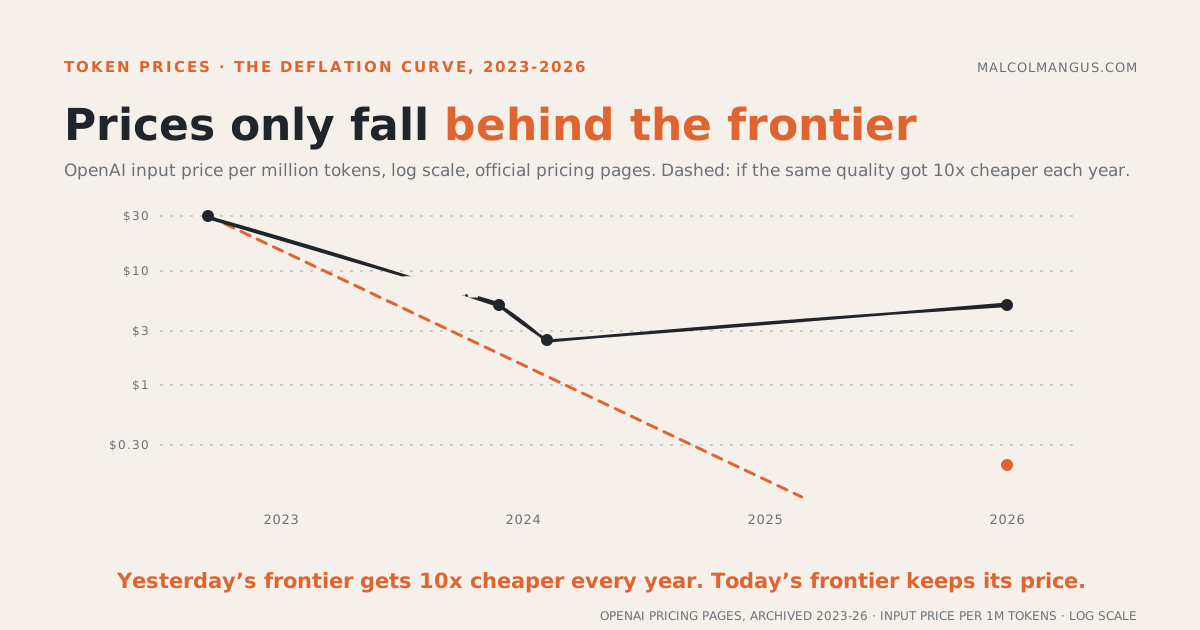
The deflation that squeezes them is printed on the labs' own pricing pages. GPT-4 launched at $30 per million input tokens in 2023; OpenAI's flagship tier sells for $5 today, and its cheapest model is 150 times below GPT-4's launch price. Andreessen Horowitz measured the trend at 10x cheaper per year for constant capability. Which makes the one counter-current on the shelf the most interesting price in the industry: Anthropic's own pricing page lists its workhorse model at $2 per million input tokens through August 31, 2026, and $3 from September 1. A frontier lab has printed a scheduled price increase, and it is the lab whose gross margin The Information said was under pressure. The era of every token getting cheaper forever now has an asterisk.
And the customer, the seat all of this exists to serve? The spend is measurable and real: on Ramp's corporate-card transaction data, 55% of US businesses paid for AI tools in June 2026, and Anthropic passed OpenAI in measured business adoption, 42% to 39%. Usage is shallower than spend: the Census Bureau's business survey puts national AI use around 20%, and even that number roughly doubled when the survey reworded its question in late 2025. Value captured is the bar my data-readiness essay already drew: measured pilot-to-production attrition around 40 to 50%, spend real, returns mostly unmeasured. The customer's bar on this map is not negative. It is blank, which is its own verdict about where the chain still has to prove itself.
Put simply: The app layer's lesson is the grocer's: if you retail someone else's commodity, your margin is their pricing decision. Either own a layer of the stack or own the customer relationship so thoroughly that the layer above you cannot reprice you out of existence.
The seat that gets paid to make it work
One family of seats on the drain side is positive, and it is the one every map of this industry forgets to draw: the layer paid to close the gap between a model and a business result.
Palantir is its archetype. The company that put the phrase forward-deployed engineer into its S-1 grew revenue 56% to $4.5 billion in 2025 at a 32% GAAP operating margin, then accelerated to 85% growth at a 46% operating margin in the first quarter of 2026, per its SEC releases. No adjustments required; those are GAAP numbers that would look at home on the left side of the cliff. The scaled consultancies sit one notch down with the same shape: Accenture's generative AI new bookings nearly doubled from $3 billion to $5.9 billion in fiscal 2025, with revenue from generative and agentic AI tripling to $2.7 billion, per its CEO, inside a $69.7 billion business running a 14.7% operating margin. One disclosure detail worth savoring: after the first quarter of fiscal 2026, Accenture stopped breaking the AI number out. When a metric disappears from the press release, it has stopped being special and started being the business. IBM's cumulative generative AI "book of business" passed $12.5 billion, four fifths of it consulting, a figure IBM itself says should be viewed independently of revenue; the bookings-versus-revenue discipline matters most in exactly this section.
The adjacent make-it-work seats share the profit. In data services, Surge AI reportedly crossed $1 billion of revenue, bootstrapped and profitable, per a Reuters exclusive, out-earning Scale AI, whose $14.3 billion Meta deal triggered a customer exodus; Turing claims profitability at about $300 million of annual recurring revenue. In fine-tuning and custom inference, Together AI reports annual bookings past $1.15 billion on open-model demand and Fireworks passed a $1 billion run rate with 95% of its tokens coming from models specialized on customers' own data, at gross margins one analyst pegs near 50%: positive, compressed, and nothing like software.
And the confirmation comes from the top of the chain: OpenAI seeded a $4 billion Deployment Company with TPG, Advent, Bain Capital, and Brookfield to send forward-deployed engineers into the field, Anthropic embeds its own through its Applied AI team, and postings for forward-deployed engineers jumped more than 800% over nine months of 2025. When the model makers spend billions to enter a seat, believe the seat. The gap this layer monetizes is the same one the data-readiness essay measured; here it is again, wearing a P&L.
Put simply: Below the chip, the profitable question is not what the model can do; it is who gets paid to make it do that here. If you sell AI, sell deployment attached. If you buy AI, budget for the gap, because the gap is where everyone else's margin comes from.
The seat under construction
One seat appears in the second chart as a dashed outline with no height: governance, the layer that will get paid to prove AI systems behave. The outline is deliberate. A bar's height is a margin, and nobody in this seat has disclosed one; the seat exists as a category before it exists as a business.
The demand is being written into statute. The EU AI Act carries penalties up to 7% of worldwide turnover, and its general-purpose model obligations have applied since August 2025. But the compliance cliff keeps moving: the omnibus amendment the EU adopted in June 2026 pushed the high-risk obligations from August 2026 out to December 2027 and August 2028. Even the demand is arriving behind schedule.
Meanwhile the seat is institutionalizing without a profit and loss statement. There is now a Gartner Magic Quadrant for AI governance platforms; AWS and Anthropic hold ISO 42001 certifications for their AI management systems, and EY audits Microsoft's Copilot against the same standard. The money, so far, is all anticipation. LangChain raised at a $1.25 billion valuation against a reported $12 to 16 million of annual recurring revenue, not yet profitable. OpenAI paid a reported $1.1 billion for the experimentation platform Statsig. And Weights and Biases, the seat's flagship exit, closed at $1.0 billion per CoreWeave's own quarterly filing, which describes the acquired results as not material; the $1.7 billion you may remember was the pre-close press number. Forrester's forecast for the whole category, $15.8 billion by 2030, grows off a base smaller than a single quarter of one hyperscaler's capex.
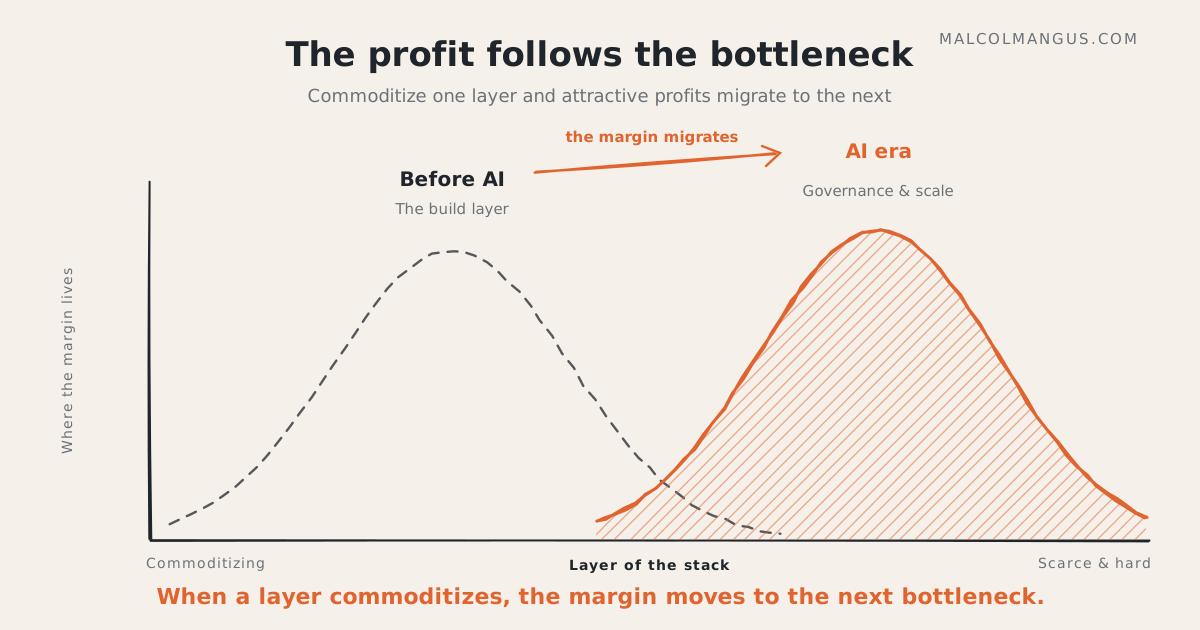
If margin migrates the way past platform shifts suggest, the next hump lands here. The verified record says: plausible seat, wrong tense. Today it is scaffolding: certifications, quadrants, and nine-figure acquisitions that are immaterial to their own acquirers, waiting for the audit to become mandatory.
Put simply: Governance is the rare seat you can watch being built before the money arrives. If you sell here, capitalize to survive until the mandate. If you buy here, date your compliance roadmap to December 2027, not August 2026, and read every vendor's valuation as a bet on the statute, not the software.
So who makes money on AI?
Five seats, all above the chip line: the toolmaker collecting tolls twice, the foundry walking its margin to 68%, the chip designer at a 56% net margin that memory's history says is a timestamp, the memory maker riding the most violent pendulum in silicon, and the cloud landlord quietly compounding at 35%. Below the line, the money is all motion: the neocloud carries the debt, the labs convert compute into growth at a negative exchange rate, the apps retail intelligence below cost, and the enterprise pays for all of it while its own return remains the one unmeasured number on the map. The exception below the line is the seat paid to close that gap: the services layer compounds while its clients experiment.
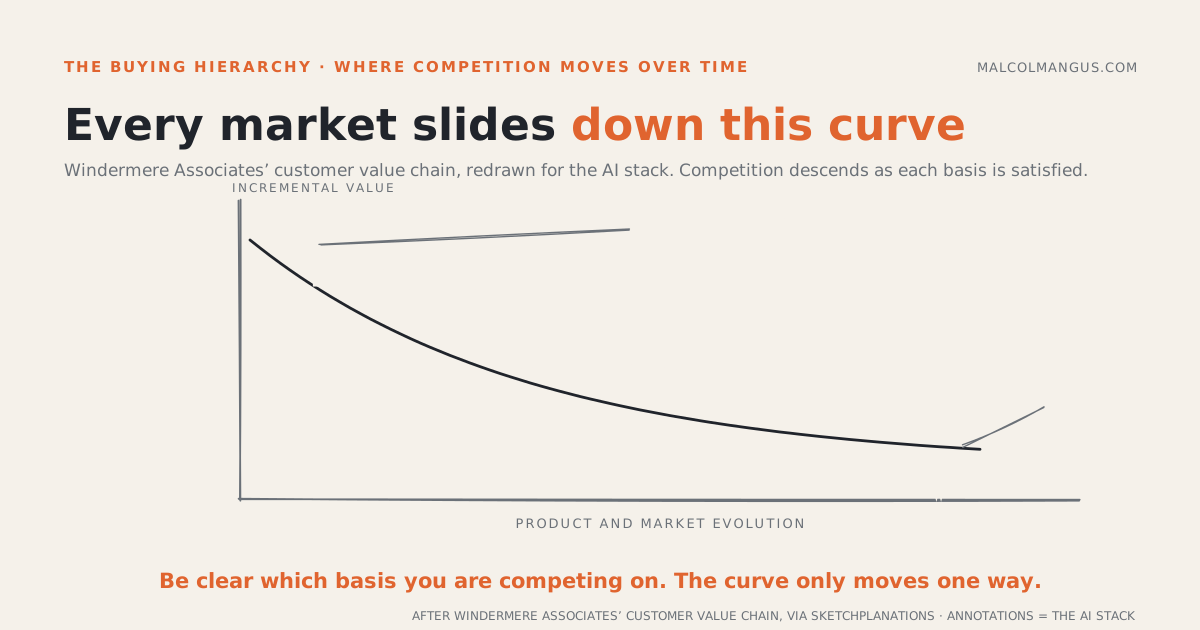
The egg market taught me that profit is not always a pool; sometimes it is a pendulum. The AI chain adds a third state: profit as a promise, flowing down the chain as vendor investment and back up as purchase commitments, real on every balance sheet and contingent on the same bet everywhere, that the blank bar at the end of the map fills in before the pendulum swings. Above the chip, margins. Below it, promises. The most important number in the industry is not any of the ones on this map; it is the one the customer's seat has not reported yet.
Put simply: Every seat that compounds sells scarcity or sells deployment; every seat that runs on promises is renting one of those two from someone above it. Before you commit to a seat, name the scarce thing you own or the gap you close, and if the honest answer is neither, you are the demand this map is waiting on, not a place it settles.

Malcolm Angus
I'm an analytics engineer, data product manager, and forward-deployed engineer. I write about data products, moats, flywheels, and business strategy, the loops that make companies harder to catch.

The charts in this essay are free to reuse with credit.