← All essays·July 21, 2026·10 min read
Who makes money on $8 eggs?
Eggs hit $8 wholesale in 2025 and 74 cents in 2026. I traced the dollar through the whole cycle: the farmer on a flat 27-cent fee, the integrator that banked $2.7 billion, the grocer selling below cost, the brand that escaped the commodity, and the carton maker who never felt a thing. Egg profit is not a pool. It is a pendulum.
In March 2025, the average American dozen hit $6.23 at retail, an all-time record, and the wholesale benchmark touched $8.07, with grocers advertising eggs at $3.99 against that replacement cost. Sixteen months later, in July 2026, the same wholesale eggs sold for 74 cents, and the farmers producing them were 44 cents per dozen underwater. Same egg, same aisle, opposite catastrophe.
So who makes money on $8 eggs? I traced the dollar through the whole cycle, and the answer breaks the tool I usually use. My profit pools essays assume the money settles somewhere and you can map where. The egg market refuses to settle. Its profit is not a pool; it is a pendulum, and every seat in the chain is defined by what happens when it swings through.
The dozen, decomposed
Start with the commodity dozen in a normal year, using Iowa State's Egg Industry Center cost series, the industry's own accounting. Producing a dozen costs about 86 cents: 46 cents of feed, 13 cents of young hens, 27 cents of everything else. Grading, the carton, and the truck add roughly another 47 cents to the store door. Against a $1.66 retail dozen, that leaves around 35 cents of retail gross and a farm profit measured in pennies.
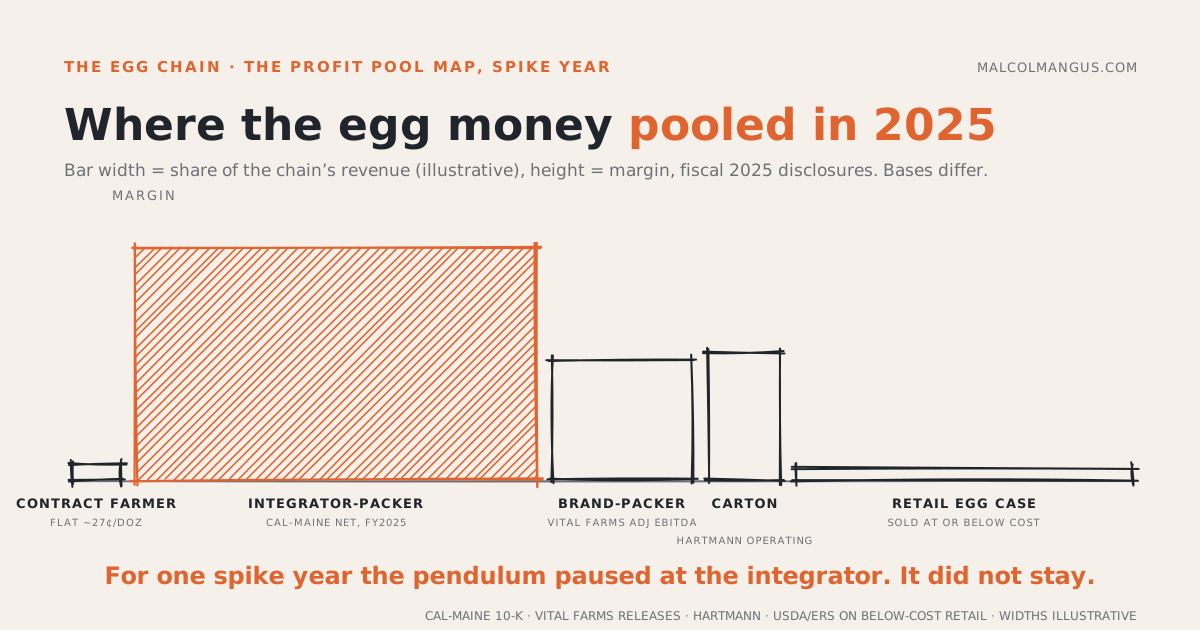
Nobody pools anything. Cal-Maine Foods, the largest egg producer in America with roughly 24% of national shell-egg consumption per its own annual filing, earned $2.1 million of net income on $1.35 billion of sales in fiscal 2021: a 0.15% net margin in the industry's last normal year. The retailer barely tries: eggs are the canonical loss leader, the price-visible item economists flatly describe as sold below cost to pull you into the store. Everyone handles the egg; almost nobody profits from it.
Put simply: A normal-year dozen is a cost ledger, not a business: 86 cents to make, 47 to pack and haul, pennies of profit anywhere. When a whole chain runs this thin, the interesting question is not who earns, but who gets hit when something breaks.
The pendulum
Then something broke. Avian influenza forced the destruction of about 151 million laying hens between 2022 and 2026, against a flock that normally stands near 320 million. Demand for eggs barely moves with price, so scarcity repriced every surviving dozen instantly, and the money surged to whoever owned hens.
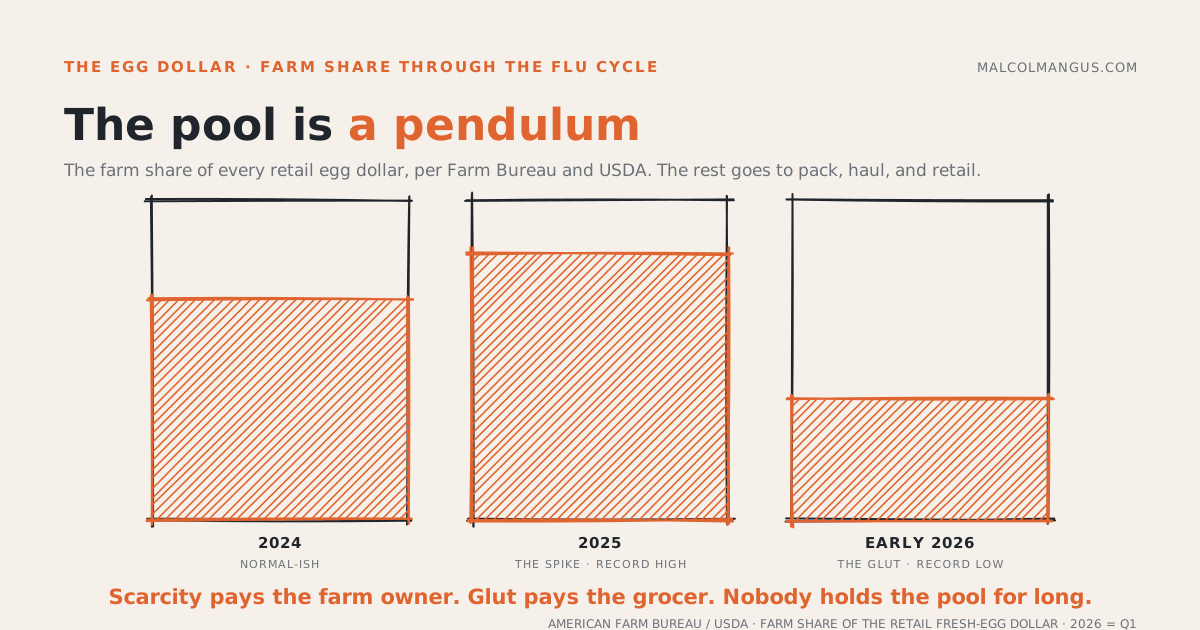
The Farm Bureau's series makes the swing legible: the farm share of the retail egg dollar was 69 cents in 2024, a record-high 83 cents in 2025, and a record-low 38 cents in early 2026. Both extremes ran below cost for somebody. At the peak, retailers sold under replacement, USDA's Economic Research Service economists confirm grocers "occasionally and temporarily have sold eggs at a loss", and chains rationed cartons instead of repricing them. In the glut, the farmers went under water instead, while sticky shelf prices quietly handed the margin back to the grocer.
And the owner of the hens? Cal-Maine's own filings price the windfall per dozen: its average selling price went from $1.22 (FY2021) to $2.62 (FY2023) to $3.13 (FY2025) while its production cost went from 77 cents to just 92, because feed got cheaper after 2022. The spread it kept went from 15 cents a dozen to roughly $1.44, and cumulative net income from fiscal 2022 through early 2026 reached about $2.7 billion, against $2.1 million in the last normal year. The money went out as roughly $680 million of dividends across the two spike years, a $500 million buyback, and a $258 million acquisition, all per its SEC filings. The contract farmers who actually tend integrator flocks captured almost none of it: they earn a flat production fee, one farmer-advocacy account puts it at about 27 cents a dozen, raised a penny in a decade, and Cal-Maine owns 91% of its production outright.
There is a coda about accountability. In June 2026, the Department of Justice and 17 states sued the largest producers for coordinated manipulation of the very wholesale benchmark the windfall was priced against, and settled the same day: conduct remedies, $3.3 million to the states, donated eggs, and, in the government's own words for Cal-Maine, no fines or penalties. A 2023 jury separately found the industry liable for a 2004 to 2008 supply-reduction conspiracy; the trebled judgment, $43.6 million, is on appeal. Against a multi-billion-dollar windfall, the legal system's clawback rounds to zero.
Put simply: In a supply shock, the profit goes to whoever owns the scarce asset, not whoever works it: hen owners banked billions while fee-paid farmers got pennies and grocers ate losses. If your industry prices off a benchmark, know who owns the assets under it, and who merely gets a fee.
The escape hatch: the premium dozen
There is a version of the egg business that got off the pendulum. The pasture-raised dozen, the $7 to $9 carton with the storybook copy, runs on a different architecture at every link.
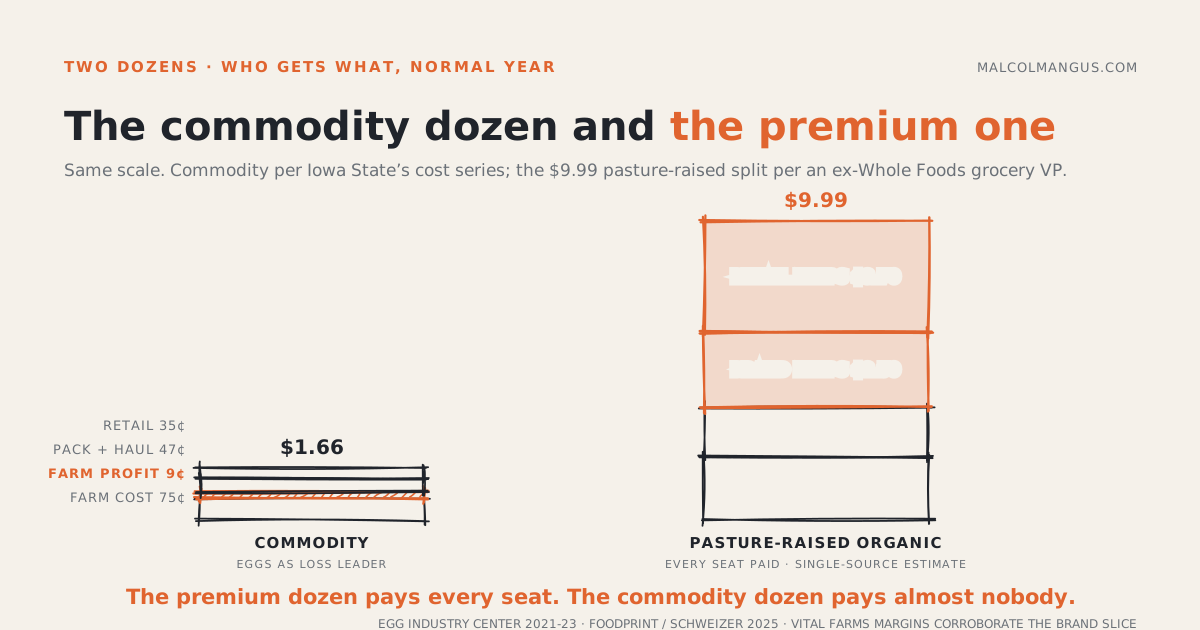
Decompose a $9.99 pasture-raised organic dozen and every seat gets paid. The retailer takes its largest slice in the case, about 37%, flipping eggs from loss leader to profit contributor. The brand runs a genuine CPG gross margin: Vital Farms, the publicly traded pure-play, held 37.9% and then 37.6% gross margins straight through both avian-flu shocks, per its earnings releases, grew revenue from $261 million to $759 million in four years, and reached 15% adjusted EBITDA margins. Part of that margin is vertical: it grades and packs the majority of its eggs at its own Egg Central Station plant in Missouri, with co-packers handling the rest, so most of the packer's slice of the premium dozen stays in-house. And the farmer's deal inverts the integrator model: instead of a flat fee on someone else's hens, a Vital Farms farmer owns the birds and the barn, and the company is contractually obligated to buy every egg produced at an agreed price, adjusted quarterly for feed costs, on multi-year contracts. What the farmer actually nets is undisclosed anywhere public; what is documented is the trade: stability and guaranteed offtake in exchange for carrying up to $1.2 million of barn capital.
The spikes even worked as free advertising for the premium tier. Because the brands moved prices, in their CEO's words, reluctantly and in small amounts, the commodity spikes collapsed the premium gap; at the producer level it literally inverted, with Cal-Maine's conventional eggs out-pricing its specialty book in late 2022. Shoppers who traded up at parity stayed: household penetration went from 7% to 10.5% across the two spikes. Cal-Maine's own segment split states the structural point plainly: through the FY2025 spike its conventional price rose 102% while its specialty price rose 9%. One book is a commodity; the other behaves like packaged goods.
Put simply: The premium tier de-commoditized every link: the farmer owns assets on a guaranteed contract, the brand earns CPG margins, and the retailer finally profits on eggs. If you sell into a commodity pendulum, the escape is not a better price; it is a different contract structure.
The spread bites back
Then 2026 punished the escape hatch from the other direction. The rebuilt flock crashed conventional eggs to a dollar on the shelf and 74 cents wholesale, stretching the pasture-raised premium to record width, and velocity broke. In May 2026, Vital Farms cut its revenue guidance by over $100 million, guided adjusted EBITDA from $105-115 million to roughly zero, and announced it would wind down its butter business, per its first-quarter release, absorbing about $32 million of costs to manage oversupply, because the obligation that protects its farmers, buying every contracted egg, meant dumping surplus into breaker markets at as little as a dime a dozen. The stock round-tripped from a $53 peak to around $13.
That is the honest shape of the premium model: it is a spread business. The brand earns its margins while the gap between pasture-raised and conventional sits in a tolerable band; commodity spikes hand it customers, and commodity gluts tax it, because the brand, not the farmer, is now the residual risk-holder. Meanwhile the middle tier turns out to be the worst seat of all: cage-free, mandated into existence by nine states and now 46% of the national flock, carries premium costs with near-commodity pricing, and its large aviaries took the worst of the 2024 flu losses. The safest structures were the extremes: the indemnified mega-integrator and the dispersed small-farm network, which lost 5 of 600-plus farms across the entire epidemic.
Put simply: Escaping a commodity does not delete the risk; it moves it. The premium brand absorbed the volatility its farmers shed, and it only earns while the price gap to commodity stays reasonable. When you de-risk your suppliers, price the risk you just inherited.
The seats that never swing
Two kinds of players never felt the pendulum at all. Denmark's Brodrene Hartmann, the world's largest maker of molded-fiber egg cartons and of the machines that make them, ran a 15% operating margin in 2024 and 16.1% in 2025, per its annual reports, straight through a cycle that took the integrator from a windfall to below cost; the business was so steady that its majority owner Thornico took it private in 2023. Cartons are bought per dozen sold, not priced off the benchmark: the classic picks-and-shovels seat, twice over. At the long tail, a woman-owned Massachusetts mill business founded by a petting-zoo owner, EggCartons.com, breaks bulk and sells small-batch and custom-printed cartons to the backyard-flock boom, whose demand fires precisely when retail prices spike.
And the most elegant seat in the whole industry belongs to a brand with no hens at all. Eggland's Best is a producer cooperative that placed its brand into a 50/50 joint venture with Land O'Lakes and licenses regional franchises to commodity producers, collecting fees that scale with specialty volume. Cal-Maine is its largest franchisee, roughly half of the brand's volume. The franchise layer skims the premium tier's economics while the farms, the flu, and the feed risk stay on the producers' books; the result is the country's number one branded egg with an asset footprint of approximately zero.
Put simply: In a whipsaw market, look for the seats paid per unit rather than per price: the carton maker, the machine seller, the brand licensor. They earn less than the windfall winners and more than everyone else averaged across the cycle, which is usually the better trade.
So who makes money on $8 eggs?
Mostly the people who owned hens when the flu came, briefly and spectacularly: the integrators banked billions, paid it out, bought rivals, and settled the benchmark-manipulation case for donated eggs and no fines. The grocer ate the spike and got repaid in the glut. The contract farmer never touched the money in either direction. The premium tier built the only durable per-dozen economics in the industry and then demonstrated their limit the moment the commodity got cheap. And the carton makers, machine sellers, and brand licensors clipped their steady margins through all of it.
This is the cheese cartel's lesson run at ten times the speed: the reliable money sits with whoever escapes the commodity price, whether by cartel, contract, license, or carton. The egg market just compresses the whole demonstration into one violent four-year swing. The pool was never still water. Watch where it sloshes, and notice who built their seat above the waterline.
Put simply: Windfalls go to asset owners in shortages; gluts pay the buyers; fee-earners and spread businesses live in between; and the steadiest money belongs to the seats priced per unit, not per price. Map your own industry's pendulum before it swings.

Malcolm Angus
I'm an analytics engineer, data product manager, and forward-deployed engineer. I write about data products, moats, flywheels, and business strategy, the loops that make companies harder to catch.

The charts in this essay are free to reuse with credit.