← All essays·June 23, 2026·3 min read
Where velocity becomes money
AI made every data team faster. Whether that shows up in profit depends on the distance between the team's output and the work that earns revenue.
Listen to this page
AI made every data team faster. The bottleneck moved upstream, and the code got cheap. But faster has not made every company richer. The difference isn't the tooling, and it isn't the talent. It's the operating model the velocity lands in.
Two landings for the same speed
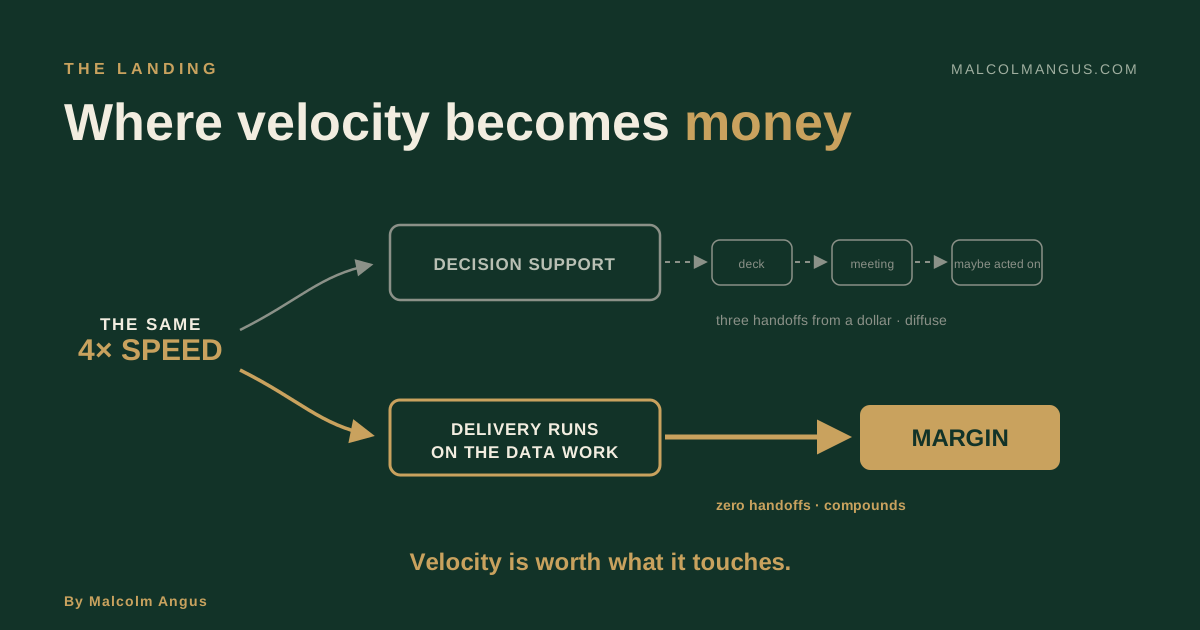
In most software companies, the data team's output is decision support. Models, dashboards, analyses: they inform choices that other people then make. The work is real and the value is real, but it's diffuse. Triple the team's velocity and you get more analyses, faster dashboards, quicker answers, feeding the same decision cadence. The P&L barely notices, because the team's output was never wired to it directly. Data team ROI in these businesses has always been notoriously fuzzy, and speed doesn't fix fuzzy. It just produces fuzz faster.
Now put the same velocity inside a business whose delivery runs on data work: an agency, a services firm, a logistics operator, anyone whose product is partly produced by pipelines, reports, research, and analysis. Here the data team's output is the operating work. Every hour of repeatable delivery that migrates into the software layer shows up directly: fewer hours per client, more clients per team, margin that expands without headcount. Same tooling, same multiple of speed, completely different financial result.
The distance test
Here's the diagnostic: count the handoffs between the data team shipping something and a dollar moving.
If the answer is zero or one, velocity converts to margin almost mechanically. If the answer is three or more (analysis, to deck, to meeting, to decision, to maybe someone acting on it), velocity converts to slideware. Neither answer is wrong. But you should know which business you're in before you fund an AI initiative expecting margin from a structure that can only produce insight.
The services opportunity
This is why the agentic era is quietly a services-business moment.
For two decades the smart money said services don't scale: revenue arrives with headcount attached, margins are capped by payroll, and buyers discount the whole category accordingly. The software layer changes the first premise. When the repeatable parts of delivery migrate into pipelines, agents, and workflow automation, the people move up to the work that machines can't scale (judgment, relationships, strategy) and revenue starts to grow faster than the org chart.
Buyers price how revenue is produced, not just how much. Durable revenue, expanding contribution margin, low key-person risk: firms that show these trade like platforms. Firms that can't, trade like hours. Two companies with identical topline can sit on very different multiples because one of them looks like a machine and the other looks like a staffing plan.
One number carries most of this story: revenue per employee. A conventional services firm runs somewhere around $150k to $250k per head. Platform-grade operations clear $350k and up. The gap between those numbers is the software layer, and the agentic era just made building it dramatically cheaper.
The humane check
None of this works as a layoff strategy. The frontier of what agents absorb keeps moving outward, and the durable version of this play moves people up, not out: operators shift to the judgment work, the accounts, the strategy, while the software layer absorbs the repetition underneath them. If your automation plan requires people to leave for the math to work, you've built a cost cut, not a compounding machine, and your best people will read it that way.
The question to ask
Ask where your velocity lands. If the honest answer is "better-informed decisions," fine: budget it like intelligence, expect diffuse returns, and don't promise the CFO margin. If the answer is "fewer hours per unit of delivery," you're holding the rarer thing: a straight pipe from AI velocity to the P&L. Feed it. Only one of these compounds on its own.

Malcolm Angus
I'm an analytics engineer, data product manager, and forward-deployed engineer. I write about data products, moats, flywheels, and business strategy, the loops that make companies harder to catch.

The charts in this essay are free to reuse with credit.