← All essays·June 19, 2026·3 min read
The bottleneck is not the code anymore
Agentic tooling commoditized the work data teams spent a decade being hired for. The constraint didn't disappear. It moved upstream, to data readiness and product judgment.
Listen to this page
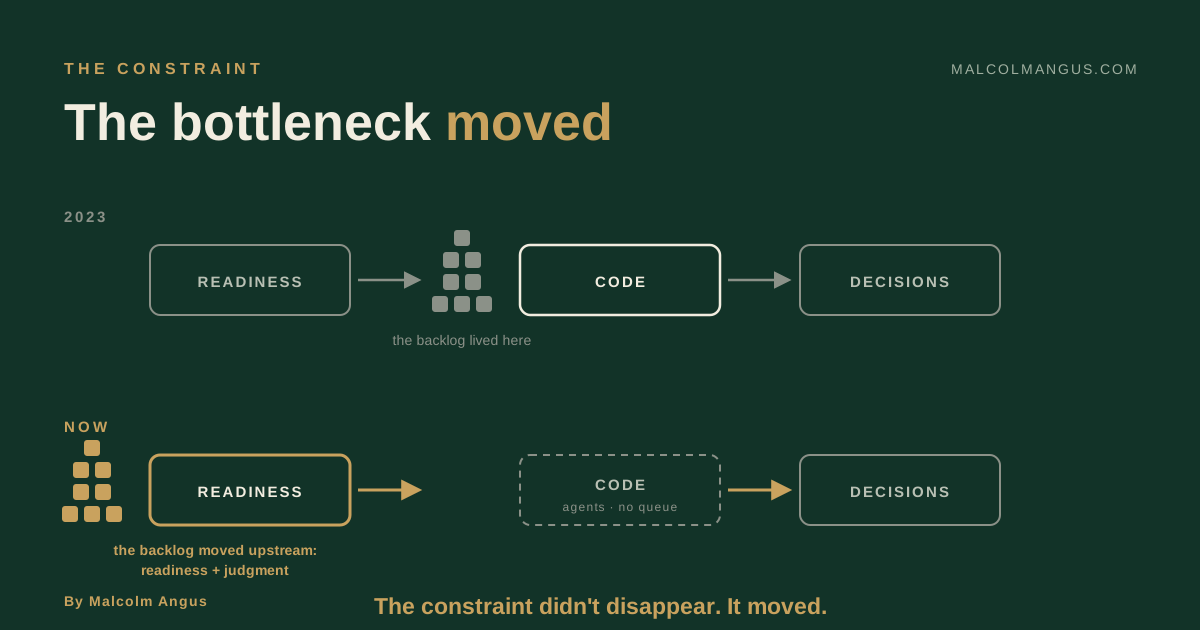
Ask where a data team's hours went in 2023 and the answer was code. Pipelines by hand, dashboards by hand, integrations by hand. Writing it all down was the bottleneck, so writing it all down was the job.
Agentic coding broke that ratio. Work that took a data professional weeks now ships in days, sometimes hours. A three to four times increase in output velocity is a realistic planning number, not a vendor slide. And the same shift reached non-engineers: an operator with a vibe-coding tool can prototype an internal app in an afternoon that would have been a quarter-long ticket three years ago.
Which sounds like the constraint is gone. It isn't. Constraints don't disappear, they move. When the code got cheap, two things upstream of the code got expensive.
Expensive thing one: deciding what to build
When building was slow, bad ideas died in the backlog. Nobody noticed how much quality control the queue was quietly providing. Now that anything can be built in a week, the filter is gone, and the scarce skill is the one the backlog used to fake: product judgment. Which decision is worth improving. What the smallest useful version is. What not to build at all.
The failure mode has a look: app sprawl. Twenty prototypes, each built in a burst of enthusiasm, each half-adopted, none owned. The tools did exactly what they promised. Nobody was doing the job above the tools.
Expensive thing two: data readiness
Here's the anti-pattern I see most: expecting the app, or the agent, to do the analysis just-in-time, when it should have been done ahead-of-time in the pipeline.
An AI data agent without a prepared foundation is a search engine with just-in-time crawling. Ask it a question and it can technically go find out: slowly, expensively, and differently every time. The wow-factor answer, the one that lands in seconds and holds up in a board meeting, is mostly ahead-of-time work. Clean, keyed, historized, aggregated data that was ready before the question arrived. Dashboards always worked this way. Agents inherit the same physics; they just hide the missing foundation behind a confident sentence.
This is the trap in the vibe-coding era. Teams feel enabled by the building tools and sprint straight into the sprawl, and the data architecture quietly becomes the new constraint. Everyone can build the app now, which is precisely why the app is no longer the advantage. Readiness is.
What this does to the job
The data professional's center of gravity moved up a level: from writing the pipeline to owning the architecture, from building the dashboard to deciding what the answer should be, from executing tickets to curating the datasets, evals, and standards that agents multiply. The engineer who owns the pipeline is becoming the product manager of the answer.
It also changed the leverage math. A two-person data team with agentic tooling and a ready foundation can now run the data layer of a company that would have needed a department. But only if the foundation is real. Velocity applied to unready data just produces wrong answers faster, and where that velocity actually lands in the P&L depends on your operating model.
The audit
Look at where your data team's hours actually go this quarter. If the biggest line is still labeled engineering, look closer; some of it is real, and some of it is readiness debt wearing an engineering costume.
Then ask the sharper question: if building became free tomorrow, what would stop you? Whatever you just thought of is your actual bottleneck. For most companies the honest answer is some mix of "we don't know what to build" and "our data isn't ready for it." Neither of those is fixed by another tool. Both are fixed by treating readiness and judgment as the product.

Malcolm Angus
I'm an analytics engineer, data product manager, and forward-deployed engineer. I write about data products, moats, flywheels, and business strategy, the loops that make companies harder to catch.

The charts in this essay are free to reuse with credit.