← All essays·October 25, 2026·12 min read
Product-led growth: the operator's playbook
Show notes from seven talks on product-led growth, heard together: Hila Qu on adding a PLG motion, Elena Verna on product-led sales and why the old playbooks are crumbling, and Bill Macaitis on the metrics that fuel it. The three go-to-market motions and how you layer them. The difference between an MQL, a PQL, and a PQA, and why a hot account often has no buyer in it. The five shared metrics. And the punchline a data engineer hears under all of it: product-led growth is data-led growth.
Listen to this page
These are show notes from seven talks on product-led growth, heard together. Hila Qu (Reforge, formerly GitLab and Amplitude) gives the guide to adding a PLG motion. Elena Verna (now Head of Growth at Lovable, formerly Amplitude, Miro, and SurveyMonkey) covers product-led sales, the first step B2B must master, and why the old growth playbooks are crumbling. Bill Macaitis (former CMO of Slack and Zendesk) walks through the metrics that fuel PLG. Two further Verna and Lovable talks, on the rise of high-impact individual contributors and how Lovable reached $200M in a year, round out the set.
The standing disclosure: everyone here sells the thing they teach, whether a Reforge course, a growth advisory practice, or a growth-tooling seat. That does not make them wrong. Operators who have actually run the motion are the best source on it. But the frameworks are also their product, so take the certainty with a grain of salt.
The through-line is one sentence from Hila Qu: product-led growth is fundamentally data-led growth. You give the product away to get two things back, reach and usage data, and "if you don't have a foundation of data and an understanding of how to analyze it, you're giving away a free product for nothing." Everything below sits on that.
The three motions: PLG, sales-led, and product-led sales
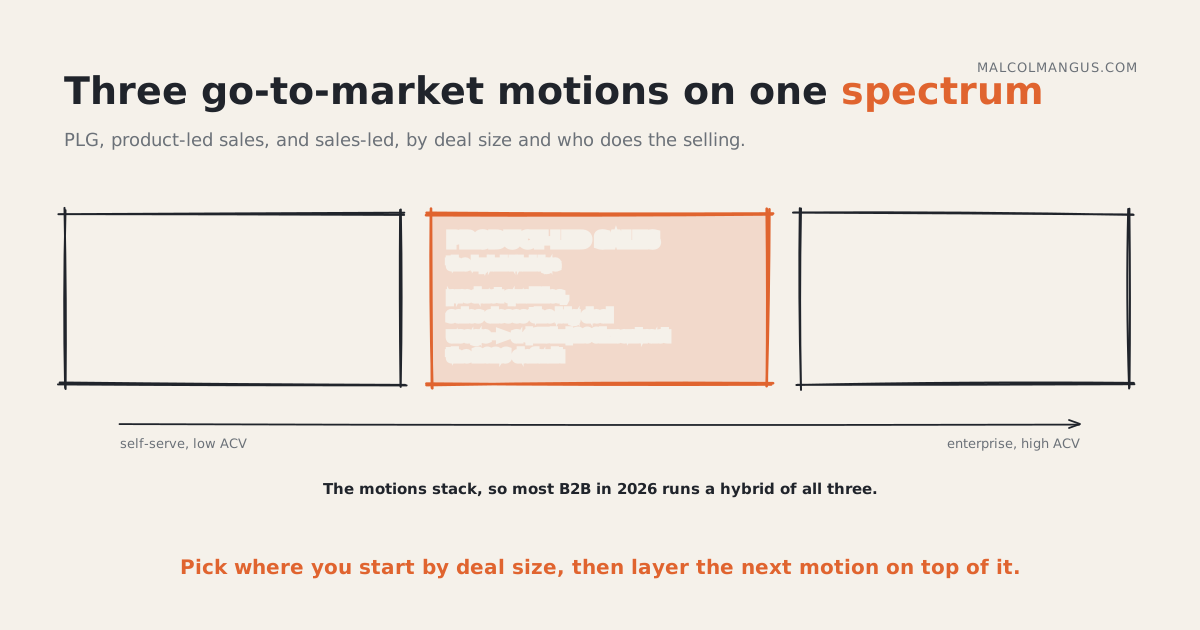
Before any tactic, the map. There are three go-to-market motions, and the operators are emphatic that it is not a binary choice. Sales-led growth puts a sales team at the front: outbound, inbound demos, enterprise negotiation, and the buyer cannot fully evaluate or purchase without a human. It fits complex products, multi-stakeholder committees, and deal sizes roughly above twenty-five thousand dollars. Product-led growth puts the product at the front: a user reaches value through a free trial, freemium, or self-serve before any sales conversation. It fits simpler products with a self-serve price point, which Elena Verna caps near ten thousand dollars, the ceiling of what people will put on a credit card. Product-led sales is the hybrid: the product acquires and qualifies, and a salesperson attaches to convert the high-value accounts into a fifteen-thousand to two-hundred-thousand-dollar contract.
Verna's standing claim is that every sales-led company must add a product-led element or be disrupted by someone who does, and every product-led company eventually needs sales to reach the enterprise buyer. Most B2B in 2026 runs a hybrid. Her way to see it is three dimensions at once: a company chooses on acquisition (product, marketing, or sales-led), on relationship type (one-to-many collaborative products like Slack and Figma suit PLG; single-mode products like Snowflake do not), and on monetization (self-serve versus sales-led).
Put simply: you do not pick one motion, you pick where to start by deal size and then layer the next one on top of it.
Two funnels: usage replaces the lead score
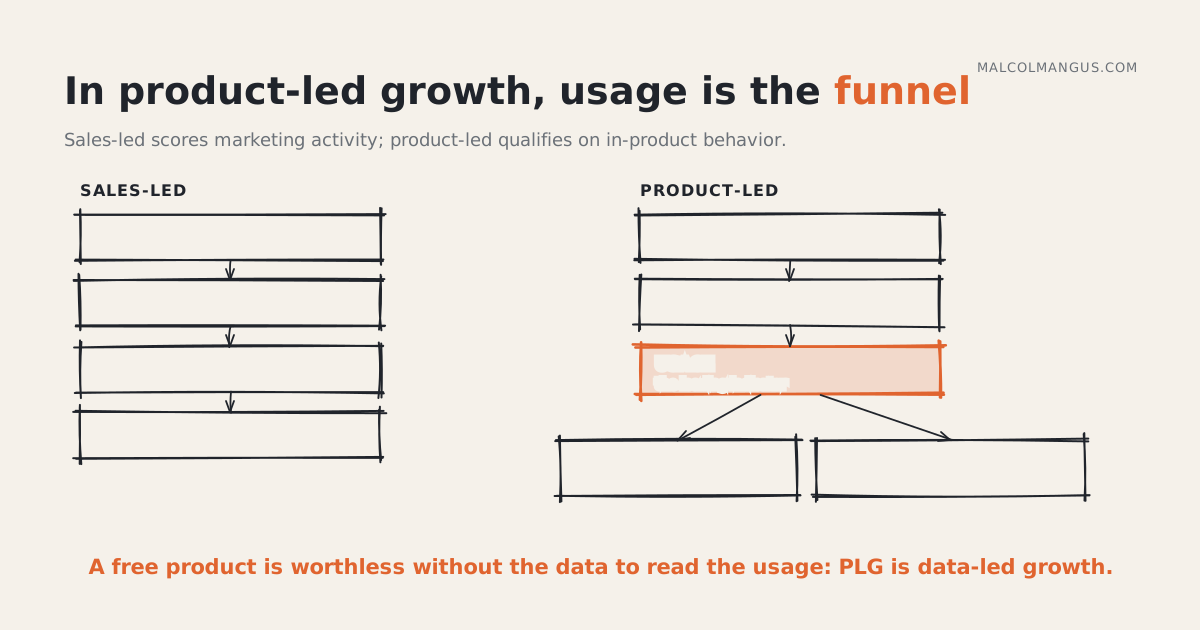
The first thing to map, per Hila Qu, is how the two funnels differ. The sales-led funnel scores marketing activity: a visitor opens an email, reads three white papers, attends a webinar, accrues points, and crosses a threshold to become a marketing-qualified lead handed to sales. The product-led funnel makes in-product usage the leading indicator, and usage then splits into two conversion paths: self-serve checkout (buy on a card, under the ten-thousand-dollar ceiling) and the qualified-account path (high usage plus a fit with your ideal customer profile, worth a salesperson's time).
Sequence matters too. Verna's rule is that you must be product-led in retention first, where retention equals activation plus engagement, because product-led acquisition, users inviting, referring, and creating content, is impossible unless the product is already habit-forming.
Put simply: in a product-led funnel, what someone does in the product replaces the lead score, and you have to earn retention before any of it works.
Activation is the first bet you should make
Hila Qu's four opportunity buckets are acquisition, activation, conversion, and retention, and growth is finding the one with the most leverage. For most B2B the answer is activation, because the quick wins are there and because B2B software historically was not built for fast time-to-value. Retention is the messy middle, with too long a feedback loop to start on.
The aha moment is derived, not guessed. Brainstorm about ten candidate high-value actions, then run a correlation analysis: does doing the action in the first few days lift both ninety-day conversion and thirty-day retention above average? Pick the standouts, then prove causation with experiments, because correlation alone will lie to you. GitLab's answer was two users using two features within the first fourteen days: two users captures the collaboration, two features captures the platform. Miro gets a person from the landing page to using a template in about five minutes.
Put simply: start on activation, and treat the activation metric as something you discover in the data and confirm with an experiment, not something you assert.
The metric stack, shared across the company
Bill Macaitis frames five metrics, plus a sixth, that should be shared across marketing, sales, success, and product rather than owned by a lone "PLG team," because "metrics incentivize people; they drive people."
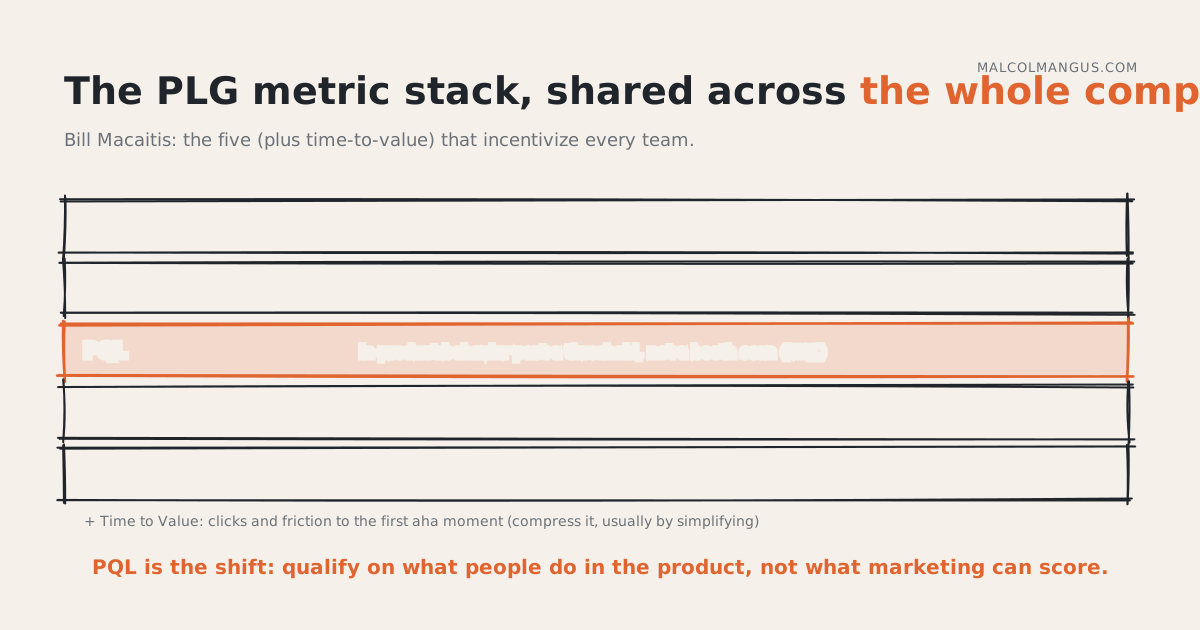
- Daily, weekly, or monthly active users. Are people actually using it. Usage drives renewal, recurring, and expansion revenue. Slack's number-one integration for the longest time was Giphy, not Salesforce, because fun lifts usage.
- NPS. Would they recommend it, scored from minus one hundred to plus one hundred, emailed to everyone rather than a sample. B2B SaaS averages about minus nineteen; great companies hit sixty to eighty. A minus nineteen cannot grow efficiently by word of mouth.
- PQL, the product-qualified lead. The metric that makes PLG different: a lead scored on in-product behavior past a threshold, not a booth scan.
- "How fun is it?" and "how simple is it?" Thumbs up or down surveys about a week after signup. The average company runs five hundred or more SaaS apps; fun and simple are what get used and recommended, and ease of use is what NPS promoters cite.
- Plus time to value. Clicks and friction to the first aha moment. One company's was about three months, which crushed adoption; compressing it, usually by simplifying, lifts everything else.
Put simply: pick a small set of in-product metrics, share them across every team, and tie incentives to them.
Product-led sales: the product owns the pipeline
Elena Verna's defining claim is that in product-led sales the product creates the pipeline for sales, so the core relationship is product-to-sales, not marketing-to-sales. "The worst thing you can do is run product-led sales out of marketing, you'll be in failure mode within six months." Sales exists because products are good at showing an individual what they can do and terrible at showing an organization the value, which is what justifies the larger contract.
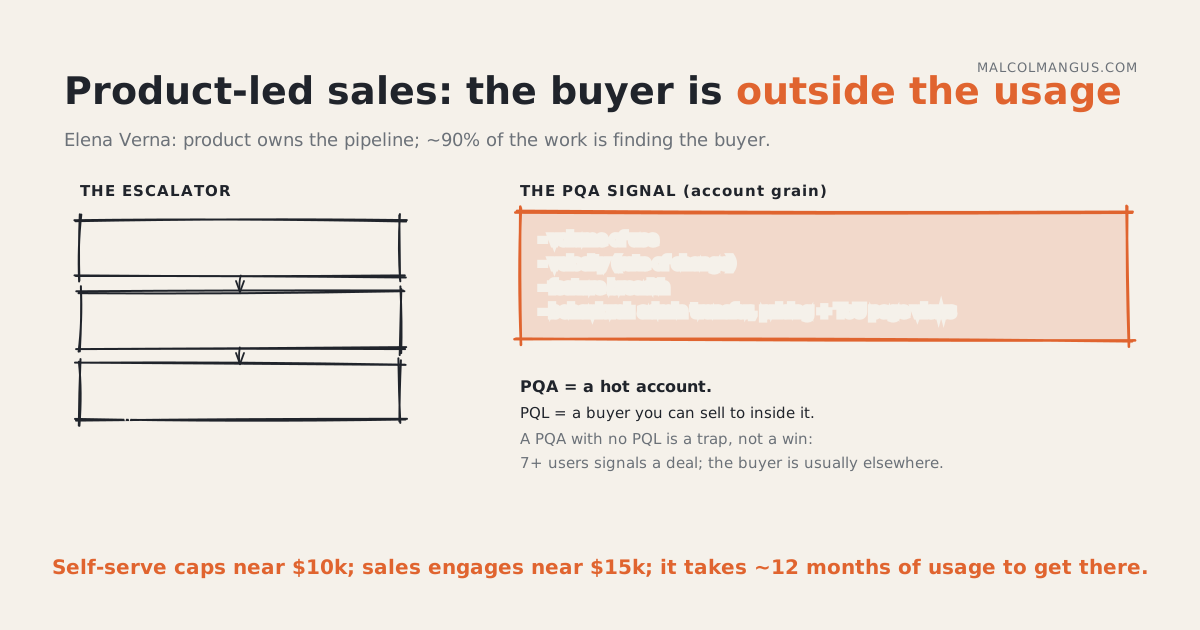
- The escalator. Individual (a personal job-to-be-done), to team (collaboration), to enterprise (org-wide value and a contract). Sales bridges the gaps where the user lacks the permission or the ability to drive an enterprise deal.
- The magic number is about seven users in a company before an enterprise conversation is likely, a parallel to Facebook's seven friends and LinkedIn's seven connections.
- The benchmarks. Self-serve caps near ten thousand dollars; sales engages near a fifteen-thousand-dollar floor and usually chases a hundred to two hundred thousand; and it takes about twelve months of usage on average to escalate to a contract, so this quarter's closes were seeded by last year's signups.
- Free-to-paid is mostly monetization awareness. About seventy-five percent of freemium users do not know what you sell. Fix that with feature and usage walls and the rule of three before you ever touch pricing or packaging.
Put simply: the product's job in a sales motion is to manufacture qualified accounts, and the hardest part of the job is finding the human who can actually buy.
The qualification ladder: MQL, PQL, PQA
The single most useful distinction in the whole playbook is how a lead gets qualified, because it is where product-led and sales-led actually diverge.
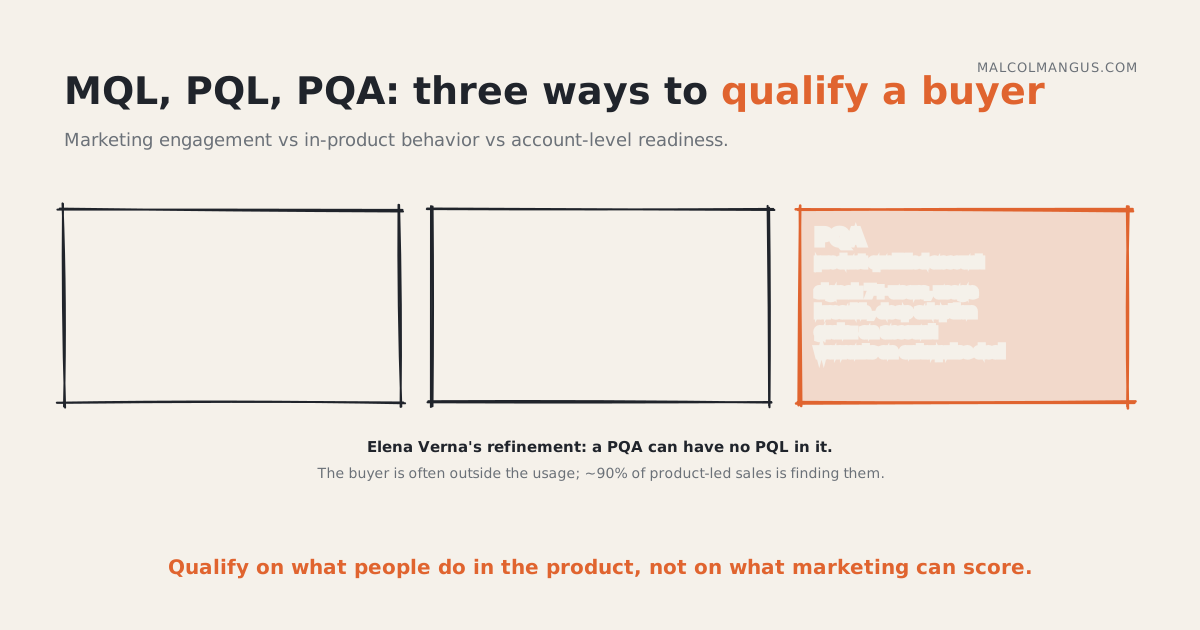
- MQL, the marketing-qualified lead, is scored on marketing engagement (form fills, events, gated content, webinar attendance) plus firmographics like title and company size. It is "someone who walked by our booth."
- PQL, the product-qualified lead, is scored on in-product behavior past a threshold: hit an activation moment, crossed a usage limit, adopted a sticky feature, invited teammates. Because they have already felt the value, PQLs convert roughly five to seven times higher than MQLs.
- PQA, the product-qualified account, is the account-level version: a company with enough users (the magic number of seven), usage breadth, and depth of adoption to warrant an enterprise conversation. It is built from product metrics, volume, velocity, feature breadth, and behavioral signals like an admin transfer or views of your pricing page.
Verna sharpens the textbook. A PQL is specifically a buyer you can sell to, and a red-hot PQA often has no PQL inside it, because the end user is many steps from the buyer. That is the whole game: about ninety percent of product-led sales is converting usage into an opportunity by finding the buyer outside the usage. It produces her three attribution buckets. Usage plus a lead already in the account is a PQL, so go. Usage with no lead means marketing has to bring a qualified lead and connect it to the usage. A lead with no usage is a true top-down sale. Each has a different conversion rate and often a different sales team.
Put simply: an MQL is a hand-raise, a PQL is a user who has shown real intent, and a PQA is a whole account worth a sales conversation, but the account being hot does not mean the buyer is in it.
The account-scoring world formalizes this exact split into a two-score routing model, fit crossed with intent, which I pull apart in a separate note.
The failure pattern: do not starve the hand that feeds you
Elena Verna's cautionary cascade, which she says plays out again and again. A product-led company closes its first enterprise deal from inside its own user base, which is exhilarating and a little addicting. It hires sales and wins early, because the buyers are already users. Then it stalls, because only about thirty percent of the time is the buyer actually in the user base. To chase the rest it moves upmarket and hires enterprise marketing and account-based teams, and it hits a resourcing fork: a growth PM or an enterprise rep. The fatal move is that about eighty percent of companies let go of their product-led initiatives to fund enterprise. Self-serve growth dries up, and because usage was the root of the enterprise pipeline in the first place, that slows too. "They've forgotten the hand that feeds them."
Put simply: when you add sales, hunker down on sales while keeping the product loop fed, because the usage is what was generating the enterprise interest in the first place.
The 2026 distribution shift
From the Lovable seat, Verna argues that distribution, not product, is what makes a company valuable, and that AI is simultaneously collapsing the channels PLG was built on and commoditizing simple product functionality. "The fastest growing companies don't grow via funnels, they grow via loops," a compounding flywheel where a new user's action produces an output that creates the next user. Dropbox runs about sixty percent of its acquisition on a product loop.
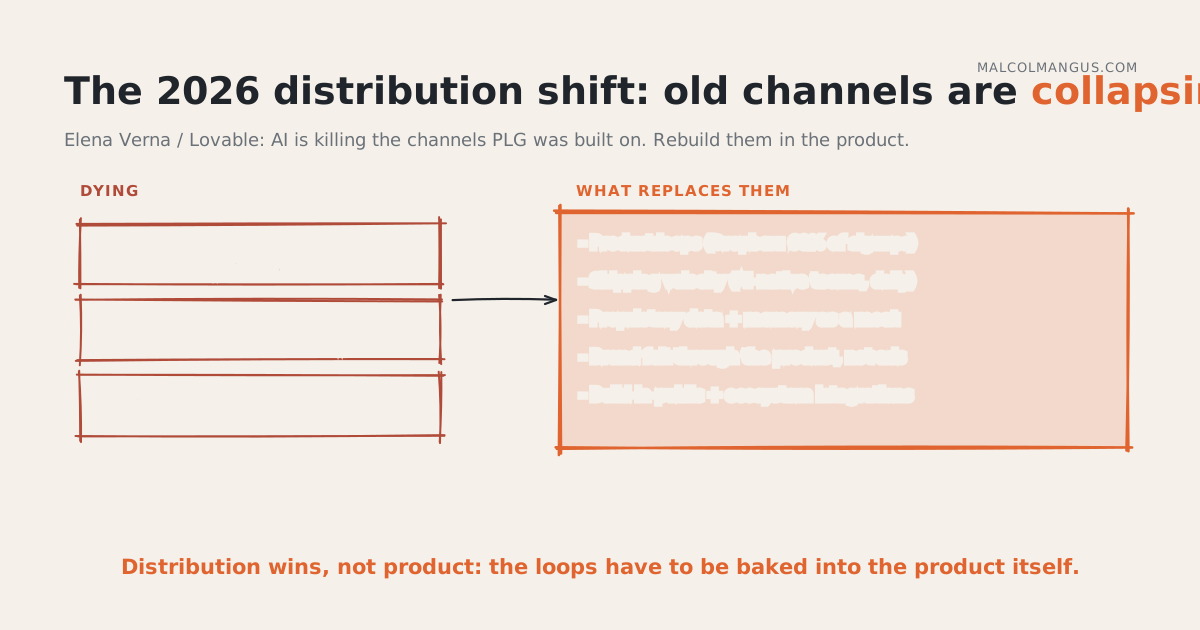
- The old channels are structurally dying. G2's search-driven acquisition fell eighty to ninety percent after ChatGPT; social networks clamp down on outbound links to protect their own engagement; and paid campaigns go stale in about a week.
- Your own customers become competitors. Vibe-coding lets users rebuild simple-but-highly-used functionality, forms, signatures, dashboards, scheduling, the danger quadrant of her simple-versus-complex-by-utilization grid.
- The margins flip the math. AI compute has pushed SaaS gross margins from around eighty or ninety percent toward thirty, so free and premium usage should be run as a marketing budget, not a cost center. "We'd rather give the product away than make Google richer."
- The new channels are product-native: product loops, shipping velocity from AI-native teams, proprietary data and memory as a moat, brand felt through the product rather than bought, build-in-public, and ecosystem integrations.
Put simply: the channels that made PLG work are breaking, so the new distribution has to be built into the product itself.
What this is, underneath: a data problem
Strip away the growth vocabulary and this is a data-platform spec. Every number above is an artifact of the same instrumented layer, which is why Hila Qu calls PLG data-led growth and why she would make the data analyst the first growth hire, before the growth PM. The backbone is a customer-360 join: product usage joined to CRM and marketing, at account grain. "If a target account is using my product, do I know it, which features, and whether we marketed to them?" On top of that sit the activation metric (candidate actions correlated against retention and conversion, then proven by experiment), the PQA model (a living, quarterly-refit model over volume, velocity, feature breadth, and behavioral events, surfaced to sales as a flag), loop attribution (input to action to output to reinvestment, with the conversion rate at each hop), and the shared scoreboard. And all of it rests on unglamorous foundations the operators keep insisting on first: a data dictionary, clean instrumentation, and a warehouse, before any tool purchase, because garbage in is garbage out.
Put simply: the person who owns the usage layer owns the growth engine, which is the real reason product-led growth and data engineering are the same job seen from two sides.
Sources (the seven videos)
- Hila Qu (Reforge) on Lenny's Podcast, the ultimate guide to adding a PLG motion.
- Elena Verna on Lenny's Podcast, the ultimate guide to product-led sales.
- Elena Verna on Lenny's Podcast, the first step B2B PLG must master.
- Elena Verna (Lovable) at Product School, why growth playbooks are crumbling.
- Bill Macaitis (former Slack and Zendesk CMO), the top five metrics that fuel PLG.
- Elena Verna on Lenny's Podcast, the rise of high-impact individual contributors.
- Lenny's Podcast, the new AI growth playbook and how Lovable hit $200M ARR.

Malcolm Angus
I build 0 to 1 data products: I turn the data a company already has into a decision it wouldn't otherwise make, shipped end to end. I also write about how markets really work, moats, flywheels, and the loops that make companies harder to catch.

The charts in this essay are free to reuse with credit.