← All essays·October 25, 2026·6 min read
Your best account and a tire-kicker can score the same
Two accounts can land on the same lead score and mean opposite things: an ideal customer that went quiet, and a bad-fit startup binge-reading your pricing page. Fit asks whether you should sell to an account at all; intent asks whether it is active right now. They move on different clocks, so you keep them as two scores and let the pair decide who a rep calls.
Listen to this page
Two accounts sit at the top of a rep's queue this morning, and both scored 74. The first is a 300-person logistics company that looks like your best customers on every axis, same size, same stack, same reason to buy, and it has gone quiet for three weeks. The second is a four-person startup that wandered onto your pricing page from a newsletter and has opened six emails since Tuesday. The rep works the list from the top, because 74 is 74, and spends the morning on the startup. The logistics account, the one worth six figures a year, waits.
That 74 is the whole problem. It is an average of two numbers that should never have been averaged, because they answer unrelated questions. One is fit: should we sell to this account at all, ever? The other is intent: is this account doing something right now that says to call today? An ideal account that is fast asleep and a hopeless one that is suddenly wide awake can arrive at the same blended score, and that single number leaves the rep no way to tell which is which.
So you carry two scores instead. You build them from different data, on different clocks, and you let the two of them together decide who gets a phone call.
Fit is the slow score
Fit barely moves from month to month, because it describes the account itself, not its week. It stacks a few layers: firmographics (industry, headcount, geography), technographics (what already runs in their stack, read off a source like HG Insights or BuiltWith), and buying triggers (a funding round, a hiring spree, a new VP who owned your category at her last company). Firmographics usually take the largest share of the weight, roughly a third, for a dull but decisive reason: company size is the cheapest fact to verify and the hardest for a prospect to fake.
The weights are not yours to assign by feel. They fall out of your own closed-won deals. Line up the last twenty accounts you won, read off the attributes they shared on the way in, and weight each one by how sharply it split the deals you won from the deals you lost. Then run the check that almost everyone skips: hold those same attributes against your closed-lost pile. If the losses look firmographically identical to the wins, your profile is describing companies that will talk to you rather than companies that will buy, and you keep adding layers until the two piles finally stop looking alike.
Put simply: Fit is a model trained on your own history, and the only proof it works is that it separates your wins from your losses. A profile that cannot do that is a description dressed up as a predictor.
Intent is the fast score, and it rots
Intent behaves the opposite way. It swings by the day, and its entire value is freshness. It reaches you from two directions. First-party intent is what the account does inside your world: logins, feature use, a second seat added, a long look at the pricing page. Third-party intent is what it does everywhere else, the research surges a vendor like Bombora detects when a company's employees start reading about your category across the web.
What really sets intent apart is that it has a half-life. A pricing-page visit last Tuesday is a live signal; the same visit from March is archaeology, because the project behind it has long since shipped or died. So any intent score worth trusting decays, weighting last week far above last quarter. It usually carries a second term as well, reachability, because a red-hot account you have no way to contact is a billboard. The score should say so.
If you have read the product-led growth notes, you have already met this score under another name. The product-qualified account, assembled from usage volume, velocity, feature breadth, and behavioral flags, is an intent score living at account grain. This is the same machinery with the timing math written down.
Put simply: Intent is perishable, so a signal from last week has to outweigh the same signal from last quarter. A score with no decay term is just a running total, and a running total will never tell you to call today.
The blend is where the information dies
Now the two accounts from this morning come back. Average fit and intent into a single 74 and you have discarded the one fact the rep actually needed: why each account scored what it did. The logistics company is a 74 because its fit is 95 and its intent is 50. The startup is a 74 because its fit is 40 and its intent is 98. Those are not two flavors of the same lead. One is your ideal customer taking a nap; the other is a tire-kicker on a sugar high. They demand opposite responses, and the blended score quietly recommends you treat them as twins.
Put simply: A blended score buries the reason an account is interesting, and the reason is the entire decision. Give fit and intent their own axes so a human can see what kind of 74 is in front of them.
Four corners, four moves
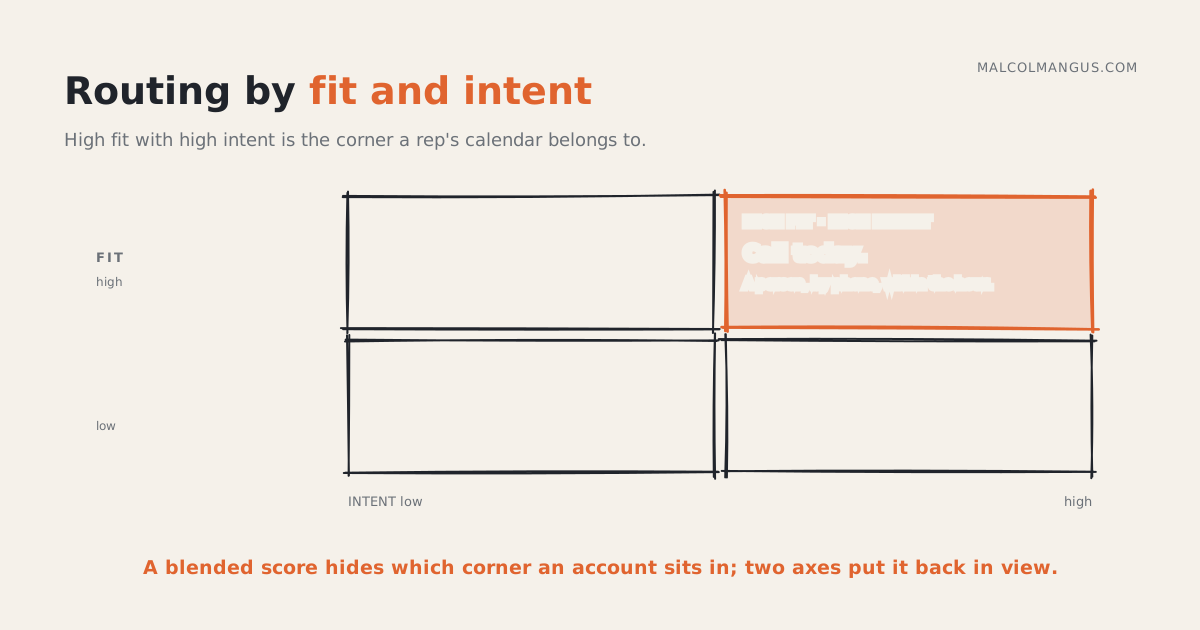
Spread across those two axes, accounts land in four corners, and the corners do not earn equal attention. High fit with high intent is the reason the system exists: an ideal account that is also active today, handed to a person within the hour, usually by phone, with a response time measured in minutes. High fit with low intent is your bench, the accounts worth holding onto for the day a trigger wakes them, kept warm by marketing until it does. Low fit with high intent is the tar pit, an account thrashing around that was never going to close, and nothing teaches a sales team to ignore your scores faster than a steady diet of these; someone verifies them before a rep ever gets one. Low fit with low intent you let lie.
Most teams bolt thresholds onto the picture. Past roughly 80 an account goes straight to a rep; the 60s wait in nurture until they climb or lapse. Those cutoffs are a dial you turn against how much rep capacity you have. The rule beneath them carries the weight: a salesperson's hours live almost entirely in the top-right corner, and everything else about the scoring exists to keep that corner honest.
Underneath, it is two models and a join
Strip off the go-to-market vocabulary and this is a modest data build, sitting on the same customer-360 join a product-led motion already requires. The fit model is a weighted score, or a small logistic regression, over firmographic and technographic columns, its coefficients fit on labeled won-and-lost outcomes and refit maybe once a quarter. The intent model runs over the behavioral event stream joined to each account, with a decay applied to every event so the score sags as the account cools. Both land as their own columns on the account record, and a thin layer of routing logic reads the pair and writes down the next action. Everything rides on one piece of discipline: those two columns stay separate all the way to the routing rule.
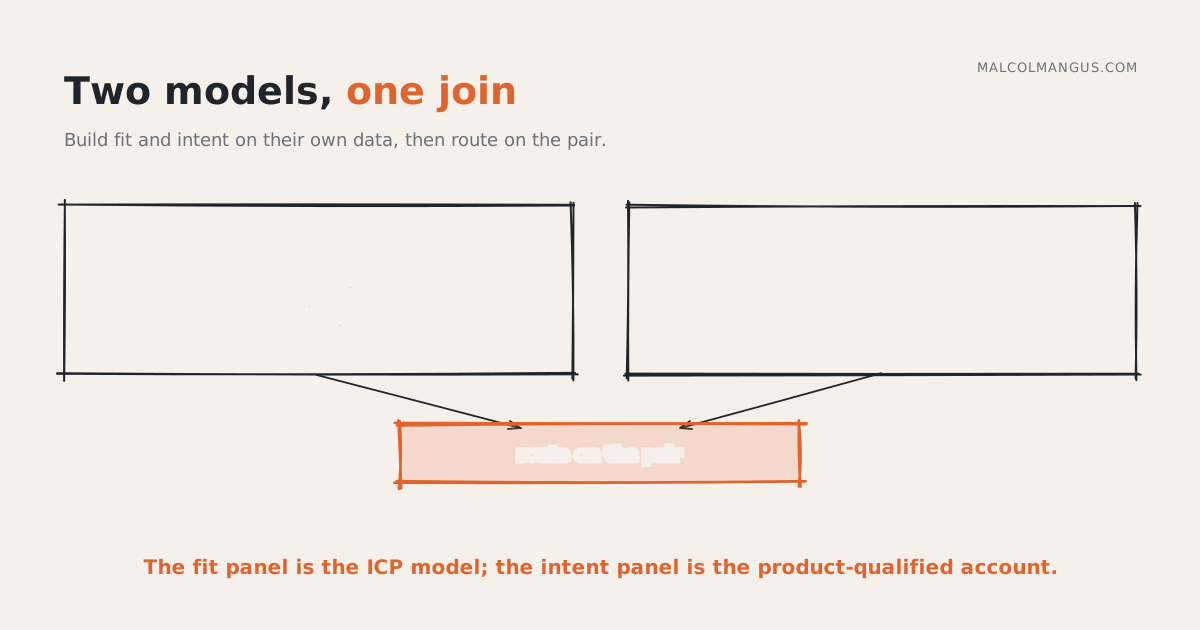
Put simply: It is two models and a join, and the discipline is all in the plumbing. The instant fit and intent merge into one column, the rep is back to guessing which 74 is worth the call.
The frameworks here draw on the fit-and-intent lead-scoring literature, including Unify on composite account scoring, Artemis on validating an ICP against closed-won data, and the Pedowitz Group on balancing fit against intent.

Malcolm Angus
I build 0 to 1 data products: I turn the data a company already has into a decision it wouldn't otherwise make, shipped end to end. I also write about how markets really work, moats, flywheels, and the loops that make companies harder to catch.

The charts in this essay are free to reuse with credit.