← All essays·June 14, 2026·3 min read
Give away the scoreboard, sell the fix
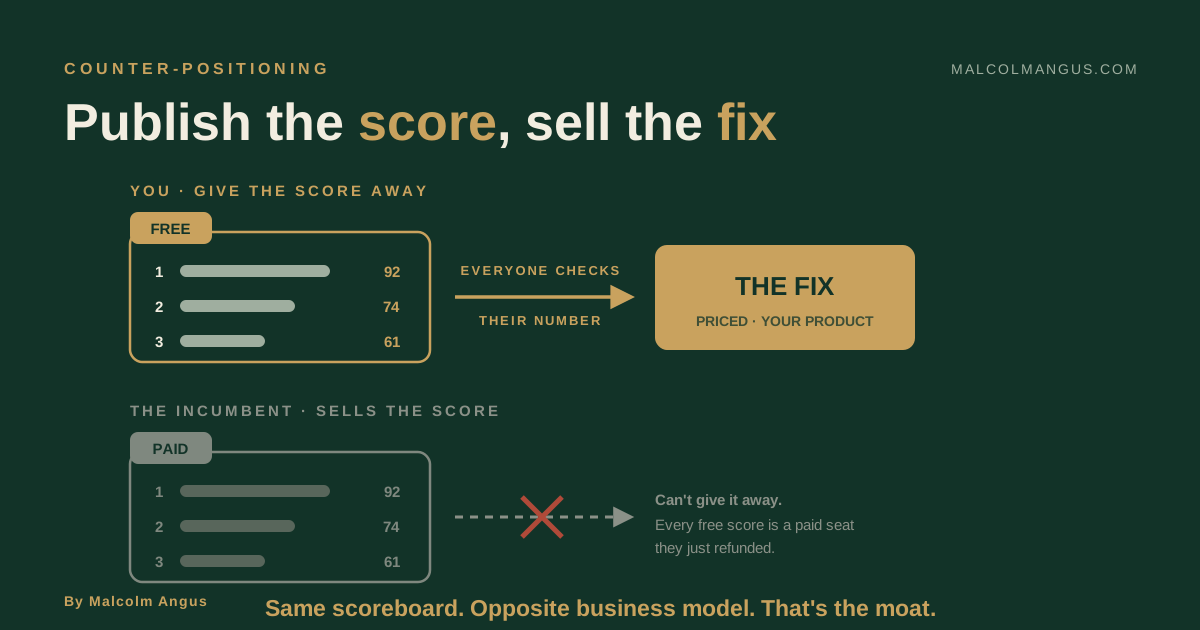
The strongest distribution move in data products is publishing the measurement your incumbents charge for. If you sell the fix, the score is marketing. If you sell the score, you're stuck.
Listen to this page
There is a pricing decision hiding inside most data products, and it quietly determines your entire distribution strategy: do you sell the measurement, or do you sell what happens after the measurement?
Most founders answer without noticing they've been asked. They build the index, the benchmark, the audit, the score, and they put a price on it, because the measurement is the thing they built and the thing they built should cost money. It's the intuitive move, and it's usually the wrong one.
Measurement creates demand for remediation
A score does something no ad can do: it makes the problem personal. A restaurant that reads a breakdown of its own menu, a brand that sees its own ranking, a company that gets graded on its own data hygiene, these are not prospects anymore. They are people with a number they don't like. Whoever shows someone their score owns the next conversation.
So the real value of measurement is rarely the subscription revenue it can command. It's the qualified demand it manufactures. Which means the question isn't "what would people pay for this data?" It's "what does this data make people want to buy?"
Why incumbents can't follow you
Hamilton Helmer calls this counter-positioning: adopting a business model the incumbent cannot copy without damaging their own economics. It's the sharpest version of this play.
If the incumbent's revenue is the measurement itself, they cannot give it away. Every free score they publish cannibalizes a paid seat. You, selling the fix, have opposite economics: every free score you publish is a sales conversation you didn't have to buy. Same data asset, inverted business model, and the inversion is the moat. Not the data. The data they could match. The giveaway they can't.
The economics have also collapsed on the cost side. A measurement product that would have taken a data team a year to stand up in 2020 can now be rebuilt monthly for the price of a nice dinner in API calls. When the score costs almost nothing to produce, charging for it isn't just strategically wrong. It's defending a price the market is about to set to zero anyway.
The second unlock: the on-ramp
Publish a serious measurement and something else happens: you surface everyone who isn't ready.
Every services business and most product companies quietly turn away demand. Budget too small, data too messy, foundation not there. The default is to say "not yet" and lose them forever. But the same audit that disqualified them tells you exactly what the gap is, and a gap you can name is a gap you can productize: a smaller, cheaper engagement that closes it and upgrades them when they're ready.
Turned-away leads become pipeline. That's the half of this strategy almost nobody runs.
A worked example
This is how I built Menuomics. The breakdowns are published free, in full, with the reasoning shown. The product is the implementation: the rewrite, the repricing, the reordering. A restaurant owner who has already read their own breakdown doesn't need convincing that the menu is leaving money on the table. The scoreboard did the selling before the conversation started.
The test
Ask one question: what would your incumbent have to break to match you?
If the answer is their pricing model, you have counter-position. Publish freely, refresh on a cadence, make it citable, and enjoy watching them not follow you. If the answer is "nothing, they could match it by Friday," then you don't have a strategy yet. You have a free tier.

Malcolm Angus
I'm an analytics engineer, data product manager, and forward-deployed engineer. I write about data products, moats, flywheels, and business strategy, the loops that make companies harder to catch.

The charts in this essay are free to reuse with credit.