← All essays·July 22, 2026·11 min read
Alex Hormozi: "AI does dumb things faster"
Alex Hormozi made the same argument twice recently, in eleven impromptu minutes and across two hours on The Diary of a CEO, and both times it lands on one rude question. This is the combined case: why AI is doing the wrong things faster, where value survives when intelligence is cheap, and the deliberately unglamorous program he says actually compounds, with his frameworks drawn out and one of his stats checked against the Federal Reserve.
Alex Hormozi has made the same argument twice this month, and it is worth taking seriously precisely because he sells attention for a living and is telling his audience to stop chasing the thing everyone is chasing. In an eleven-minute video he opens with a confession you rarely hear from someone whose feed is wall-to-wall AI: his business just took another step up in revenue, and AI had nothing to do with it, and when he asked his wealthiest friends, in private, how much they personally use AI, the answer behind the public advocacy was barely at all. Their teams use it. They fund the training. They do not touch it. And their businesses keep compounding. In a two-hour Diary of a CEO episode he makes the same case at length, opening instead with an exhibit: a company paying about $11,000 a month for eleven virtual assistants that spent, in his telling, more than three years of that bill building an AI system to replace them. The automation worked. It was also pointed at the wrong thing, because the company was demand-constrained, and no quote-process automation gets you customers.
Both arguments compress to one rude question he applies to any AI initiative: are you making more money? He has a name for the failure it catches, "token maxing": activity that feels like progress because it consumes frontier technology, measured in everything except profit. Below is the combined case, mechanism first, then the program, drawn out.
Put simply: Hormozi's test is a one-line financial audit for the AI era. Before any AI initiative, write down which line of the P&L it moves and by when. If the answer is a feeling, it is token maxing.
The mechanism: doing the wrong things faster
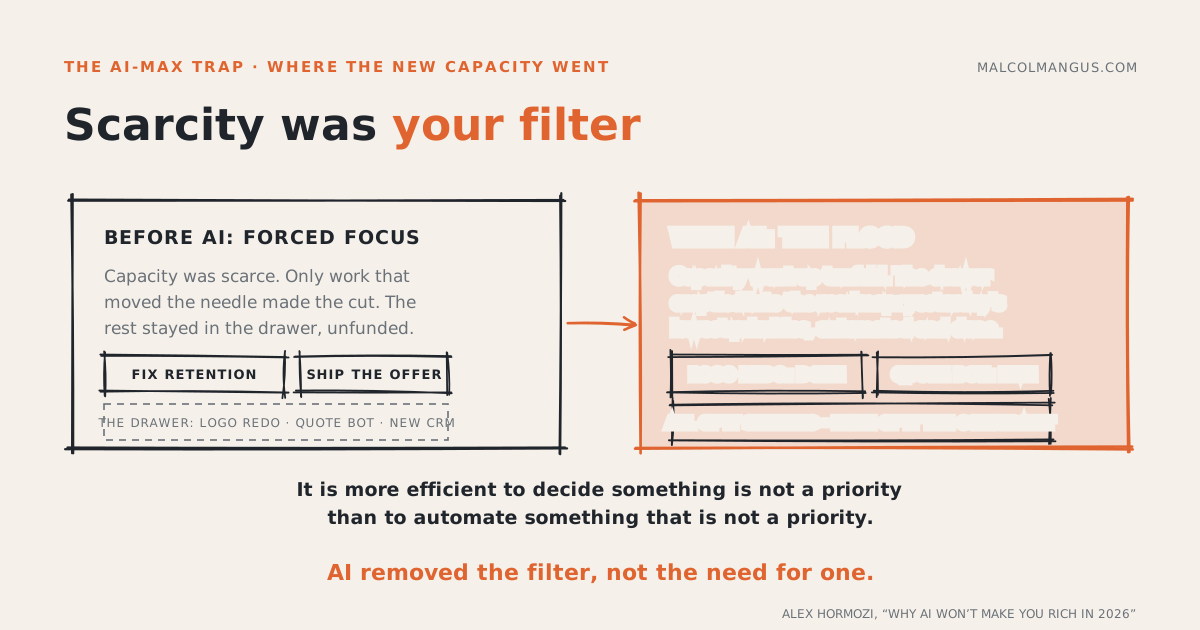
The sharpest idea across both videos is an inversion. Before AI, your capacity to work was scarce, and that scarcity was quietly doing your prioritizing: only the needle-movers got done, because nothing else fit. AI removed the filter. The freed capacity now flows into work you would never have done before, and that work was, by definition, your lowest priority. So businesses are doing less important things faster and automated, the needle does not move, and everyone is confused about why. His own phrasing is the whole thesis: "it is more efficient for me to determine that something is not a priority than for me to automate something that is not a priority."
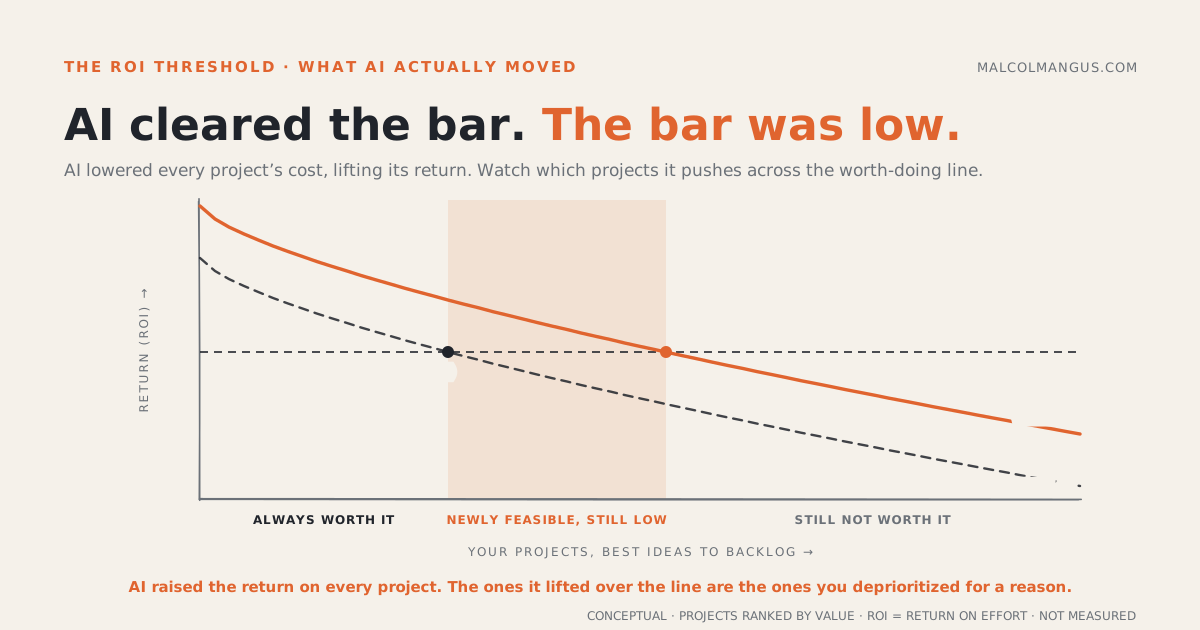
There is a more precise way to see the same trap, in the language of return on investment. AI did not make your backlog valuable; it made it cheap, and cheap is enough to clear the bar. Because the cost side fell, every project's return rose, so work that used to sit just below the line of being worth doing now sits just above it. Doing that work is not irrational, because it clears break-even. But it clears it from below, which is another way of saying it was your lowest-value work, and clearing a low bar is not the same as a high return. The genuinely high-return projects were always above the line; AI did not create them. Pointing freed capacity at the newly feasible band is exactly how a business gets busier without getting richer.
This is why he is careful not to say AI is weak. His point is that AI is one form of leverage, not a replacement for all the others. Leverage is just output over input, and the old sources still multiply: capital, media, and people all still work, and he notes the irony that the frontier labs, holding more AI than anyone on earth, still employ thousands of humans. He puts it most bluntly in a third clip: no AI beats a good decision for leverage, which is why there are "old men right now that don't use AI that are making way more money than the kids using AI." AI is a term in the product. Judgment is the term that scales every other term.
Put simply: AI multiplies whatever work you point it at, including the work that never mattered. The constraint on a business was never how fast it could execute; it was deciding what deserved executing, and AI makes that decision more valuable, not less.
The one-question audit
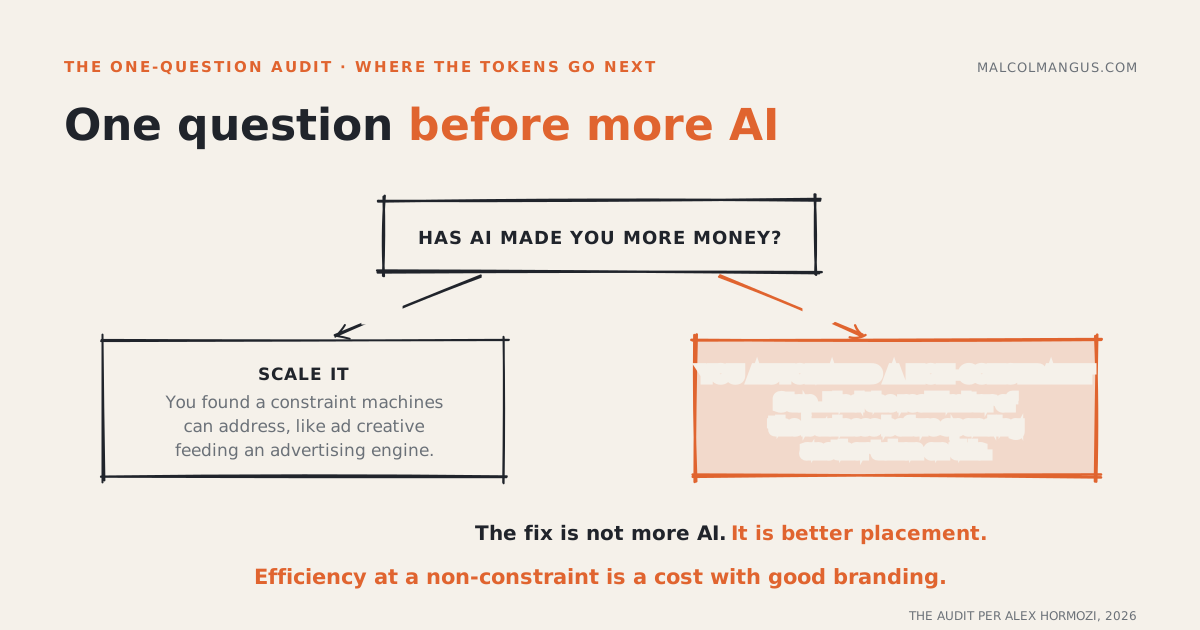
His test resolves the confusion in a single branch. Has implementing AI in your business made you more money? If yes, you found a place where the constraint was actually addressable by machines, like his ad creative, where more variants genuinely feed the advertising engine. If no, you automated a non-constraint, and the fix is not more AI. It is walking back to the oldest question in operating a business: what is the actual constraint, and how do you point your speck of resources at it. His own AI sales rep works fine, and he still discounts its importance, because sales capacity was never his limiter. Efficiency at a non-constraint is a cost with good branding.
The analogy he closes the short video on will age interestingly: most current AI use looks like cheap access to a lot of virtual assistants, and virtual assistants have existed for decades, sometimes below today's token bills, and they never changed who won. Quality still won, brands still won, good offers still beat bad ones. A terrible offer with AI on the back end is still a terrible offer.
Put simply: Run the audit before the tool. If AI has not moved a number, you have not found your constraint, and buying more of it is buying speed you cannot spend.
What only a human can do
If intelligence becomes abundant, what is left that still earns? His list is specific, and it is the same list from the other side that my map of the AI value chain keeps landing on: value migrates to what a model cannot supply. Somebody still has to own the decision, because AI, in his framing, is not a citizen. He makes the liability point concrete in the third clip: you cannot start an LLC as an AI, process payments as an AI, or file taxes as an AI, so a human takes the risk and is, in his words, "compensated for risk" for decisions a machine cannot be held to. Judgment with consequences attached stays human and stays billable.
Humans also want stakes. Nobody watches a robot win at chess, yet chess is more popular than ever; MrBeast survives generated content because the money on the line has to be real; you still want a person in the Formula 1 car. His prediction, and he labels it one, is that fiction and pure entertainment get hit far harder than anything anchored in reality. And he is blunt about the private failure mode: do not outsource your thinking. He runs the same question through several frontier models, gets scattered answers, and treats the disagreement as proof the judgment is still his, because "you can get it to agree to anything." Delegating your decisions to a model, on his account, makes you dumber at exactly the skill that still commands a premium.
Put simply: When answers are abundant, the scarce assets are the ones with consequences attached: the signature, the liability, the stake, the reputation. Price your role by what you are accountable for, not by what you can generate.
The program: old levers, deliberately unglamorous
What he tells founders to do instead is almost aggressively pre-AI, and that is the point.
Pick the longer horizon. His blocks exercise: the foundation you lay depends entirely on how much time you give the build, and "the fastest way to build a $10 million business is not the fastest way to build a $100 million business." His line worth keeping verbatim: "focus and patience are the two enduring competitive advantages because they're so antihuman."
Fix retention before reach. His Company A versus Company B math: two identical businesses acquiring the same customers every year, and only the one that keeps them compounds. Marketing skill on a leaky product is dangerous precisely because it works, scaling the leak faster.
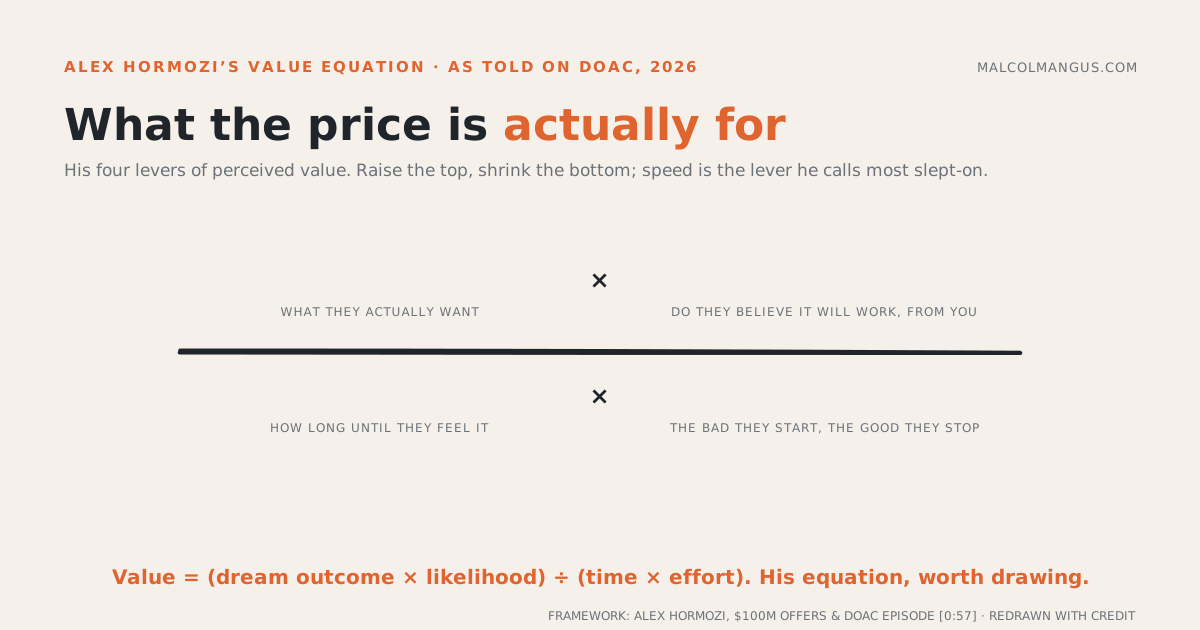
Reprice against the value equation. The most drawable framework he carries is the one his books are built on: value is the dream outcome times the perceived likelihood of getting it, divided by the time delay and the effort and sacrifice it takes. The lever he calls most slept-on is the denominator's clock, because if you deliver what everyone else delivers in half the time, someone always pays a premium. His margin diagnosis follows from it: "I'm running out of time" is a pricing problem two steps upstream, usually caused by founders who "sell out of their own wallet," assuming a thing is cheap because it is easy for them.
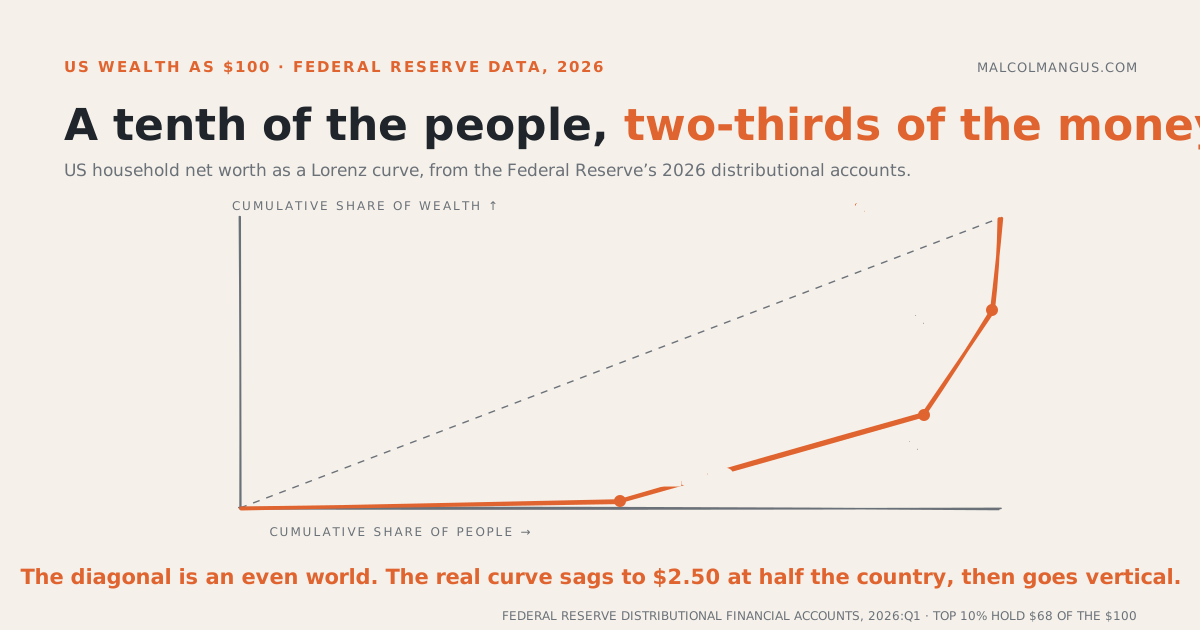
Do the unscalable premium thing first. Add one or two zeros to your price and ask what you would have to deliver to justify it. You need only five clients. Premium buyers upgrade your worldview, unscalable delivery generates data nobody else has, and the Tesla sequence, Roadster before Model S before the masses, funds the move down-market later. His justification for aiming up is a wealth split he sketches from memory, hedged in the moment as rough math, so I checked it against the Federal Reserve's Distributional Financial Accounts, and his memory is good. As of the first quarter of 2026, picture US household wealth as $100: the bottom half of the country holds about $2.50 of it, the next 40% about $30, the next 9% about $36, and the top 1% about $32. Sixty-eight dollars sit with a tenth of the people, which makes premium pricing less a strategy than an act of aim.
Move incentives, not slogans. His behaviorist streak is the connective tissue of the whole program: "we arranged the conditions to maximize the likelihood of the outcome that we wanted." It applies to customers, to copy, and, pointedly, to AI adoption inside companies, where telling a team to "please adopt AI" fails because their incentive structure is to do their job. His bluntest version: "humans don't really behave outside of their incentives unless they're psychopaths."
Put simply: The program is a compounding checklist, not a growth hack: longer horizon, retention first, price from the value equation, earn premium data through unscalable delivery, and change incentives when you want changed behavior. None of it requires AI. All of it determines whether AI pays.
Reality is the moat
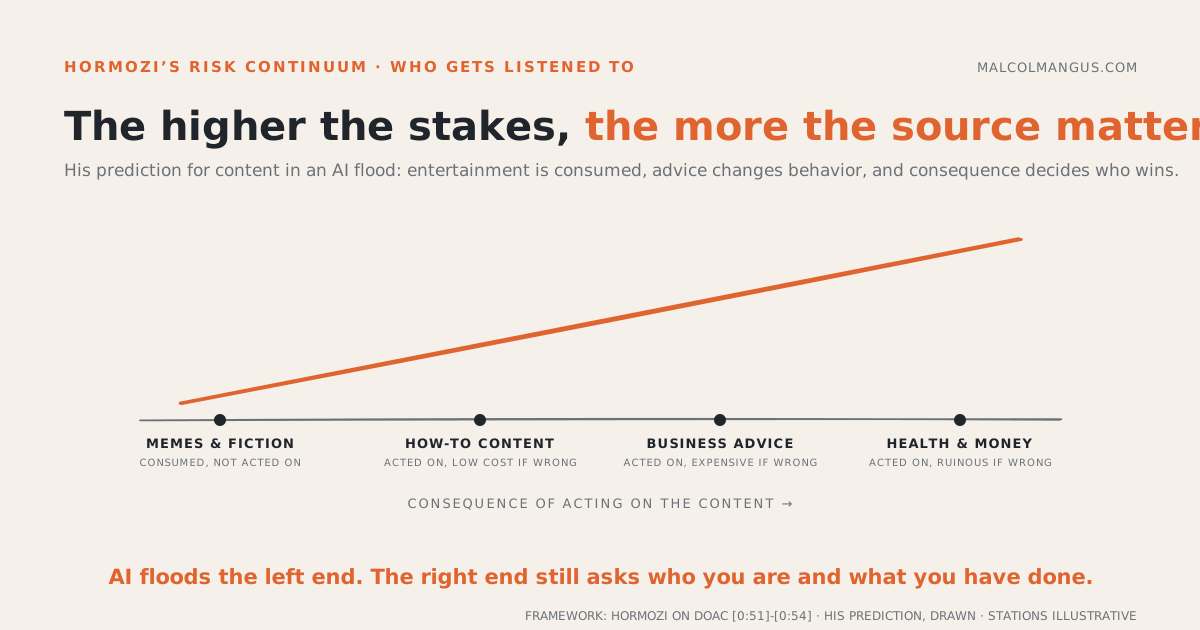
The phrase both videos will be remembered for is his answer to the flood. AI now produces competent writing at zero marginal cost, so what makes anyone listen to you? "Reality is the moat." A teacher who quotes Warren Buffett word for word still loses to Buffett, because "they just forgot to build Berkshire Hathaway." Reputation is the one content asset that can only be earned outside the content.
He sharpens it into a rule about where credibility decides outcomes: entertainment exists to be consumed, but advice exists to be acted on, and the higher the cost of acting on bad advice, the more the source decides who gets listened to. His prescription for anyone without a track record yet is honest about the cold start: document proof of effort until you have proof of outcome. Record the calls you take, and cut the best moment into a thirty-second clip.
Put simply: In an AI content flood, the question a reader asks before your first sentence is "why should I listen to you," and only reality answers it. Build the record before you need it, and document effort while the outcomes accrue.
The closing answer
Steven Bartlett ends the long conversation with the maximalist's trap question: if superintelligence is a few years out, what would you even do in the meantime? Hormozi refuses the fatalism in the premise and, in refusing it, restates the whole case. He would spend the years accumulating real-world proof and customer track record, because, and these are his predictions, people will still care about reputations and distribution will still cost money. "I would continue to build trust and distribution."
That answer holds up against everything my own mapping of the AI economy keeps finding from the numbers: the spend is measurable, the value capture is not, and the seats that earn are the ones holding what a model cannot generate. Hormozi got there without a single margin table, from the operator's side of the same wall. The test he opens with is the audit. The program is what passes it. And the moat, on his account, was never intelligence. It was evidence.
The arguments, frameworks, and figures are Alex Hormozi's, from the two videos and a third short clip above; the plates, the Federal Reserve check, and the reading are mine.

Malcolm Angus
I'm an analytics engineer, data product manager, and forward-deployed engineer. I write about data products, moats, flywheels, and business strategy, the loops that make companies harder to catch.

The charts in this essay are free to reuse with credit.