← All essays·May 11, 2026·3 min read
Strategy is the stuff that compounds
Most strategy documents are lists of things to do. Real strategy is choosing the few activities where effort this year makes effort next year more valuable.
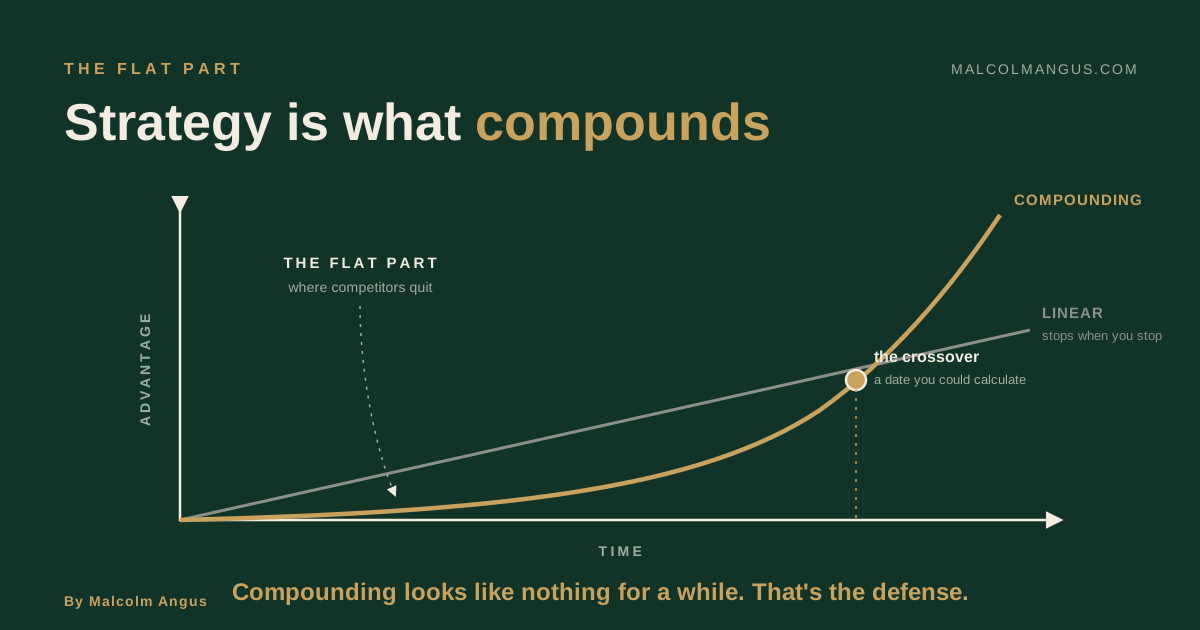
Read most strategy documents and you'll find a to-do list wearing a suit: enter this market, launch this product, hit this number. Those are plans. Plans are fine. But they answer "what will we do," and strategy has to answer a harder question: "what will we do that gets more valuable because we did it?"
Here's the frame I use. Every activity a company does falls into one of two buckets. Linear work produces output proportional to input, and stops producing when you stop. Compounding work produces output that makes the next unit of input more productive. Strategy is the discipline of moving as much of the company as possible from the first bucket to the second.
Why this framing earns its keep
Because it makes strategy falsifiable. "Be the leader in X" can't be wrong; it's an aspiration. "Invest in Y because each customer makes Y better for the next customer" can be wrong, and you'll know within quarters. A strategy you can't be wrong about isn't a strategy, it's a mood.
It also explains why some small companies beat some big ones. The big company has more of everything: people, data, distribution. But if all of it is linear, the advantage is a snapshot. The small company with one genuinely compounding loop, in learning, in distribution, in cost, will pass them. Not this year. But on a date you could roughly calculate.
The compounding audit
Take your current roadmap and ask, for each major line item: if we complete this, does anything about next year get easier, or do we just have one more thing to maintain?
Be brutal. Most launches add surface area, not slope. A new product line that shares no customers, no data, and no infrastructure with the existing business isn't compounding, it's a second company wearing your logo. A partnership that requires constant re-selling isn't an asset, it's a subscription you pay with meetings.
What survives the audit tends to look boring. Systems that capture what worked and feed it back. Distribution that customers do for you. Costs that fall with scale because of how you built, not how hard you negotiate. Reputation in a niche where reputation gets referenced.
Where data strategy meets business strategy
This is why I write about data products and business strategy as one subject, not two.
Data is the most legible compounding asset a modern company can build, and also the most commonly faked. A warehouse full of events is linear: it grows with spend. A loop that captures decisions and outcomes is compounding: it grows with use. When boards ask "what's our data strategy," the honest translation is "which of our loops are we going to instrument, and what will the sediment be worth?"
The same audit applies to AI initiatives, and it's ruthless there. A chatbot bolted onto support is linear. Fine-tuning on your own resolved tickets, where every resolution improves the next one, is compounding. Most AI roadmaps I see are eighty percent linear work described in compounding language.
The one-sentence version
If you can't say what compounds, you don't have a strategy yet. You have a budget with a narrative.
The good news is that the fix is small. You don't need a fifty-page deck. You need one loop you're genuinely committed to, a way to measure whether it's spinning faster, and the discipline to keep feeding it while it's still too small to look impressive. Compounding always looks like nothing for a while. That's the price, and it's also the defense: your competitors will quit during the flat part.

Malcolm Angus
I write about data products, moats, flywheels, and business strategy, and I advise companies on all four. Follow on LinkedIn or work with me.