← All essays·July 3, 2026·9 min read
Rookie vs. Pro: How Market Analysis Actually Works
Same frameworks, different questions. The four layers that separate a rookie market analysis from a pro's: attractive for whom, with what strategy, against which competitive response, and what would prove me wrong.
Listen to this page
I've read a lot of market analyses. Mine included. Almost all of them end the same way: the market is big, customers have pain, competitors lack our features, green light.
Sit with that for a second. If every analysis says go, the analysis isn't doing anything. It's a pitch with a bibliography.
The pros I've watched (and slowly, painfully tried to become) use the same frameworks everyone learns, TAM and personas and buyer journeys, and reach different conclusions. Not because they know more frameworks. Because they're answering a different question. The rookie asks: is this a good market? The pro asks: attractive for whom, with what strategy, against which competitive response, and what would prove me wrong?
Four layers. Here we go.
Layer 1: Follow the money
Sizing. The rookie goes top-down. $80B market, we take 1%. The 1% is arbitrary and the $80B came from an analyst report written by a 26-year-old who's never sold anything. The pro starts somewhere harder: what economic activity are we actually capturing? Sometimes it's labor. Sometimes it's a compliance cost, or a budget that already exists inside somebody else's line item. Toast looked like it was selling restaurant point-of-sale software, a modest market by any count, while the payments and payroll and lending flowing through that terminal were the actual prize. Uber's market wasn't taxis, it was every trip people skipped because hailing one was a hassle. Where you draw that boundary is itself the strategy.
Then size bottom-up from what you can actually operate: reachable accounts, realistic contract value, how many reps you can hire and ramp. If your projection requires 400 enterprise deals and you have budget for eight salespeople, your SOM is fan fiction.
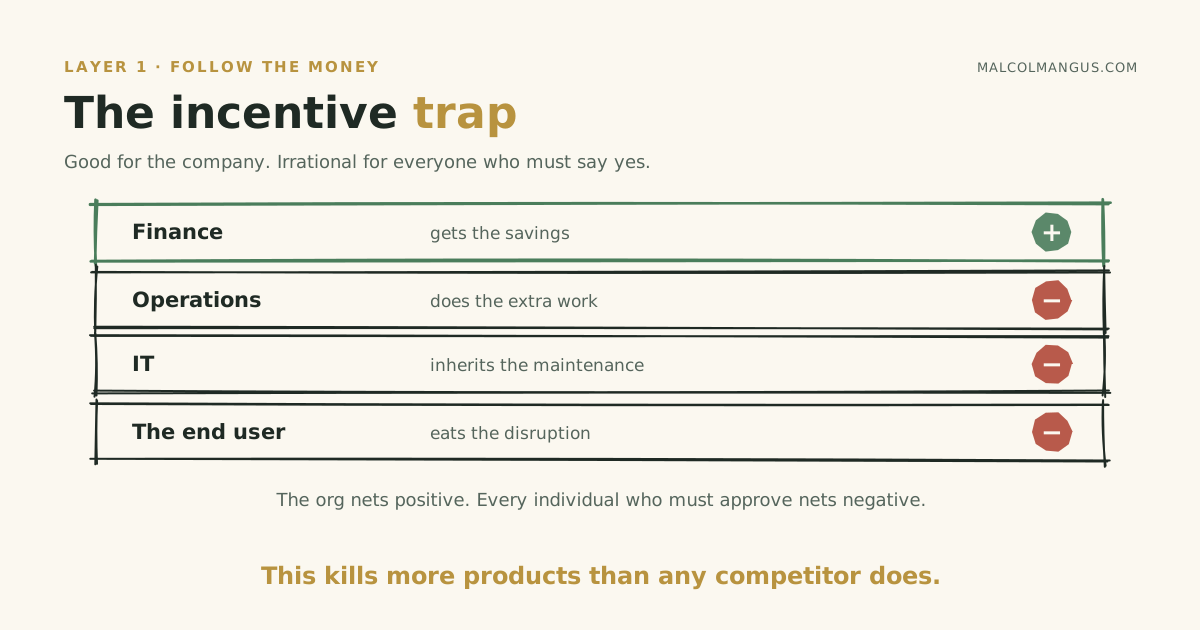
Incentives. Rookies list stakeholders. Pros ask what each person stands to lose. The pattern that has killed more products than any competitor: finance gets the savings, operations does the work, IT inherits the maintenance, and the end user eats the disruption. Positive ROI for the company, irrational for every individual who has to say yes.
The reverse case is Concur, the corporate expense-report software. Employees hated it. Openly, vocally, for two decades. Didn't matter, because finance loved it and finance held the budget. Users were never in the winning coalition. That's the pro's real sales question, and it's coalition math: what's the smallest group of people whose incentives you can align to get a purchase and a deployment that survives?
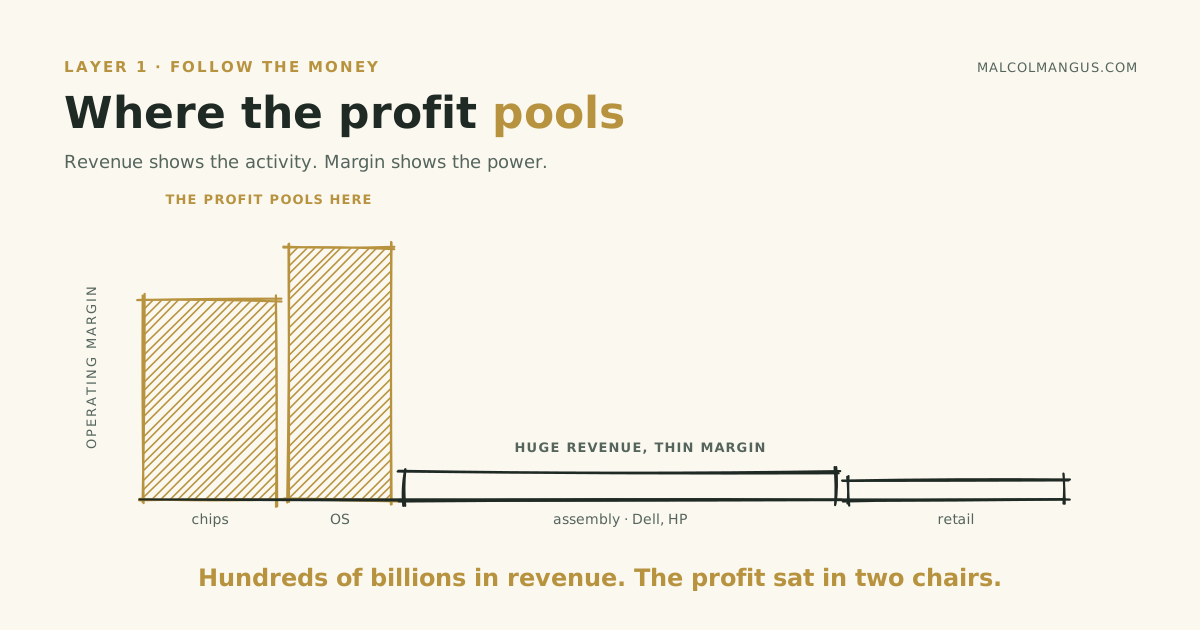
Profit pools. Revenue tells you where the activity is. Margin tells you where the power is. The PC industry did hundreds of billions in revenue while nearly all the profit sat in two chairs, Intel's and Microsoft's, and Dell fought HP for the crumbs. Airlines are the same story with worse food. So ask where margin migrates when a layer commoditizes, and whether the pool is even reachable. Payments and insurance hold oceans of profit behind licenses and capital requirements. A pool you can't get to is scenery.
Ecosystems. The rookie draws a logo map. The pro draws a power map: who owns demand, who controls distribution, which platform can absorb you as a feature. Zoom won the pandemic, was genuinely the better product, and spent the next five years defending against Teams, which shipped free inside a bundle every customer already paid for. Better wasn't the question.
Buyer journeys. Awareness-consideration-purchase is a diagram, not a description of anything that happens inside a company. What actually happens: a trigger (a breach, a new CFO) suddenly makes the status quo unacceptable, then one worried person spends months turning their worry into a funded priority, and by the time an RFP exists the winner has usually already been decided by whoever shaped the problem definition. Nobody buys security tooling on a calm Tuesday. Everybody buys it the quarter after the incident. And purchase isn't the finish line, because a six-month deployment isn't a product flaw, it's a smaller market wearing a disguise.
Put simply: First find who actually profits versus who merely handles money, then check that every person who must approve your product gains something from it. Deals die when the org wins but each approver loses.
Layer 2: Power
Here's what rarely makes it into the deck: a great market with no defense is worse than a mediocre one, because it costs more to find out you were wrong. Attractive economics attract competition until the economics stop being attractive. Layer 1 tells you where the value is. Whether you get to keep any is a separate question, and Hamilton Helmer's 7 Powers is the strictest tool I know for it. A power needs a benefit (better cash flow) and a barrier (a reason rivals can't or won't copy it). Great UX is not a power. Nothing stops anyone from copying great UX, and someone with more engineers will.
The seven: scale economies, network economies, counter-positioning, switching costs, branding, cornered resource, process power.
Counter-positioning. My favorite, because it's incentive mapping turned into a weapon. The incumbent could copy you but won't, because copying you torches their own P&L. Vanguard forced active managers to choose between ignoring index funds and vaporizing their fee base. They chose to ignore. Blockbuster couldn't chase Netflix without killing the late fees that were the margin. The barrier lives inside the incumbent's income statement, which also means it expires: once the legacy business is dying anyway, the incentive not to respond dies with it.
Two things separate people who use this from people who cite it.
Powers have a clock. Counter-positioning is available at birth. Network and scale effects get locked in during hypergrowth, which is the only window where blitzscaling makes sense; outside it, blitzscaling is arson with a pitch deck. Switching costs and brand pay off late. So the pro question isn't which powers do we have. It's which power is available at our stage, and what has to happen in the next 18 months to lock it before the window shuts.
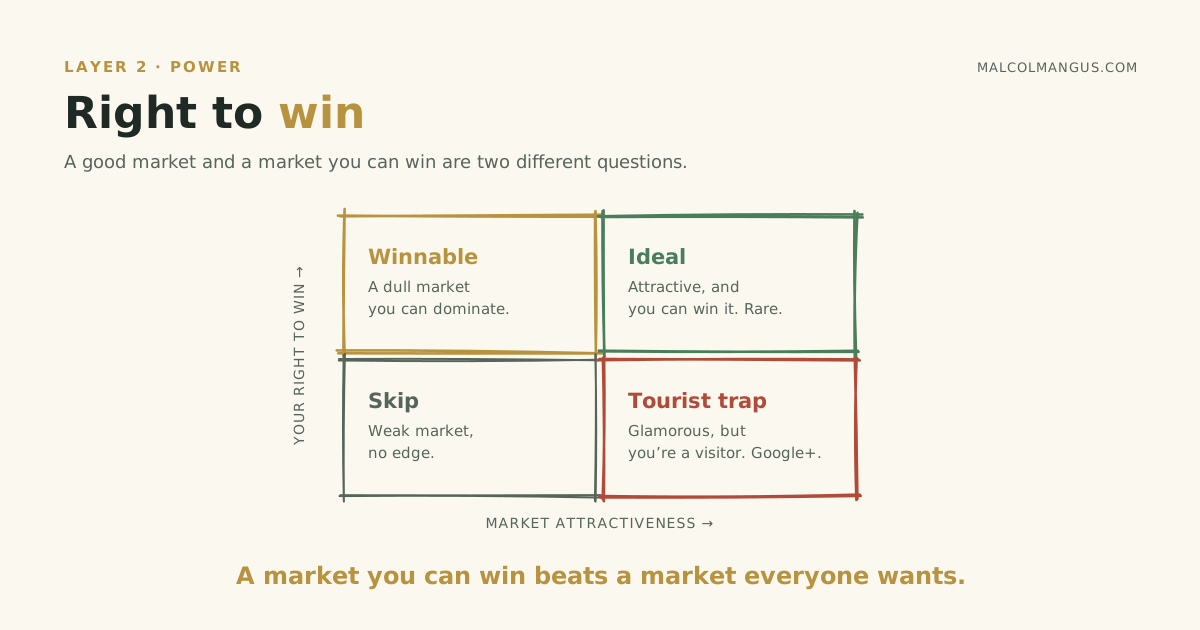
Right to win. A different axis than market attractiveness. Rookies collapse them: nice market, let's go. Google had effectively unlimited capital and distribution and still couldn't will Google+ into existence. A mediocre market where you hold real advantages beats a glamorous one where you're a tourist. This is the sentence I'd tattoo on every product strategy doc if I could.
Model the response, not the roster. Your real competitor is rarely the closest product. It's whoever has the installed base or can bundle you to zero. Evaluate your advantage after the incumbent's best move, and take seriously the possibility that their best move is doing nothing and letting you educate the market for them.
Put simply: A dull market you can dominate beats a glamorous market where you are a tourist. Ask what gives you the right to win, not just whether the market looks attractive.
Layer 3: Why now
The most underrated question in strategy, and the fastest way to tell who's done this before. Most good ideas already failed once, as the same idea. Webvan and Kozmo torched billions on delivery in 1999. Instacart and DoorDash built the same concepts into giants twenty years later. The idea never changed. Smartphones and a gig-labor supply did.
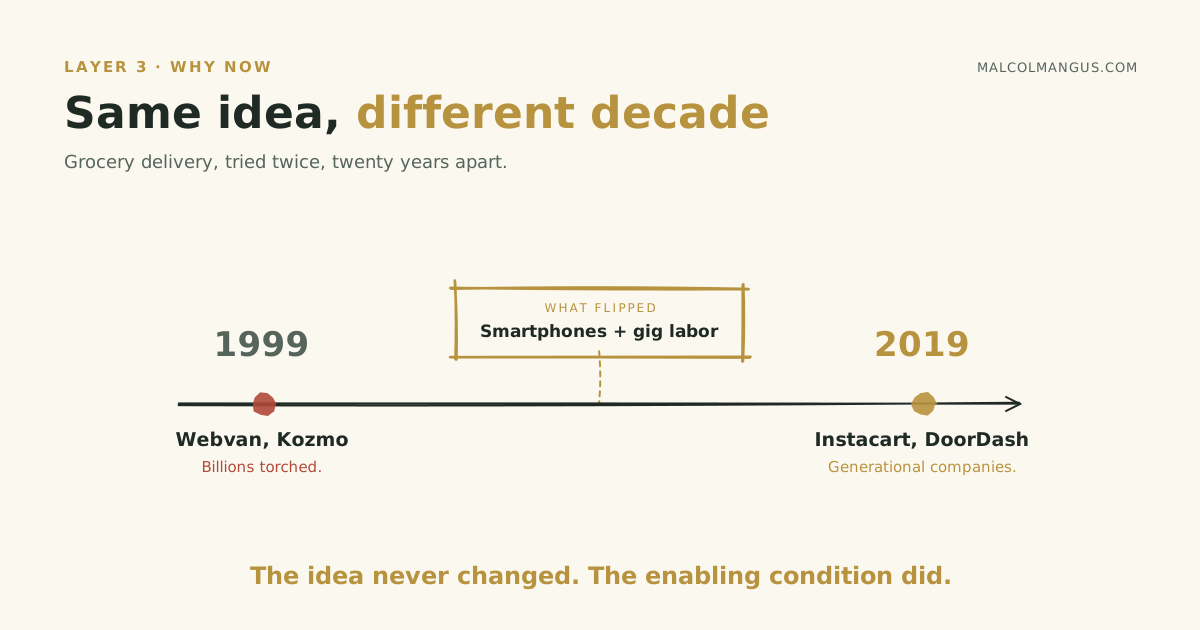
So: what enabling condition just flipped? A cost curve crossing a threshold. A regulation. A layer of the stack becoming a utility. If there's no crisp answer, there's usually no company. Quibi had $1.75 billion, Katzenberg's rolodex, and no answer.
Corollary: treat early bets as options, not NPV projects. Buy information cheaply. Keep the right to double down.
Put simply: Most new ideas are old ideas that failed; what matters is naming the specific change in technology, cost, or behavior that makes it work this time. No credible why-now, no thesis.
Layer 4: Discipline
This is the layer that points inward, which is why it's the rarest.
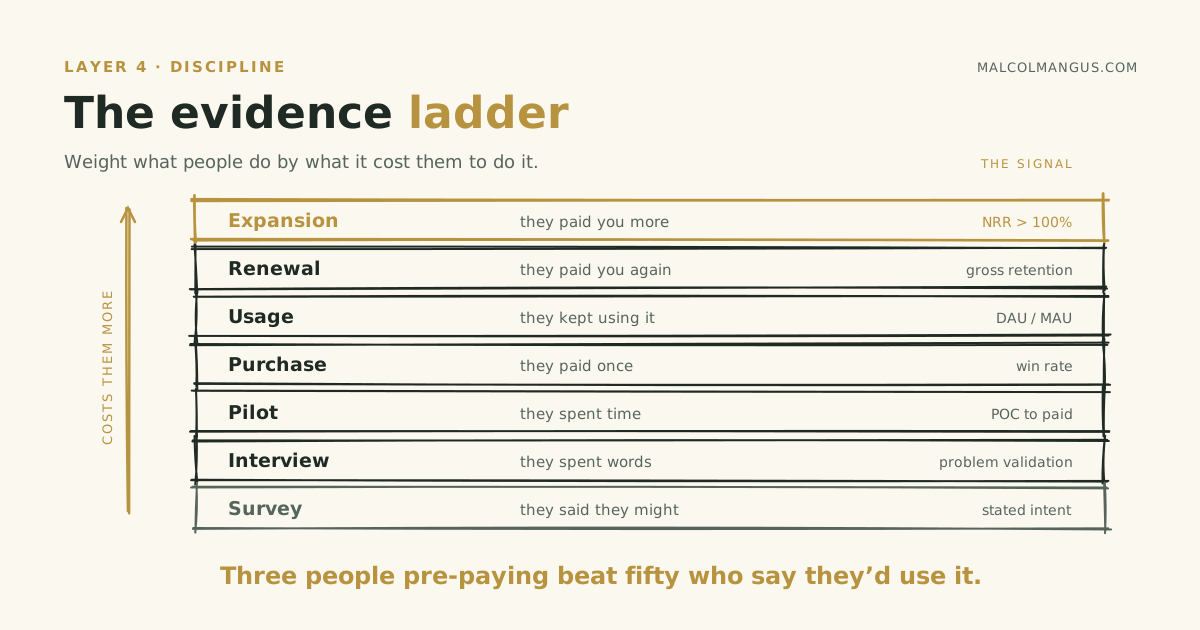
Weight evidence by what it cost the customer. An expansion beats a renewal beats sustained usage beats a purchase beats a pilot beats an interview beats a survey, and the signal that measures each one gets harder to fake as you climb: net revenue retention at the top, stated intent at the bottom. Fifty people telling you they'd "definitely use this" is worth less than three people pre-paying. I've learned this one the expensive way.
Hunt for the assumption that kills the thesis. Because if your last ten analyses all said go, you're not analyzing, you're decorating a decision somebody already made. The most valuable output a strategist can produce is sometimes the word no.
Check your hockey stick against base rates. What did companies like yours actually achieve, not what does your spreadsheet permit.
Write kill criteria before you commit. After commitment, sunk costs and politics make the judgment nearly impossible, and everyone in the room knows it.
Strategy is resource allocation. Where the headcount goes is the strategy. The calendar and the org chart don't lie. The strategy doc does.
Put simply: Weight what people do by what it cost them to do it: a customer who pre-pays outweighs fifty who say they love the idea. Cheap signals flatter; costly signals inform.
The output
Run all four layers and the output stops being "the market is large and growing." It becomes choices: a target segment, a wedge, an economic buyer, a motion the economics can afford, and a ladder where each rung makes the next one cheaper to climb. Toast again: POS to payments to payroll to lending, every step generating the data and trust that sold the next. The test is whether the rungs are actually connected, not whether the vision slide claims a platform.
A pro's thesis sounds like this:
"The overall category is large but unattractive for a horizontal entrant. However, regulated regional operators with 50 to 500 locations face a recurring compliance trigger, have a clearly identified economic buyer, and are poorly served by enterprise incumbents. A narrow monitoring product can be sold through specialist consultants at a contract value that supports assisted sales. The wedge creates a proprietary compliance dataset and positions us to add filing, remediation, and insurance products. The thesis fails if channel partners won't distribute it or if customer acquisition costs exceed $X."
Falsifiable, sequenced, with a named tripwire. The whole distance between rookie and pro in one paragraph.
The rookie points every instrument outward, at the market. The pro points half of them inward, at their own cost structure, their own incentives, their own capacity for self-deception. Because markets rarely kill companies. Companies kill companies.
Frameworks describe. Models decide.
Put simply: A finished analysis is not a market report, it is a falsifiable plan: who exactly you serve, why you win, and the named tripwire that would prove you wrong. If you cannot state what kills the thesis, you do not have one yet.

Malcolm Angus
I'm an analytics engineer, data product manager, and forward-deployed engineer. I write about data products, moats, flywheels, and business strategy, the loops that make companies harder to catch.

The charts in this essay are free to reuse with credit.